Podcast: Play in new window | Download
Subscribe:
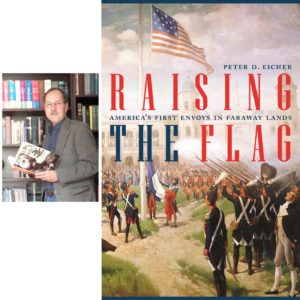 Peter Eicher spent many decades working in the US Foreign Service. He’s always been interested in history and after he retired he began writing on the history of US diplomacy. I interviewed him about his latest book “Raising the Flag.”
After our interview he wanted to make sure this story was mentioned:
Of course, after we hung up, I thought of the most significant instance of diplomatic-navy coordination recounted in the book — the effort to free American prisoners held in Tripoli during the first Barbary War, and to negotiate peace with the ruler. More than 300 officers and men from the USS Philadelphia had been captured when the frigate ran aground in Tripoli harbor. Tobias Lear (once George Washington’s private secretary) was commissioned to negotiate peace and release of the prisoners, in close coordination with a military campaign to put pressure on the Tripoltanians. The campaign included naval action and a land campaign in which William Eaton, erstwhile U.S. consul in Tunis, appointed himself as a general and led a land attack across the desert with a ragtag army of Arabs and mercenaries, plus eight U.S. Marines, to capture the western Libyan town of Derne. This was the famous “to the shores of Tripoli,” which I did mention in our talk. Lear eventually negotiated the peace and release of the prisoners, on substantially better terms than the government in Washington was prepared to accept.
1:45 – Peter Eicher discusses how he got into history. He enjoyed studying it and joined the US Foreign Service.
3:32 – His first book was Emperor Dead, another diplomatic history. Raising the Flag discusses about the first 70 years of US diplomatic history. Many diplomats were taken to their posts by US Navy ships. He has a chapter about the Barbary Coast and US diplomacy.
8:22 – At this time, US diplomats were given vague orders and often left on their own. Diplomacy changed radically after the US Civil War.
10:11 – Part of the book deals with consuls stationed in areas that are now part of the US. That includes California when it was Mexican.
15:01 – It was difficult for Washington DC to monitor how well diplomats were doing what they were supposed to do.
16:45 – The US’s first diplomat in Argentina and Chile also served as a General in the Argentinian military against Spanish Royalists.
18:17 – In many ways, diplomats and consuls were working a part-time job.
20:38 – Edmund Roberts used a Naval vessel to do his diplomatic work in Southeast Asia and Malaysia. He had the Navy threaten to bombard a Malaysian city because they harbored pirates. There was a lot of naval gunboat diplomacy at the time.
26:30 – The Navy was reformed after the Revolution to deal with the Barbary pirates. It wasn’t disbanded after the Barbary War.
29:40 – The National Archives hold all the main diplomatic correspondence since the nation was formed. However handwritten letters on microfiche can be hard to read.
31:30 – Many of these diplomats knew they were making history so they wrote a lot of reports on their work.
35:05 – The State Department had developed a report style that diplomats were supposed to use. Former Commodore David Porter was regularly reprimanded for not using that style.
40:09 – The diplomat at Monterrey wrote that ships docking in California would lose crews to the gold rush. Many of the diplomats then were dealing with the same trade issues that we deal with today. This includes war in the Middle East, tensions with Turkey and Mexico, trade problems with China.
42:20 – Mr. Eicher’s book contains stories and people that history buffs will never have seen or heard of before. For example, he found information on Daniel Clark who had a lot to do with the Louisiana Purchase and he found many details that historians haven’t discussed before.
45:30 – His stories have swashbucklers, heroes, villains and intrigue. The book is not a general history but is rather a story book of very interesting events with important lessons and morals.
47:45 – One of the most difficult tasks was reading the writing of these early diplomats.
55:45 – A future project may be a book on Americans in France.
For more “Military History Inside Out” please follow me on Facebook at warscholar, on twitter at Warscholar, on youtube at warscholar1945 and on Instagram @crisalvarezswarscholar
Guests: Peter Eicher
Host: Cris Alvarez
Tags: military, history, military history, conflict, war, interview, non-fiction book, Barbary, China, Turkey, Commodore Porter, American Revolution, Civil War, gunboat diplomacy, Japan, Louisiana Purchase, California, gold rush, Mexico, Washington DC, US Navy

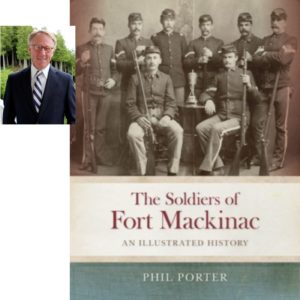 Phil Porter is director of Mackinac State Historic Parks and has studied the Mackinac area extensively. We talk about his latest book on the soldiers of Fort Mackinac.