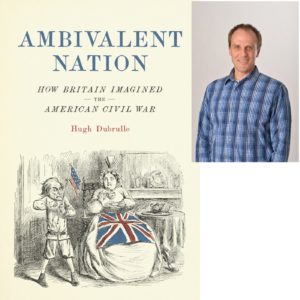
US Civil War history book – “Ambivalent Nation” (Louisiana State University Press, 2018) – Hugh Dubrulle interview

Dr. Hugh Dubrulle is a Professor in the Department of History at Saint Anselm College in New Hampshire. He has studied British history and US Civil War history extensively and has written a new book about British attitudes towards the US Civil War. I interviewed Dr. Dubrulle about the book and his findings.

2:00 – Dr. Dubrulle’s family grew up in France during WWII. The stories they told of that time inspired him to study history. When he grew up in the US, his family took trips including one to Vicksburg when he was a small child that inspired him. He then began studying British history and eventually became interested in studying British history alongside the American Civil War.

5:00 – He wrote a dissertation on this subject some time ago and that began to turn into the book.

7:17 – Past scholars have divided the British into two factions – pro-North and pro-South. Dr. Dubrulle wanted to write about the complexities of British attitudes towards Americans and the war. During the war, America was still heavily dependent on Britain economically and in other ways. The war was very disruptive to British trade.

10:47 – John Bright, pro-North, was one of the few British leaders who were whole-heartedly behind one side. But most leaders were of two minds during the war.

13:38 – Some British thought that middle-class Yankees would just pay Irish and Germans to do their fighting for them. They thought that the American middle class reflected their own middle class.

16:25 – Many British people thought New York was the financial and cultural capital of the US.

18:52 – The British were very concerned with Canadian security during the Civil War. They worried that if the North lost, they would turn north and attack Canada.

20:44 – Several British military missions traveled to the US during the war to observe. These were overwhelming Army officers and few Navy officers.

22:52 – The UK contemplated getting involved in the war on the side of the South at various times.

25:23 – After the war, the British were worried about what the US would do next. The US had raised an army larger than any that could be sent to protect Canada. But some British also worried the US would become a military dictatorship. They wondered if it would pay its debts and so on.

27:04 – Many British people were critical of Lincoln. But many lower class British people liked that a working man could become President. The British press liked Jefferson Davis. They saw a Northern middle class attacking a government of gentlemen in the South.

29:37 – British people were ambivalent about Sherman’s campaigns. They admired the military maneuvers but they were also appalled by the material destruction of the campaign. Sherman was liked more than Grant was.

31:32 – Dr. Dubrulle read many books and newspapers that were contemporary to that period. He also read personal correspondence. He found materials all over Britain for documents. The British Library has a huge collection of historic newspapers.

33:40 – The London Times was the most important newspaper at the time right before the war. But then paper became cheap and then a number of newspapers for the middle and working class rose up during the war. The Illustrated London News was the pioneer newspaper in the UK for illustrated news. Their artist worked in the North at first and then in the South afterwards. Emory University has a lot of his work.

38:48 – Dr. Dubrulle found a number of Southern newspapers and a diary of a British person who visited New York during the war.

40:49 – Dr. Dubrulle was surprised at how divergent British opinions were in public and in private.

42:31 – Frank Lolley was a very pro-South British person in public but in private he was very troubled about the Confederacy.

48:37 – The British had a problem with Northern nationalism. They didn’t believe there was a basis for American unity. They thought it was all based on the size of the country.

51:45 – He’s hoping that the discussion of British attitudes towards the US Civil War will focus more on the bigger picture than on who thought what.

Links

http://iln.digitalscholarship.emory.edu/

For more “Military History Inside Out” please follow me on Facebook at warscholar, on twitter at Warscholar, on youtube at warscholar1945 and on Instagram @crisalvarezswarscholar

Guests: Dr. Hugh Dubrulle

Host: Cris Alvarez

Tags: military, history, military history, conflict, war, interview, non-fiction book, US, Civil War, Grant, Lincoln, Sherman, Davis, North, South, London, New York, antebellum
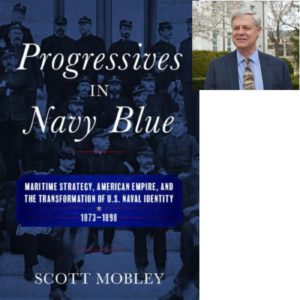
19th C Naval Warfare book – “Progressives in Navy Blue” (Naval Institute Press, 2018) – Scott Mobley interview

Dr. Scott Mobley studied history at the US Naval Academy and stayed in the Navy until retirement. He then went to the University of Wisconsin-Madison to earn a PhD in history. The work for his PhD led to the publication of his book “Progressives in Navy Blue.”

1:23 – Scott talks about how he got into writing and history. He majored in history at the US Naval Academy. He stayed in the Navy until retirement and then got a PhD in history afterwards at the University of Wisconsin. He became interested in the book’s subject matter while pursuing his PhD. The book comes from his dissertation.

3:55 – The main themes of the book are maritime strategy, American Empire and the transformation of US Navy professional culture from 1873 to 1898.

5:35 – The modern Navy was born at the end of the 19th century from a Navy of mariner-warriors to warrior-engineers.

7:05 – The backdrop of an American empire changes much of what the Navy is about. The role and missions of the Navy changes.

9:46 – During the US Civil War, the US Navy went from a commercial mission to a whole new War Navy but it returns to the commercial mission after the war. But the commercial mission eventually moves to second place in the 1880s and becomes more of a war fighting Navy.

13:26 – Two groups of Navy thinkers emerged after the Civil War. One was based on technology. They were dissatisfied with the direction the Navy went during the 1870s.

17:18 – The other group of thinkers were strategic in focus. They worried more about planning for wars. They focused on policy and strategy rather than technology. Mechanism was the term used in the 19th century for technology.

19:07 – Bradley Fiske was on both sides of this debate. But in the 1890s these factions were fighting for limited resources.

26:06 – Torpedo technology is the one technology Congress supported right after the US Civil War. Technical subjects were taught to Navy officers at the new Torpedo School in Newport, Rhode Island.

30:26 – Fears of international turmoil and advancing technology abroad got Navy officers worried about future war involving the US.

32:05 – The Endicott Board was a joint board between the Army and Navy to discuss coastal fortifications. They discussed how to defend the US against modern mechanized threats.

36:43 – Navy officers embraced progressive methods and ideas quicker than other professionals in the 1880s and 1890s.

38:19 – Peacetime war planning efforts, contingency planning, began at this time for the first time in the US. There was no Naval plan for the US Civil War until the war started.

40:25 – Scott possibly found the first strategic peacetime war plan in the papers of a junior Naval officer. The plan was focused on a possible war with Canada. The plan was read by Mahan and possibly incorporated into Naval War College classes.

45:25 – Scott was surprised to learn that the building of modern warships was not motivated by empire as many scholars have claimed. Naval growth was spurred by a desire to defend the US. Some wanted empire but the majority wanted to protect US shores.

51:46 – The US did not have an empire-focused Navy until after 1898. The US had to quickly acquire gunboats, logistics ships, and other vessels to control its new empire.


For more “Military History Inside Out” please follow me on Facebook at warscholar, on twitter at Warscholar, on youtube at warscholar1945 and on Instagram @crisalvarezswarscholar


Guests: Dr. Scott Mobley

Host: Cris Alvarez

Tags: military, history, military history, conflict, war, interview, non-fiction book, navy, empire, mahan, civil war

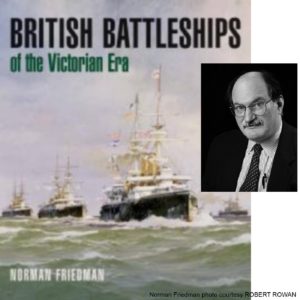
19th C Warfare book – “British Battleships of the Victorian Era” (Naval Institute Press, 2018) – Norman Friedman interview

Norman Friedman is a physicist and historian who has written extensively on naval matters especially the US and UK navies. I interviewed him about his latest book.

1:27- Mr. Friedman has been interested and writing about navies for some time. He’s written about 40 books, 30 of them in history.

3:29 – He had written on later battleships and became interested in the ships that came before the world wars. One of the themes in technological surprise.

5:14 – The French tried to beat the British with technological change but the British simply didn’t want to spend money. Steam propulsion is an early technological race between the French and British.

7:29 – For much of this period, British statesman didn’t believe war would happen. But the Franco-Prussian war shocks them. In 1877, the British think they have to fight the Russians when Russia goes to war with Turkey.

9:14 – The British find they can’t man the fleet properly and that their intelligence service is weak.   But they still scare the Russians by sailing into the Black Sea in a storm. But the British are unable to keep a fleet in the Baltic Sea.

12:32 – The British financial sector had great sway over British politics. Their influence affected the British Navy. They wanted parts of China, Argentina and the United States protected by the British Navy for trade reasons.

16:44 – Underwater weapons have a great effect on worldwide naval strategy in this period. They’re cheap weapons that can destroy expensive ships. In 1885, people begin to wonder if the sea can be controlled by anyone. These weapons help fleets escape from their own ports easier and it’s harder for big fleets to control smaller fleets. The British try to tabulate information and learn their fleet isn’t big enough for sea control.

19:29 – Steel comes in between 1870 and 1880. The French build new ships in 1875. Sails disappeared in the 1880s.

21:36 – British engineers say that sails should be discarded but many people fear that coal won’t be available in sufficient quantities abroad at coaling stations to get rid of sails.

23:15 – The British made their own steel. But the French made better steel at the time. Most countries bought British steel for armor and guns. Krupp in Germany made excellent steel and excellent guns.

26:14 – He extensively used documents from the British Archives. The National Maritime Museum has ship covers.

31:04 – In 1882, the US formed a naval intelligence organization that wrote about information from abroad and that included UK material.

33:44 – reading technology books contemporary to that period was helpful.

35:08 – The French held a World’s Fair where naval capabilities were one thing showcased.

37:43 – He was most surprised about the effect of underwater weapons on how worried naval thinkers were about them. He also didn’t feel he fully understood the development of heavy guns and on the effects of exports. He’d like to know who was buying British heavy guns and why.

48:31 – His works can be found on Amazon and Seaforth publishes his books in the UK.

49:32 – The Victorian period is an interesting time that a lot of people have forgotten. There are a lot of parallels between that period and now. It also tells us about where the modern world came from.


For more “Military History Inside Out” please follow me on Facebook at warscholar, on twitter at Warscholar, on youtube at warscholar1945 and on Instagram @crisalvarezswarscholar


Guests: Norman Friedman

Host: Cris Alvarez

Tags: military, history, military history, conflict, war, interview, non-fiction book, victorian era, UK, Germany, Russia, France, steel, armored hulls, steam, coaling stations, coal, Franco-Prussian war – Russo-Turkish war, trade