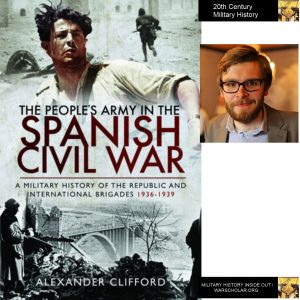
Spanish Civil War military history book – “The People’s Army in the Spanish Civil War” (Pen & Sword Books, 2020) – Alex Clifford interview

Check out the book here https://amzn.to/3bxeXn6

Alexander Clifford is a history teacher and has a passion for study of the world wars. He delved into the Spanish Civil War and wrote a book about the Republican Army. We spoke about his new book. Check out the book here https://amzn.to/3bxeXn6

1:09 – Alex discusses how it got into studying and writing on the Spanish Civil War.

3:45 – Alex talks about the levels of hatred and killing during this war.

6:07 – Alex talks about how he breaks the book down. The focus is mainly on military history and the Republican military.

9:02 – Alex talks about the make up of both armies.

19:30 – Alex talks about what the Soviets took from the Republicans and what they gave in return.

23:45 – Alex talks about Soviet goals during the war and how the fighting was going in 1937. He also discusses the French-Soviet alliance.

32:24 – Alex talks about the communist element in the war.

39:38 – Alex talks about urban warfare and where the Republicans did best such as at Madrid.

42:52 – Alex talks about where the International Brigades came from and did.

45:16 – Alex talks about how the Republicans managed the foreign fighters.

47:12 – Alex talks about the make-up of the International Brigades.

51:31 – Alex talks about how black Americans commanded white Americans in this war.

54:13 – Alex talks about the sources for his research starting with the International Brigade literature. He took a more military history angle when looking at them.

1:00:39 – Alex talks about German and Russian documents about the war..

1:03:07 – Alex talks about the honesty of the reports he read.

1:06:14 – Alex talks about Spanish afternoon naps during the war.

1:09:00 – Alex talks about trying to assess the people’s army overall.

1:19:30 – Alex can be found on twitter @historysmost and he has a podcast titled “History’s Most.”

Links of interest

https://amzn.to/3bxeXn6

https://www.pen-and-sword.co.uk/The-Peoples-Army-in-the-Spanish-Civil-War-Hardback/p/17104

https://podcasts.apple.com/us/podcast/id1482668168

https://twitter.com/HistorysMost

For more “Military History Inside Out” please follow me at www.warscholar.org, on Facebook at warscholar, on twitter at Warscholar, on youtube at warscholar1945 and on Instagram @crisalvarezswarscholar. Or subscribe to the podcast on Apple Podcasts | Stitcher | Spotify

Guest: Alexander Clifford

Host: Cris Alvarez

Tags: military, history, military history, conflict, war, interview, non-fiction book, inter-war period, spanish civil war, world war one, WWII, Guernica, Picasso, facsism, communism, democracy, hitler, hemmingway, orwell, stalin, mussolini, ideological conflict, colonial warfare, russian civil war, international brigades, guerilla warfare, for whom the bell tolls, pan’s labyrinth, moroccan, morroco, spanish foreign legion, condor legion, messerschmit, stuka, blitzkreig, militia, WW1, t-26, poland, monarchy, republican, POUM, trotsky, may day, catalan, madrid, barcelona, artillery, felicia brown, clive of india, african-americans, oliver law, berkley, merriman, el campesino, comintern, soviet union, poland, red army, ww1

Check out the book here https://amzn.to/3bxeXn6

As an Amazon Associate I earn from qualifying purchases.
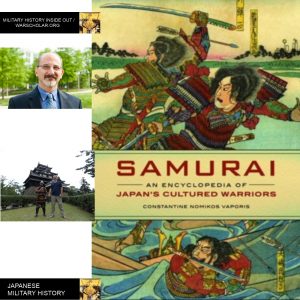
Samurai military history book – “Samurai” (ABC-CLIO Press, 2019) – Constantine Vaporis interview

Samurai military history book – “Samurai” (ABC-CLIO Press, 2019) – Constantine Vaporis interview
Check out the book here  https://amzn.to/2uImEGh

Dr. Constantine Vaporis teaches and writes on Japanese history, especially that of the samurai. We recently discussed his latest book on the samurai of the Tokugawa period. Samurai (ABC-CLIO Press, 2019)

0:38 – Constantine talks about how he got into writing on Japan and samurai.

3:22 – Constantine talks about how he determined what he wanted to focus on in this book. He focused on the Tokugawa period.

7:48 – Constantine talks about how the daimyo and samurai ran the government.

9:18 – Constantine talks about how samurai and non-samurai interacted in the government.

11:14 – Constantine talks about how men became samurai.

13:12 – Constantine talks about loyalty among the samurai.

14:53 – Constantine talks how some samurai were developed to be military leaders both in the army and navy.

18:30 – Constantine talks about the make-up of the Japanese military.

19:31 – Constantine talks about the size of the Japanese military before Tokugawa and during that period.

21:27 – Constantine talks about how the Tokugawas took weapons from the populace and the pacification of the countryside.

22:23 – Constantine talks about Japan became remilitarized and how samurai were unmade in the mid 1800s.

24:08 – Constantine talks about how the peace was kept during the Tokugawa period.

26:30 – Constantine talks about how peasants dealt with their problems with samurai.

27:29 – Constantine talks about the rules of the military household.

29:19 – Constantine talks about female fighters.

30:43 – Constantine talks about samurai who fled to southeast Asia at the end of the 16th century.

31:32 – Constantine talks about samurai attachment to their name and the land.

34:07 – Constantine talks about the cultural diversity of Japan in this period.

37:44 – Constantine talks about the resources he used for this book. He mentions the archives he used.

40:04 – Constantine talks about samurai helmets and sword guards.

42:05 – Constantine talks about the quality of samurai weapons and armor.

44:07 – Constantine talks about conflicts between Japanese and westerners.

45:36 – Constantine talks about the pressure the westerners put on Japanese culture.

47:02 – Constantine talks about Japanese analysis of western books and technology.

48:57 – Constantine talks about coming across a temple to a loyal cat. He also talks about samurai keeping dogs.

54:30 – Constantine talks about how justice was dispensed by the samurai.

1:00:48 – He has a site at voicesofearlymodernjapan.wordpress.com

Links of interest

Check out the book here

https://www.abc-clio.com/ABC-CLIOCorporate/product.aspx?pc=A4999C

voicesofearlymodernjapan.wordpress.com

Contact Information

For more “Military History Inside Out” please follow me at www.warscholar.org, on Facebook at warscholar, on twitter at Warscholar, on youtube at warscholar1945 and on Instagram @crisalvarezswarscholar. Or subscribe to the podcast on Apple Podcasts | Stitcher | Spotify

Guests: Constantine Vaporis

Host: Cris Alvarez

Tags: military, history, military history, conflict, war, interview, non-fiction book, chanbara, seven samurai, daimyo, shogun, edo, tokugawa, status, tokugawa ieyasu, jesuits, portuguese, smithsonian, osaka, Sekigahara, muskets, suicide, vendetta, shogunate, mito, izu, naginata, fief, martial customs, horse riding, katana

Military History Inside Out banner

WWI history book – “Remembering World War I in America” (University of Nebraska Press, 2018) – Kimberly Lamay Licursi interview

I interviewed historian Kimberly Lamay Licursi about her new book “Remembering World War I in America” being released by University of Nebraska Press in March 2018.

1:09 – Kimberly’s interest in history began with her interest in genealogy. She began in the government field. The book came out of a seminar class she was taking and research she did at the archives of New York state. She noticed that not many books had been written about America in WWI.

3:26 – States tried to create histories of the war. Kimberly looked at movies and pulp fiction to determine how Americans remembered the war. There was even a WWI pulp fiction genre.

6:12 – Many Americans were apathetic after the war. People wanted to move forward from it and thought that maybe they shouldn’t have been involved in it. A lot of soldiers wouldn’t even participate in state remembrances for the war. Many were unemployed and poor after the war.

8:12 – Gold Diggers is a 1930s movie that mentions the Bonus Army. She looked at other movies from 1918 to 1941 such as Four Horsemen of the Apocalypse. The Big Parade is the first to really look at the American experience in the war. Aviation movies like Wings became popular later on. Sergeant York becomes very popular right before WWII.

13:24 – King Vidor was one director who wanted to make a grand film but didn’t necessarily want to do a war movie. Warner Brothers made a WWI movie only because they were focused later on WWII.

15:29 – The soldiers who returned after the first returning wave didn’t get parades. Many soldiers resented what they had been through. They weren’t commonly thanked for their service.

17:44 – Americans didn’t see much of the war or the dead. Many dead soldiers were interned in Europe.

19:43 – Even Europeans didn’t talk about the Americans very much. Many Americans wrote memories but they weren’t popular among the public.

21:57 – A Farewell to Arms is one of the more important books about WWI for Americans. But it doesn’t really sell well until the 1950s when it came out into paperback. Academics made it popular and made students read it.

26:19 – The American Legion was prominent in trying to remember American soldiers after WWI. It was made up of veterans without much support from civilians.

28:59 – Kimberly most enjoyed reading the pulp fiction about the war. It was very light hearted and fun in many ways.   Many of the writers were veterans.

34:21 – During the war many publishers were making a fortune putting out memoirs but soon after, the market disappeared. Most of the war books were supportive of the war, especially with the speech restrictions.

35:33 – There weren’t Federal efforts to get information out. Carnegie funded some national level private efforts.

36:53 – One female memoir by Ellen Lamotte called the Backwash of War is difficult to read because it presents the horror of war and was banned. Katherine Mayo wrote a popular memoir named That Damned Y. Many women wrote war memoirs who were in the war as ambulance drivers and nurses. Willa Cather and Edith Wharton wrote about the war.

39:48 – Two black women wrote memoirs about the war. A black film production company made a movie about the war and African-Americans.

43:40 – Kimberly would like to next write about remarkable women in the 1920s and 1930s. Women lost to history.


Links

http://www.imdb.com/title/tt0024069/?ref_=nv_sr_2

http://www.imdb.com/title/tt0012190/?ref_=nv_sr_5

http://www.imdb.com/title/tt0015624/?ref_=fn_al_tt_1

http://www.imdb.com/title/tt0018578/?ref_=fn_al_tt_2

http://www.imdb.com/title/tt0034167/?ref_=nv_sr_1

https://en.wikipedia.org/wiki/A_Farewell_to_Arms

https://en.wikipedia.org/wiki/King_Vidor

https://en.wikipedia.org/wiki/Ellen_LaMotte

https://en.wikipedia.org/wiki/Katherine_Mayo

https://en.wikipedia.org/wiki/Willa_Cather

https://en.wikipedia.org/wiki/Edith_Wharton


For more “Military History Inside Out” please follow me on Facebook at warscholar, on twitter at Warscholar, on youtube at warscholar1945 and on Instagram @crisalvarezswarscholar


Guests: Kimberly Lamay Licursi

Host: Cris Alvarez