Battles of January 29 including descriptions of the battles, geographic locations, associated artwork, and museums where a person can find associated artifacts and artwork.
1. Battle of Brienne
Date: January 29, 1814
War: War of the Sixth Coalition (Napoleonic Wars)
Cause: Following the disastrous campaign in Russia and the defeat at Leipzig, Napoleon was fighting a defensive war on French soil. The Battle of Brienne was triggered by Napoleon’s attempt to surprise and crush the Prussian and Russian forces under Marshal Blücher before they could unite with the main Allied army.
Result: French Victory (Tactical). Napoleon successfully forced Blücher to retreat from the town of Brienne-le-Château, though he failed to destroy the Allied army. Both sides suffered heavy casualties, and Napoleon himself narrowly escaped capture by Cossacks during the night.
Paintings & Art
Painting: Battle of Brienne, 29th January 1814 Artist: Jean-Antoine-Siméon Fort Year: 1840
Museums & Artifacts
Musée Napoléon (Brienne-le-Château, France): Located in the very town of the battle, it houses personal artifacts of Napoleon, who attended military school there, and exhibits regarding the 1814 campaign. Palace of Versailles (Versailles, France): Houses the original Jean-Antoine-Siméon Fort painting in the Gallery of Battles.
Location
General: Brienne-le-Château, Aube, France Coordinates: 48°23′29″N 4°31′15″E
Recommended Book The Fall of Napoleon: The Allied Invasion of France, 1813-1814 by Michael V. Leggiere.
Imagined Painting
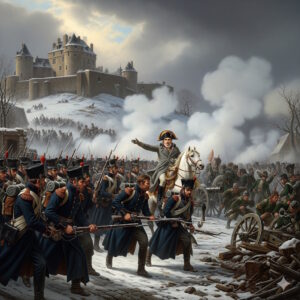
Part of the Battle Shown: This image depicts the French assault on the town and château of Brienne during the late afternoon. It captures the moment the French infantry, under Napoleon’s direct supervision, breached the initial defenses to drive Blücher’s forces out of the urban center.
Elements and Rationale:
- The People & Uniforms: I included French infantry in their signature blue greatcoats and shakos to reflect the winter campaign gear of 1814. Napoleon is centrally placed on a white horse, a classic trope of Napoleonic art (like that of David or Gros) to signify leadership and the “miracle” of his presence during the defensive campaign. The Allied forces (Prussians/Russians) are shown in green and grey to distinguish them in the chaos.
- The Weapons: Fixed bayonets are prominent to emphasize the close-quarters, high-stakes nature of street fighting where musket fire was often followed by a cold-steel charge.
- The Buildings: The stone château is the focal point of the background because it was the strategic prize of the day and Napoleon’s former school, adding a layer of personal irony to the scene.
- Background/Atmosphere: The heavy grey sky and snow-covered ground are essential for historical accuracy, as the 1814 campaign was fought in brutal winter conditions, which significantly hampered movement and morale.
-
Battle of Bear River (Bear River Massacre)
Date: January 29, 1863
War: American Civil War / Western Frontier Conflicts
Cause: Growing tensions between Mormon settlers, emigrants on the Oregon Trail, and the Northwestern Shoshone over resources and land. Colonel Patrick Edward Connor led a force of California Volunteers to “punish” the Shoshone for alleged attacks on travelers.
Result: Union/US Military Victory. It was a one-sided slaughter where roughly 250 to 400 Shoshone (including many women and children) were killed. It effectively broke the power of the Northwestern Shoshone in the region.
Paintings & Art
Painting: The Battle of Bear River (Mural) Artist: Edmond J. Fitzgerald Year: 1941
Museums & Artifacts
American West Heritage Center (Wellsville, Utah, USA): Contains exhibits on the Shoshone people and the regional history surrounding the conflict. Bear River Massacre Site (Preston, Idaho, USA): A National Historic Landmark with markers and commemorative plaques; the Northwestern Band of the Shoshone Nation is currently developing a cultural center at the site.
Location
General: Near Preston, Idaho, USA Coordinates: 42°08′46″N 111°54′44″W
Recommended Book The Shoshoni Frontier and the Bear River Massacre by Brigham D. Madsen.
Imagined Painting
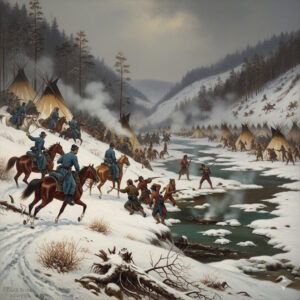
Description of the Painting (Style of 1860s-1880s): A wide, panoramic landscape painting showing the frozen Bear River in the foreground. U.S. Cavalry soldiers in dark blue uniforms are seen crossing the icy water and ascending the bluffs. In the middle ground, the Shoshone willow-brush lodges (wickiups) are visible nestled in the ravine, with plumes of white smoke rising into a crisp morning sky.
Elements and Rationale:
- Uniforms & Equipment: The soldiers would wear the standard-issue Civil War-era Union blue uniforms with “Hardee hats” or forage caps. They would be carrying Springfield rifled muskets and sabers.
- The People: The Shoshone would be depicted in traditional winter buffalo robes and buckskins, highlighting the suddenness of the dawn attack on a non-combatant village.
- Background: The “Steam Steaming” (hot springs) near the site would be represented by mist rising from the river, providing a ghostly, atmospheric quality common in 19th-century frontier art.
- Buildings: Instead of permanent structures, the focus would be on the temporary winter encampment, showing the vulnerability of the Shoshone position against a professional military force.
-
-
Battle of Rennell Island
Date: January 29–30, 1943
War: World War II (Guadalcanal Campaign)
Cause: As the Japanese were preparing to evacuate Guadalcanal, they launched a series of air attacks to disrupt US Navy efforts to resupply the island. Task Force 18, escorting a convoy, was intercepted by Japanese land-based torpedo bombers.
Result: Japanese Victory. The heavy cruiser USS Chicago was torpedoed and subsequently sunk the following day. The US force was compelled to withdraw, though the transport ships they were protecting reached their destination safely.
Paintings & Art
Painting: Naval Battle off Rennell Island Artist: Yasushi Santa (三田康) Year: 1943
Museums & Artifacts
National Museum of the U.S. Navy (Washington D.C., USA): Holds models of the USS Chicago and documentation/photographs from the Battle of Rennell Island. Yamato Museum (Kure, Japan): Features artifacts and exhibits related to the Imperial Japanese Navy’s “Betty” bombers used in the engagement.
Location
General: South of Rennell Island, Solomon Islands Coordinates: 11°25′S 160°20′E
Recommended Book The Naval Siege of Guadalcanal: Night Battles in the Solomon Islands by James D. Hornfischer.
Imagined Painting
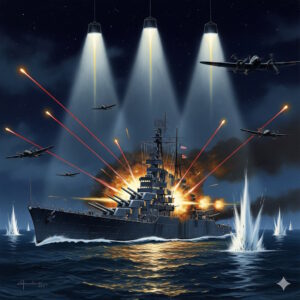
Description of the Painting (Style of 1940s-1960s): A “Combat Art” style painting, reminiscent of the works found in the Navy’s historical archives. The scene is set at dusk/night, dominated by the silhouette of the USS Chicago. Great fountains of water erupt from torpedo hits, illuminated by the orange and yellow glow of fires on deck and the brilliant white of Japanese “floating” flares hanging in the sky.
Elements and Rationale:
- The Vessels: The USS Chicago (CA-29) would be shown with its distinct heavy cruiser profile. I would include the anti-aircraft tracers (red and white streaks) arching into the dark sky to show the intensity of the defense.
- The Aircraft: Mitsubishi G4M “Betty” bombers would be shown as dark, low-flying shadows skimming the water’s surface, reflecting the Japanese tactic of low-level torpedo runs to avoid radar and AA fire.
- Atmosphere: The contrast between the deep indigo of the Pacific night and the violent flares/explosions captures the confusion and terror of night naval warfare before the widespread perfection of radar-directed fire.
- Background: Rennell Island would be a dark, low landmass on the horizon, providing a sense of geographical scale and the proximity of land during the Solomons campaign.
-
-
Battle of Khafji
Date: January 29 – February 1, 1991
War: Gulf War (Operation Desert Storm)
Cause: Iraqi leader Saddam Hussein ordered a multi-pronged invasion of Saudi Arabia to draw Coalition ground forces into a costly battle and disrupt their preparations for the liberation of Kuwait.
Result: Coalition Victory. After initially occupying the town of Khafji, Iraqi forces were driven out by Saudi Arabian and Qatari ground forces supported by US Marine Corps reconnaissance and heavy Coalition air strikes.
Paintings & Art
Painting: War Painting (Invasion Series) Artist: Afifa Aleiby Year: 1991
Museums & Artifacts
National Museum of Saudi Arabia (Riyadh, Saudi Arabia): Features exhibits on the Gulf War and the defense of the Kingdom. National Museum of the Marine Corps (Triangle, Virginia, USA): Displays artifacts and vehicles, including LAV-25s, used by the Marines who directed fire during the battle.
Location
General: Khafji, Saudi Arabia (on the Kuwaiti border) Coordinates: 28°25′N 48°30′E
Recommended Book The Battle of Al-Khafji: The First Ground Battle of the Gulf War by V.J. Croizat.
Crusade: The Untold Story of the Persian Gulf War by Rick Atkinson
Imagined Painting
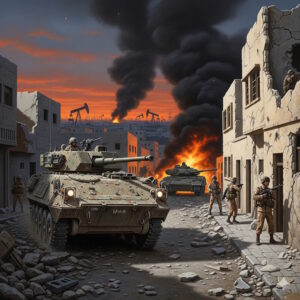
Description of the Painting (Style of 1990s Contemporary Realism): A gritty, realistic acrylic painting depicting a chaotic street battle in the abandoned Saudi Arabian town of Khafji at twilight. In the foreground, a U.S. Marine Corps LAV-25 (Light Armored Vehicle) is maneuvering around a debris-filled corner, its bushy 25mm chain gun trained on a distant target. In the middle ground, Saudi National Guard soldiers are dismounting from V-150 Commando vehicles to clear a building. The background is dominated by a dark, apocalyptic sky, stained black and oily orange from the burning oil wells set alight by Iraqi forces, casting an eerie, unnatural gloom over the scene. Iraqi T-55 tanks are visible as burning hulks in the distance.
Elements and Rationale:
- The Vehicles (LAV-25 & V-150): The Battle of Khafji was the first major ground engagement of the war and heavily involved Coalition light armor. The LAV-25 is iconic to the US Marines’ involvement in this specific battle, chosen for its speed and reconnaissance capabilities.
- The Sky (Oil Fires): The sabotage of Kuwaiti oil wells by retreating Iraqi forces created a distinct environmental backdrop for this battle. The “noon-day darkness” caused by the smoke is a defining visual element of the Gulf War.
- The People (Saudi & Qatari Forces): Unlike many other Gulf War battles which were predominantly US-led, the retaking of Khafji was a joint effort where Saudi and Qatari troops bore the brunt of the street fighting. Including them is essential for historical accuracy.
- The Setting (Urban): Most people associate Desert Storm with open tank battles in the sand. Khafji was unique because it was urban combat in a coastal city, making the “buildings and debris” element crucial to distinguishing it from the rest of the campaign.
Books for sale
WarScholar Press
Contact Information
For more “Military History Inside Out” please follow me at www.warscholar.org, on Facebook at warscholar, on twitter at Warscholar, on youtube at warscholar1945 and on Instagram @crisalvarezswarscholar. Or subscribe to the podcast on Apple Podcasts | Google Podcasts | Stitcher | Spotify
Tags: military museum, military artwork, battles, Military History, War History, Battle Art, War Paintings, War Art, Military Art, Museum Visit, Art History, Historical Artifacts, Museum Collection, Battlefield Tours, History Museum, Museum Life, History In Art, Historic Preservation, January 29, On This Day, History, Military History, War History, Historical Events, History Buff, World History, Napoleonic Wars, Napoleon, American Civil War, Shoshone History, WWII, Pacific War, Naval History, Battle Of Brienne, Bear River Massacre, Battle Of Khafji, Desert Storm, Gulf War, Combat Art, Cultural Heritage, Art Curation
As an Amazon Associate I earn from qualifying purchases.