Battles of January 17 summaries plus museums, artwork, and books

Battles of January 17 including descriptions of the battles, geographic locations, associated artwork, and museums where a person can find associated artifacts and artwork.

Song of the day: It’s About That Line – Funk Pop Song

1. Battle of Cowpens

Date: January 17, 1781

War: American Revolutionary War

Cause: Part of the British “Southern Strategy” to regain control of the colonies. British Lieutenant Colonel Banastre Tarleton was sent to crush a detachment of the Continental Army led by Brigadier General Daniel Morgan, which threatened British supply lines and operations in South Carolina.

Result: A decisive American victory and a turning point in the Southern campaign. Morgan’s tactical masterpiece destroyed Tarleton’s force, boosting Patriot morale and setting the stage for the eventual British surrender at Yorktown.

Paintings & Art

  • Painting: The Battle of Cowpens
    • Artist: William Ranney
    • Year: 1845
  • Painting: Battle of Cowpens
    • Artist: Frederick Kemmelmeyer
    • Year: 1809

Museums & Artifacts

  • Cowpens National Battlefield (Gaffney, South Carolina, USA): The visitor center houses a museum with authentic weapons, uniforms, and exhibits detailing the battle.
  • Yale University Art Gallery (New Haven, Connecticut, USA): Holds Frederick Kemmelmeyer’s painting of the battle.
  • Museum of the American Revolution (Philadelphia, Pennsylvania, USA): Features rotating exhibits and artifacts related to the Southern Campaign and the Revolutionary War.

Location

  • General: Near the town of Chesnee, South Carolina, USA.
  • Coordinates: 35°08′12″N 81°49′05″W

Recommended Book


2. Battle of Falkirk Muir

Date: January 17, 1746

War: Jacobite Rising of 1745

Cause: The Jacobite army, led by Prince Charles Edward Stuart (Bonnie Prince Charlie), was besieging Stirling Castle. A British government force under General Henry Hawley marched to relieve the castle and destroy the Jacobite army.

Result: A Jacobite victory. The Jacobites successfully repelled the government dragoons and infantry in failing light and heavy rain, though they failed to fully capitalize on the retreat of Hawley’s forces, making it a hollow strategic win.

Paintings & Art

  • Map/Engraving: A Plan of the Battle on Falkirk Muir
    • Artist: Thomas Jefferys
    • Year: 1746 (Contemporary engraving)
  • Painting: The Battle of Falkirk Muir (Modern interpretation widely used in history books)
    • Artist: Chris Collingwood
    • Year: Modern (c. 1990s–2000s)

Museums & Artifacts

  • Callendar House (Falkirk, Scotland): Located near the battlefield, this mansion has a permanent exhibition telling the story of the battle and the history of the area.
  • National Museum of Scotland (Edinburgh, Scotland): Holds significant Jacobite artifacts, including weapons and personal effects of Prince Charles Edward Stuart.
  • Falkirk Muir Battlefield (Falkirk, Scotland): A monument stands on the site, and the terrain remains largely readable for visitors.

Location

  • General: Southwest of Falkirk, Scotland, UK.
  • Coordinates: 55°59′17″N 3°49′10″W

Recommended Book


3. Battle of Abu Klea

Date: January 17, 1885

War: Mahdist War (Sudan Campaign)

Cause: The British “Desert Column” was marching across the Bayuda Desert to relieve General Charles Gordon, who was besieged in Khartoum. They were intercepted by a large Mahdist force near the Abu Klea wells.

Result: A British victory, though a costly and near-disastrous one. The British square was briefly broken by the Mahdist charge—an extremely rare event—before the attack was repulsed. The delay contributed to the column arriving in Khartoum too late to save Gordon.

Paintings & Art

  • Painting: The Battle of Abu Klea, 17th January 1885
    • Artist: William Barnes Wollen
    • Year: 1896
  • Painting: The Battle of Abu Klea (Illustration/Print)
    • Artist: Frederic Villiers (War Correspondent)
    • Year: 1885

Museums & Artifacts

  • National Army Museum (London, UK): Holds the painting by William Barnes Wollen and numerous artifacts from the Sudan campaigns, including uniforms and weaponry.
  • Royal Green Jackets (Rifles) Museum (Winchester, UK): Contains artifacts related to the regiments that fought in the campaign.

Location

  • General: Near the wells of Abu Klea (Abu Tulayh), Sudan.
  • Coordinates: 16°59′00″N 33°18′00″E

Recommended Book


4. Battle of Ko Chang

Date: January 17, 1941

War: Franco-Thai War

Cause: A French naval task force, including the light cruiser Lamotte-Picquet, launched a surprise dawn attack against the Royal Thai Navy fleet anchored at Ko Chang to break the stalemate of the border war and stop Thai incursions into French Indochina.

Result: A French tactical victory. The French fleet sank two Thai torpedo boats and heavily damaged a coastal defense ship with no losses of their own. However, the strategic impact is debated as the Thai military claimed to have repelled the invasion.

Paintings & Art

  • Illustration: Franco-Thai War: Battle Fought Between Thailand And Vichy France (Modern historical illustration)
    • Artist: Giuseppe Rava
    • Year: Contemporary (2000s)
  • Note: Due to the obscurity of the battle in Western art history, few classic oil paintings exist; the primary visual records are memorial dioramas and modern naval illustrations.

Museums & Artifacts

  • Ko Chang Naval Battle Memorial (Trat, Thailand): Features a museum shaped like a warship, statues, and annual ceremonies honoring the Thai sailors.
  • Thai National Memorial (Pathum Thani, Thailand): Houses a large diorama depicting the naval engagement.
  • HTMS Maeklong (Samut Prakan, Thailand): A preserved museum ship similar to those that fought, offering context on the era’s Thai naval technology.

Location

  • General: Gulf of Thailand, off the coast of the island of Ko Chang, Thailand.
  • Coordinates: 12°00′04″N 102°27′04″E

Recommended Book

  • The Indochina War: Thailand Fights France by Sorasanya Phaengspha.

Books for sale

WarScholar Press

Contact Information

For more “Military History Inside Out” please follow me at www.warscholar.org, on Facebook at warscholar, on twitter at Warscholar, on youtube at warscholar1945 and on Instagram @crisalvarezswarscholar. Or subscribe to the podcast on Apple Podcasts | Google Podcasts | Stitcher | Spotify

Tags: military museum, military artwork, battles, Military History, War History, Battle Art, War Paintings, War Art, Military Art, Museum Visit, Art History, Historical Artifacts, Museum Collection, Battlefield Tours, History Museum, Museum Life, History In Art, Historic Preservation, January 17, On This Day, History, Military History, War History, Historical Events, History Buff, World History, Battle Of Cowpens, American Revolution, Revolutionary War, Abu Klea, Mahdist War, British Empire, Jacobites, Falkirk Muir, Bonnie Prince Charlie, Battle Of Ko Chang, Franco Thai War, Naval History

As an Amazon Associate I earn from qualifying purchases.

Military History Inside Out banner

American Revolutionary War – Battle of Cowpens, January 17, 1781 – An introduction and timeline of major events

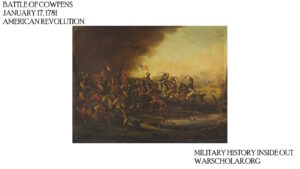
Battle of Cowpens Painting

This podcast episode is a work of historical fiction written to teach listeners, in an entertaining way, about the background and major events that happened during the battle.

Youtube link for the episode:

https://youtu.be/uv2glGUulD8

Two Stories: https://youtu.be/BMWq-R13-NQ

Youtube link for the historical song (Funk Pop):

Variation 1: https://youtu.be/ihb1fEyWxGM

Variation 2: https://youtu.be/g59eVqjqvpg

Books for sale

WarScholar Press

Contact Information

For more “Military History Inside Out” please follow me at www.warscholar.org, on Facebook at warscholar, on twitter at Warscholar, on youtube at warscholar1945 and on Instagram @crisalvarezswarscholar. Or subscribe to the podcast on Apple Podcasts | Google Podcasts | Stitcher | Spotify

Tags: American Revolution, US, Britain, Battle of Cowpens, History in Modern Song

As an Amazon Associate I earn from qualifying purchases.
Military History Inside Out banner

Battles of January 16 summaries plus museums, artwork, and books

Battles of January 16 including descriptions of the battles, geographic locations, associated artwork, and museums where a person can find associated artifacts and artwork.

Song of the day: The Arrival (Jan 16, 378) Latin Pop Song

1. Battle of Corunna (Battle of Elviña)

Date: January 16, 1809

War: The Peninsular War (Part of the Napoleonic Wars)

Cause: The British army, led by Lieutenant-General Sir John Moore, had been retreating across northern Spain in harsh winter conditions, pursued closely by French forces under Marshal Soult. The British needed to hold off the French long enough to evacuate their exhausted troops by sea from the port of Corunna (A Coruña).

Result: Tactical British Victory / Strategic French Success. The British successfully repelled the French attacks, allowing their army to embark and escape to England. However, the British commander, Sir John Moore, was mortally wounded by a cannonball during the battle. The French took control of the region after the British departure.

Paintings & Art

  • Painting: The Death of Sir John Moore at Corunna
    • Artist: Henry James Richter (also depicted by various “English School” artists and Thomas Lawrence)
    • Year: c. 1810s (Lawrence’s portrait of Moore was earlier, but death scenes appeared shortly after the battle).

Museums & Artifacts

  • National Army Museum (London, United Kingdom): Holds uniforms, letters, and lithographs depicting the death of Moore and the retreat.
  • Museo Militar Regional de Coruña (A Coruña, Spain): Located on the actual site of the battle, this museum houses artifacts, weapons, and dioramas specific to the engagement.
  • St. Paul’s Cathedral (London, United Kingdom): Contains a prominent monument and statue dedicated to Sir John Moore.

Location

  • General: Elviña, on the outskirts of A Coruña, Galicia, Spain.
  • Coordinates: 43.3333° N, 8.4167° W

Recommended Book


2. Battle of Cape St. Vincent (The “Moonlight Battle”)

Date: January 16, 1780

War: American Revolutionary War (Anglo-Spanish War)

Cause: A British fleet under Admiral Sir George Rodney was sailing to relieve the Great Siege of Gibraltar, which was being blockaded by Spanish forces. En route, they encountered a Spanish squadron under Don Juan de Lángara off the coast of Portugal.

Result: Decisive British Victory. The battle was unique because it was fought at night (rare for the Age of Sail), earning it the nickname “The Moonlight Battle.” Rodney captured four Spanish ships and destroyed two others, successfully breaking the blockade to resupply Gibraltar.

Paintings & Art

  • Painting: The Moonlight Battle off Cape St Vincent, 16 January 1780
    • Artist: Thomas Luny
    • Year: 1781

Museums & Artifacts

  • National Maritime Museum (Greenwich, United Kingdom): Houses Thomas Luny’s famous painting of the battle, as well as ship models and logs from Admiral Rodney’s fleet.
  • Museo Naval (Madrid, Spain): Contains naval records and artifacts regarding the Spanish fleet and the blockade of Gibraltar.

Location

  • General: Atlantic Ocean, off the coast of Cape St. Vincent, Algarve, Portugal.
  • Coordinates: 37.0231° N, 8.9964° W

Recommended Book


3. The Arrival (The Takeover of Tikal)

Date: January 16, 378

War: Teotihuacan-Maya Conflict (Internal Mesoamerican Power Shift)

Cause: This “battle” was a calculated military intervention (or coup). Forces from the central Mexican metropolis of Teotihuacan, led by a warlord named Sihyaj Kʼahkʼ (“Fire is Born”), marched into the Maya city of Tikal to install a new dynasty and bring the city into Teotihuacan’s sphere of influence.

Result: Teotihuacan Victory. The reigning king of Tikal, Chak Tok Ich’aak I, died on the exact same day Sihyaj Kʼahkʼ arrived (likely executed). A new dynasty was established, launching Tikal into a golden age of dominance under Mexican-influenced leadership.

Paintings & Art

  • Artwork: Stela 31 (The Ballcourt Marker)
    • Artist: Ancient Maya/Teotihuacan Sculptors
    • Year: c. 378–380 AD (Commissioned shortly after the event).

Museums & Artifacts

  • Tikal National Park (Flores, Guatemala): The site itself serves as an open-air museum where the stelae recording this specific date (8.17.1.4.12 in the Long Count) were found.
  • Museo Nacional de Arqueología y Etnología (Guatemala City, Guatemala): Houses many of the finest original jade artifacts and ceramics from Tikal demonstrating the shift in style after 378 AD.

Location

  • General: Tikal, Petén Department, Guatemala.
  • Coordinates: 17.2220° N, 89.6237° W

Recommended Book

Books for sale

WarScholar Press

Contact Information

For more “Military History Inside Out” please follow me at www.warscholar.org, on Facebook at warscholar, on twitter at Warscholar, on youtube at warscholar1945 and on Instagram @crisalvarezswarscholar. Or subscribe to the podcast on Apple Podcasts | Google Podcasts | Stitcher | Spotify

Tags: military museum, military artwork, battles, Military History, War History, Battle Art, War Paintings, War Art, Military Art, Museum Visit, Art History, Historical Artifacts, Museum Collection, Battlefield Tours, History Museum, Museum Life, History In Art, Historic Preservation, January 16, On This Day, History, Military History, War History, Historical Events, History Buff, World History, Battle Of Corunna, Sir John Moore, Peninsular War, Napoleonic Wars, Cape St Vincent, Moonlight Battle, Royal Navy, Admiral Rodney, Tikal, Maya History, Teotihuacan, Pondicherry, Seven Years War, Maya Archaeology

As an Amazon Associate I earn from qualifying purchases.

Military History Inside Out banner