Battles of December 3 including descriptions of the battles, associated artwork, and museums where a person can find associated artifacts and artwork.
Date: December 3, 1800
War: War of the Second Coalition (French Revolutionary Wars)
Cause: French General Jean Victor Marie Moreau aimed to secure a decisive victory against the Austrian and Bavarian forces led by Archduke John. The Austrians, believing the French were retreating, advanced through the dense Ebersberg forest in four disconnected columns, walking into a meticulously planned French ambush.
Result: Decisive French victory. The Austrian army was shattered, losing over 17,000 men. This victory, combined with Napoleon’s earlier success at Marengo, forced Austria to sign the Treaty of Lunéville, effectively dismantling the Second Coalition.
Associated Paintings
Painting/Work: The Battle of Hohenlinden
Artist: Henri Frédéric Schopin
Year: 1836
Painting/Work: Group of Cavalry in the Snow: Moreau and Dessoles before Hohenlinden
Artist: Jean-Louis-Ernest Meissonier
Year: 1875
Museums and Collections
Palace of Versailles (Galerie des Batailles) — Versailles, France
Schopin's "The Battle of Hohenlinden" is displayed here among the

great military victories of France. The gallery serves as a

historical record of French martial glory.
great military victories of France. The gallery serves as a
historical record of French martial glory.
National Gallery of Ireland — Dublin, Ireland
Houses Meissonier's "Group of Cavalry in the Snow," a masterpiece

detailing the harsh winter conditions and the strategic planning of

General Moreau before the battle.
detailing the harsh winter conditions and the strategic planning of
General Moreau before the battle.
Heeresgeschichtliches Museum (Museum of Military History) — Vienna, Austria
Contains extensive collections related to the Austrian army of the Napoleonic

wars, including uniforms, standards, and weapons similar to those

used by the defeated forces at Hohenlinden.
wars, including uniforms, standards, and weapons similar to those
used by the defeated forces at Hohenlinden.
Battle of the Eureka Stockade ()
Date: December 3, 1854
War: Eureka Rebellion (Civil Uprising)
Cause: Tensions between gold miners (“diggers”) and the colonial authority of Victoria, Australia, reached a breaking point over exorbitant mining license fees, police corruption, and a lack of voting rights. The miners built a crude wooden stockade in Ballarat and swore an oath to defend their rights and liberties.
Result: Military victory for the colonial forces, but a political victory for the miners. The stockade was overrun in a short, violent dawn raid by British soldiers and police, killing at least 22 diggers. However, public sympathy shifted to the miners, leading to major democratic reforms and the introduction of male suffrage in Victoria.
Associated Paintings
Painting/Work: Eureka Stockade (Mural series)
Artist: Sidney Nolan
Year: 1949
Painting/Work: Attack on the Eureka Stockade (Watercolor)
Artist: J.B. Henderson
Year: 1854 (Contemporary account)
Museums and Collections
Eureka Centre Ballarat — Ballarat, Australia
Located at the site of the rebellion, this museum interprets the social

history of the event. It is the home of the original "Eureka

Flag" (Flag of the Southern Cross), which has become a potent

symbol of Australian democracy and protest.
history of the event. It is the home of the original "Eureka
Flag" (Flag of the Southern Cross), which has become a potent
symbol of Australian democracy and protest.
Art Gallery of Ballarat — Ballarat, Australia
Holds J.B. Henderson's contemporary watercolor "Attack on the Eureka

Stockade," one of the few visual records created shortly after

the event, along with other colonial-era artworks depicting the

goldfields.
Stockade," one of the few visual records created shortly after
the event, along with other colonial-era artworks depicting the
goldfields.
Museum of Australian Democracy (Old Parliament House) — Canberra, Australia
Features exhibits on the development of Australian democracy, citing the

Eureka Stockade as a foundational event. It also holds works from

Sidney Nolan's "Eureka" series.
Eureka Stockade as a foundational event. It also holds works from
Sidney Nolan's "Eureka" series.
Date: December 3–4, 1870
War: Franco-Prussian War
Cause: Following the initial capture of Orléans by the Prussians and its subsequent recapture by the French, the Prussian Second Army under Prince Friedrich Karl launched a counter-offensive. The French Army of the Loire, attempting to advance towards Paris to relieve the siege, clashed with the Prussians just north of the city.
Result: Prussian victory. The French lines collapsed under the assault, forcing them to abandon Orléans once again. The defeat severely damaged the morale of the French provisional government and diminished hopes of lifting the Siege of Paris.
Associated Paintings
Painting/Work: Franco-Prussian War: Second Battle of Orléans (Engraving/Print)
Artist: Artigas (and various contemporary engravers)
Year: 1871
Painting/Work: General Chanzy at the Battle of Orléans (Illustration)
Artist: Alphonse de Neuville (Associated military artist of the period)
Year: c. 1872
Museums and Collections
Musée de la Guerre de 1870 — Loigny-la-Bataille, France
While focused on the nearby Battle of Loigny (Dec 2), this museum covers

the entire Loire campaign, including the battles for Orléans. It

displays weapons, uniforms, and art related to the Army of the Loire

and the Prussian forces.
the entire Loire campaign, including the battles for Orléans. It
displays weapons, uniforms, and art related to the Army of the Loire
and the Prussian forces.
Musée des Beaux-Arts d’Orléans — Orléans, France
Contains art and historical objects relevant to the city's history, including

works depicting the various sieges and battles the city endured

during the Franco-Prussian War.
works depicting the various sieges and battles the city endured
during the Franco-Prussian War.
Deutsches Historisches Museum — Berlin, Germany
Houses a vast collection of artifacts from the wars of German Unification,

including Prussian uniforms, medals, and battle maps detailing the

capture of Orléans.
including Prussian uniforms, medals, and battle maps detailing the
capture of Orléans.
Operation Chengiz Khan (Start of the Indo-Pakistani War of 1971) ()
Date: December 3, 1971
War: Indo-Pakistani War of 1971 / Bangladesh Liberation War
Cause: Seeking to neutralize the Indian Air Force (IAF) and gain air superiority before a ground offensive, the Pakistan Air Force (PAF) launched preemptive airstrikes against 11 Indian airbases and radar stations at dusk, inspired by the Israeli strategy in the Six-Day War.
Result: Pakistani strategic failure. The airstrikes caused minimal damage to Indian runways and aircraft. In response, Indian Prime Minister Indira Gandhi declared war that same night. The failure of the operation allowed the IAF to quickly establish air dominance, contributing to India’s victory 13 days later.
Associated Paintings
Painting/Work: Sabre Slayers (Depicting the Gnat vs Sabre air battles of the war)
Artist: Group Captain Debatosh Das (and other aviation artists)
Year: Contemporary (Post-1971)
Painting/Work: Hunters at Longewala (Depicting the air support following the outbreak)
Artist: Various Aviation Artists
Year: Various
Museums and Collections
Indian Air Force Museum, Palam — New Delhi, India
The premier museum of the IAF, featuring aircraft that flew in the 1971

war, including the Folland Gnat and Hawker Hunter. It houses an art

gallery with paintings depicting the air battles of December 1971.
war, including the Folland Gnat and Hawker Hunter. It houses an art
gallery with paintings depicting the air battles of December 1971.
Pakistan Air Force Museum — Karachi, Pakistan
Displays aircraft such as the F-86 Sabre used during Operation Chengiz Khan.

The museum includes archives and galleries dedicated to the PAF's

role in the 1971 conflict.
The museum includes archives and galleries dedicated to the PAF's
role in the 1971 conflict.
National War Memorial — New Delhi, India
A monument and museum complex dedicated to the Indian armed forces. It

includes murals and bronze reliefs depicting key battles of the 1971

war, including the initial air defense and subsequent ground

operations.
includes murals and bronze reliefs depicting key battles of the 1971
war, including the initial air defense and subsequent ground
operations.
Books for sale
Contact Information
For more “Military History Inside Out” please follow me at www.warscholar.org, on Facebook at warscholar, on twitter at Warscholar, on youtube at warscholar1945 and on Instagram @crisalvarezswarscholar. Or subscribe to the podcast on Apple Podcasts | Google Podcasts | Stitcher | Spotify
Tags: military museum, military artwork, Indo-Pakistani War, Eureka Rebellion, Franco-Prussian War, India history, Pakistan history, French history, Prussian history, Australian history
As an Amazon Associate I earn from qualifying purchases.
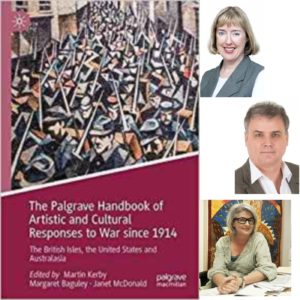 Martin Kirby and Margaret Baguley are two of three Australian academics who have been editing a new book exploring how war since 1914 has been represented in the arts in Australasia, the US, and in the British Isles. I spoke with Margaret and Martin about the book.