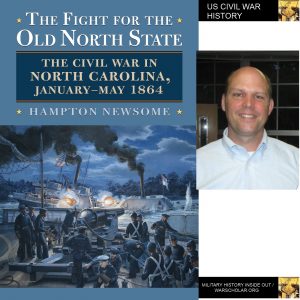
US Civil War military history book – “The Fight for the Old North State: The Civil War in North Carolina, January-May 1864” (University of Kansas Press, 2019) – Hampton Newsome – WarScholar written interview 7

Check out the book here

https://kansaspress.ku.edu/978-0-7006-2746-2.html

Brother against brother is the mantra most often heard when discussing the United States Civil War. But how often do readers consider what this means? Some of the citizens of Northern states enlisted in the Confederate Army and vice versa. In the eyes of the people of their states, these soldiers were traitors and often treated as such. That is one of the issues addressed by Hampton Newsome in his book on North Carolina during the Civil War.

As opposing armies clashed against each other in the state, so did civilians clash against each other as well as the war dragged on. African-Americans sought freedom and the chance to fight against former oppressors. North Carolina wanted peace and considered negotiating peace separately from the other Southern states. The war as a whole was much more than tactics and military operations and Hampton Newsome weaves these parts together in an engaging and enlightening read. In fact the book was named Book of the Year for 2019 by Civil War Books and Authors. https://cwba.blogspot.com/2019/12/2019-civil-war-books-and-authors-year.html

Hampton Newsome has been researching and writing on the Civil War for many years and we discussed this latest book The Fight for the Old North State: The Civil War in North Carolina, January-May 1864. There are still many stories to be told about the Civil War and Mr. Newsome has written about some very important ones.

How did you become interested in studying and writing on the subject of your book?

While I was searching for a new project several years ago, a fellow author suggested I look into Confederate efforts to capture key Union positions in North Carolina during 1864. As I read up on these events and gathered materials, I realized these battles formed a compelling story that involved not only fighting on land and water but other issues such as local resistance to the Confederacy, emancipation, desertion, and a crucial gubernatorial election.

What aspect of this subject does your book focus on?

Specifically, the book recounts the Confederate operations against New Bern, raids conducted by both sides, combat between ironclads and wooden gunboats, and the rebel victory at the battle of Plymouth. Although it is primarily a military study, the book also delves into the connections between these engagements and the political and social developments at the time.

What are the major themes of this book?

In addition to the operational and tactical details of this campaign, the book explores the motivations behind the Confederate offensive. Specifically, in attacking Union positions, rebel leaders sought to secure vital supplies from North Carolina for Robert E. Lee’s army and to dampen a growing peace movement that threatened to pull the state out of the war. The resulting engagements involved complex joint army and navy operations, daring raids, and deadly ironclads.

What resource materials did you use for your research?

I relied on a wide array of sources for this project. As with most Civil War military studies, the research began with the Official Records (“O.R.”), a collection of more than 100 bound volumes of reports and correspondence compiled and published by the War and Navy Departments a few decades after the conflict. This essential source, however, formed only the tip of the research iceberg. In searching for records beyond the O.R., I dug into the unpublished departmental, army, and personnel records at the National Archives. I also gathered diaries, letters, and other material housed at university and historical society collections around the country. I am grateful for the tremendous help from many excellent archivists at these various institutions.

I also made extensive use of period newspapers, especially those published in North Carolina. These have been a gold mine for me in this and other projects. They often contain eyewitness accounts in the form of letters sent home by soldiers on the battlefields and in the camps. These soldier dispatches, full of details not found elsewhere, provide a valuable source of information that augments official reports and correspondence. In addition, the papers routinely include colorful, unflinchingly-partisan editorials, which furnish a clear window into how different factions viewed the events of the day. Despite their immense value, I approach the newspapers with caution and weigh the reliability of each story. For instance, the lead “news” articles are often vague and inaccurate, frequently the product of murky, third-hand rumors trickling across editors’ desks.

What part of the research process was most enjoyable for you?

I enjoy the “eureka” moments. There have been many of those, both big and small. For example, in gathering research for my book on the Petersburg Campaign a few years ago, I found a lengthy court martial transcript at the National Archives, which, according to the file log, had only been viewed once before. It was stuffed with testimony from high-ranking Federal officers, and included a detailed, hand-drawn battlefield map. In my research on The Fight for the Old North State, I came upon the full transcript of an investigation into the looting, vandalism, and arson that destroyed a large part of Washington, N.C. in late April 1864. The report contained the accounts of Union commanders (both army and navy) as well as the testimony of citizens who witnessed the events that left much of that town in ashes. As far as I could tell, no author had previously used that document.

Was there anything that you wrote about during the project that moved you?

The 1864 events in North Carolina produced much tragedy and loss. The study discusses the sometimes shifting loyalties as well as the trials of the state’s population, including the challenges faced by African-Americans seeking to gain their freedom and serve the Union war effort. Throughout the eastern part of the state, many slaves fled from their owners and joined the Union army as new recruits. After the Battle of Plymouth, the Confederates captured and then killed a number of these men, an act repeated on battlefields elsewhere, including the Crater and Fort Pillow. In addition, the book recounts the execution by Confederate officials of nearly two dozen white North Carolinians who had enlisted in Union regiments. These unfortunate men had served in Confederate units early in the war, switched sides, and then had become prisoners of the rebels during the fighting at New Bern. I was struck by how these episodes brought into relief the brutal, tangled nature of the war in the region.

What was the most difficult issue to research?

The search for elusive information about Confederate supply efforts in North Carolina was particularly difficult. Most of the official Confederate commissary records from 1864 have not survived. However, I was able to find important information elsewhere in period newspapers and in correspondence. I also struggled to locate information about Union African-American recruits at Plymouth. In trying to track down several details, I pored over regimental books and personnel files housed at the National Archives as well as records in the collections at Duke University. Ultimately, I managed to put many of the pieces together but, as is usually the case, there is certainly still more to find.

What do you hope the book will do for readers?

Foremost, I hope the book provides readers with an engaging narrative of interesting, yet little-known events during the war. Additionally, I’d like them to come away with an appreciation of how complicated things were in North Carolina at the time, both socially and politically. In addition to the military details, the book highlights many issues impacting the state during the conflict including unionist sentiment, internal divisions, the contributions of African-Americans to the Union war effort, the enlistment of North Carolinians into Federal regiments, and the peace movement.

Did you have any difficulties in finishing the book and publishing it and if so, how did you overcome those?

Though this book took several years to complete, I was fortunate to avoid any extraordinary problems along the way. I enjoy juggling the research, writing, and editing involved in the process of assembling a book. I also make the maps. But there is no way I could have completed this project on my own. I’m thankful to many who helped out by assisting with research, offering suggestions, and reading drafts. Among the many readers was my father, who grew up in Ahoskie, North Carolina, not far from where many of the book’s events occurred. In addition, I’ve been lucky to work with fantastic academic presses and University Press of Kansas has been no exception. The editors, copy editors, designers, and marketing staff at Kansas have been great to work with and have produced a wonderful looking book in my opinion.

Do you have any online accounts where people can find more of your work?  

I have a blog, Ransack Garret and Closet, at www.hamptonnewsome.blogspot.com. I am also on Twitter @hamptonnewsome.

Author Biography

Hampton Newsome

Author of Richmond Must Fall: The Richmond-Petersburg Campaign, October 1864 (Kent State Univ. Press, 2013) and co-editor (with John Horn and John Selby) of Civil War Talks: Further Reminiscences of George S. Bernard and His Fellow Veterans (Univ. of Virginia Press, 2012).

Project/work being discussed: The Fight for the Old North State: The Civil War in North Carolina, January-May 1864, (Modern War Studies) (Univ. Press of Kansas, 2019).

Check out the book here

https://kansaspress.ku.edu/978-0-7006-2746-2.html

As an Amazon Associate I earn from qualifying purchases.

Military History Newsletter December 2019

The sample first issue of my newsletter.  Sign up on the right side of this page to get it emailed directly to you.

Welcome to the first issue of the WarScholar newsletter.  The Marines in Iraq and Spitfires over Europe this week. I interviewed Ed Darak about his book on the Marines fight in Anbar in 2006-2007. Listen here. I also interviewed Andrew Critchell about his history of ten Spitfires fighting the German Luftwaffe in WII. Read it here.

And in our book list below we give you everything you could ask for in military history. Tactics, war movies, logistics, ancient, WWII, Samurai clans, Crusaders, Napoleonic artillery and more. Enjoy! Click here for a list of relevant books being published between January and June 2020.

AFGHANISTAN, IRAQ, AND SYRIA – MODERN WARFARE

This is Minuteman

Night Letters

ANCIENT WARFARE

Brill’s Companion to Sieges in the Ancient Mediterranean

The Persian War in Herodotus and Other Ancient Voices

Ancient Egyptian Warfare

ASIAN AND AFRICAN PRE-MODERN WARFARE

The Remarkable History of the Yagyu Clan – William De Lange

GENERAL MILITARY HISTORY

Delivering Victory

MECHANIZED WARFARE, ARTILLERY, AND TANK STUDIES – MODERN

German Military Vehicles in the Spanish Civil War

MEDIEVAL AND DARK AGES WARFARE

Recalcitrant Crusaders?

Britain in the Age of Arthur

MILITARY AVIATION

The Messerschmitt Bf 109 E – David Johnston

MODERN MILITARY STUDIES

The Culture of Military Organizations

MODERN WARFARE/20TH-21ST CENTURY

Insurgency and War in Nigeria

Laying the Past to Rest

No Barrier Can Contain It

NAPOLEONIC WARS/19TH CENTURY WARFARE

The French Artillery of the Napoleonic War

NATIVE AMERICAN WARS

Seeking Conflict in Mesoamerica

NAVAL SHIP STUDIES

US Landing Craft of World War II, Vol 1

RENAISSANCE WARFARE

Warfare and Politics

TERRORISM AND WAR

Terrorist Decision-Making

UNITED STATES CIVIL WAR

The Second American Revolution

Caught in the Maelstrom

The Visible Confederacy

Living by Inches

WAR AND CULTURE

The Great War in Hollywood Memory, 1918-1939

WAR ART, LITERATURE, AND MOVIES

Nightmares in the Dream Sanctuary

Civil War Monuments and the Militarization of America

WORLD WAR I

Rumors of the Great War

Ireland and the Great War

Little Italy in the Great War

WORLD WAR II

Courage and Fear

Blind Bombing

For more military history…

http://www.warscholar.org

Facebook: WarScholar

Youtube: Warscholar1945

Twitter: WarScholar

Military History Inside Out podcast on Apple Podcasts

Military History Inside Out podcast on stitcher

Military History Inside Out podcast on Spotify

Instagram: crisalvarezwarscholar

As an Amazon Associate I earn from qualifying purchases.
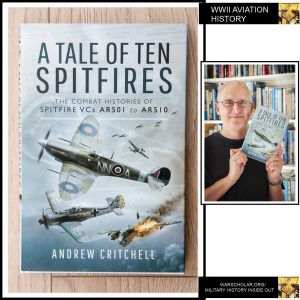
WW2 aviation history book – “A Tale of Ten Spitfires” (Pen & Sword, 2019) – Andrew Critchell – WarScholar written interview 6

Check out the book here.

https://www.pen-and-sword.co.uk/A-Tale-of-Ten-Spitfires-Hardback/p/15274

Spitfire! The name simply conjures up the thrill and adventure of World War II aerial combat. The planes and their crews certainly handled their fair share of the fighting workload for Great Britain and they have been the subject of the imaginations of many warbird aficianados. To this day they are flown for admiring fans.

However, as with any military platforms, it’s even more interesting to get into the nooks and crannies of this aircraft. It had it’s strengths and its weaknesses and it’s these details that can give readers an even greater understanding of how WWII was fought. These planes had personalities, nicknames, and histories just as as their crews did.

Andrew Critchell has photographed warbirds for quite some time and he’s also written this book about Spitfire and some of its operations during WWII. I interviewed Andrew about the book and learned some of the fascinating things about the plane and WWII air operations which you can also learn about in A Tale of Ten Spitfires.

How did you become interested in studying and writing on the subject of your book?

My father and uncles have been into aviation for as long as I can remember and I always had magazines or books on aviation around. My dad was also a keen photographer and airshow goer and so I was exposed to this as well. For some reason it was the piston powered warbirds and the Second World War that really captivated me and I found the living history aspect of this thoroughly absorbing. I remember walking down to school assemblies in Secondary School pretending that my mates and I were B-17 Fortress crews on their way to a briefing for another hellish mission over the Third Reich.

I was also hell-bent on taking better and better airshow photographs and being published. I had my first image used in a Flypast Magazine Battle of Britain Special in 2000 and spent around 10 years doing airshow reports and articles for them. This then dried up, coinciding with the arrival of my kids, so things quieted down. However, I’d had this idea to do an article on Spitfire Vc AR501 which was owned and flown by the Shuttleworth Collection at Biggleswade in Bedfordshire in the UK. I thought about looking at this aircraft’s history plus the next nine Spitfires on the production line, serials AR502 to AR510. I tried to get it published as an article but didn’t have enough historical images for the word count. Over time the thought grew that if a magazine editor was not going to publish it then why not go for the big one and write it as a book.

What aspect of this subject does your book focus on?

A Tale of Ten Spitfires is focused primarily on the combat histories of the aircraft during their time with operational squadrons which lasted from 1942 to 1944. This time coincided with the introduction into service of the Luftwaffe’s new fighter, the Focke Wulf Fw190.

What are the major themes of this book?

The principal theme is an examination of the legend of the Fw190’s supremacy over the Spitfire V which only ended with the widespread introduction into service of the Spitfire IX in 1943. With my Spitfires serving throughout this period it was an opportunity to see how the Fw190 actually impacted the RAF fighter squadrons on a daily basis. Were they being hacked from the skies whenever they met the Luftwaffe’s ‘Butcher Bird,’ or was the reality much more complex.

What resource materials did you use for your research?

I started the project by looking at the Form 78 Aircraft Movement Cards. These gave an outline of which units each Spitfire was assigned to and when, alongside details of any accidents. These also included details of the engine type and when each airframe was struck off charge, either as a result of being scrapped, lost on operations or through an accident. From here I then went to the Form 540 and Form 541 Squadron Operational Record Books. These unit diaries give a detailed breakdown of which operations the squadrons flew on and which aircraft and pilots were involved plus details of victories and losses. On the whole, these were extremely helpful, although the quality of information provided did vary from unit to unit, with a couple of diarists not recording the aircraft serials. This means that my Spitfires could have been involved with more air combats than I was able to confirm.

From there it was a question of picking significant combat operations and tracking down further information. Combat reports were extremely helpful in several instances. My own reference library was my second major source with books being borrowed from a local library if needed. Finally the internet helped a great deal in following up leads.

What were the more prominent and most interesting documentary archives you came across in the research?

The bread and butter of the research were each Squadron’s Operational Record Books. However, it was the combat reports that brought a lot of the operations to life and enabled events to be pieced together in much more detail.

Did you come across any physical objects associated with these specific planes or associated with any of the book’s events?

The most physical object is of course AR501, the Spitfire that inspired the whole book. This aircraft, owned and flown by The Shuttleworth Collection at Old Warden in the UK, was a regular at Shuttleworth airshows until 2005 when the aircraft was grounded so that its engine could be examined as it had been showing a drop in oil pressure. The Collection’s engineers then decided to give AR501 an overhaul, which then turned into a major restoration that was completed in early 2018. The Spitfire took to the air for its first post-restoration flight on 20 March just a few months before the book was finished. I first saw AR501 after her restoration on May 6 at Shuttleworth’s first airshow of the 2018 season, although unfortunately for me, it would be October before I saw AR501 flying again. That was a great sight to see and was also the day I first met Ian Lamaran who was the main man responsible for AR501’s restoration.

Did you develop a strong understanding of the engineering of the Spitfire, its engine and/or its weaponry?

Certainly I know a lot more about the various variants of the Spitfire MkV than I did before! It was also interesting to find out about the later conversion of many Spitfire Vs to LFV status which meant the aircraft were optimised for the best performance at low-level. This led to the nickname ‘clipped, cropped and clapped,’ referring to the clipped wings and cropped supercharger impeller. The clapped reference harder to explain, possibly due to the age of the Spitfires, which would already have been on operations before conversion, or the fact that performance fell off considerably above 12,000 feet. Ironically, I have a much better appreciation of the engineering of the Spitfire since I met Ian!

Is there anything about the physical structure of the Spitfire that you like and alternatively, that you thought wasn’t engineered very well?

I don’t have the engineering background to fully answer this but the Spitfire certainly just looked right from the beginning with its curving lines and elliptical wing.  Even with the addition of the 2,000hp Rolls Royce Griffon on the later marks it still looked good, just a lot more aggressive! I have also recently had the privilege of seeing some Spitfires being restored and, at every level, they are basically works of art from the fuselage frames to the wing spars to the engines. Of course, with any technology, especially one being pushed into service under the imminent threat of war, there were limitations. Certainly the undercarriage was always a problem for the Seafire variants, while things like having a liquid cooled engine made you a lot more vulnerable to battle damage. The Spitfires’ metal skinned fuselage was also less tolerant of damage compared to the fabric covered frame structure of the Hurricane.

Did you get the chance to visit any of the places associated with the events you write about in the book?

I know Belgium quite well as my wife is from Bruges so reading about missions, for example, to the coke ovens at Ghent, or when AR509 went on the rampage across Belgium and France crossing the coast at Oost Duinkerke to strafe barges and trains before being shot down by a flak train near Bethune, made it all the more real.

What part of the research process was most enjoyable for you?

The most exciting aspect was finding out that one of my Spitfires had been involved in an aerial combat and shot down or damaged an enemy aircraft. For example, I discovered that AR505 was flown by Canadian Ace John Davidson ‘Mitch’ Mitchner with several of his victories scored in that aircraft. I was able to find the combat reports for these and describe them in the book alongside extracts from letters home that Mitch had written during his training.

What did you discover in your research that most surprised you?

I think the most surprising aspect of my research was seeing how many aircraft and pilots were lost to non-operational causes, engine failures being a particular problem. Out of the ten Spitfires in my sample, only four survived their operational use. Four were lost to accidents or mechanical failures and only two to actual enemy action, one being shot down by an Fw190 and one by flak.

Was there anything you discovered that moved you?

All of the stories I discovered were moving, heroic, and often tragic. For example, one of my early focuses was on AR502 which was shot down by an Fw190 making a single pass as the Spitfires headed back across the Channel after an uneventful escort mission. The Spitfire is powered by a liquid-cooled Rolls Royce Merlin engine. Unlike an air-cooled radial, such as found in the P-47 Thunderbolt, any hit to the coolant system on a liquid-cooled power-plant is usually terminal with the pilot only having minutes until the engine overheats and fails. AR502’s pilot at the time was Czech-born Flying Officer Jan Doucha and, although he was not injured in the attack, his engine was. Doucha was still 25 miles from the nearest land when he was forced to bale out into the chilling waters of the Channel (the time being November). Doucha never made it into his dingy and, despite his Mae West lifejacket inflating, he perished in the water, his body being washed ashore a month later. He was just 28 years old at the time of his death. Another poignant piece of my research was discovering that at least twelve of the pilots who had flown in my Spitfires at some point in their service were then killed in accidents or combat later in the war.

What was the most difficult issue to research?

The only real inconsistency I found surrounded the missions recorded by the Czech Spitfire Squadron diaries for November 7, 1942. Two operations were recorded that day escorting US 8th Air Force bombers to Brest (Doucha being shot down in the first.) According to most sources only one bombing mission was flown with a time over target of 12.30 to 12.39. However, the Czech Spitfires record a second mission to the same target later in the afternoon escorting a force of B-24s. This links with a narrative account from the 93rd Bomb Group which describes the bombers returning to Exeter as it would have been too dark to land by the time they reached their home base of Alconbury. One B-24 was also claimed by a Luftwaffe pilot from 8/JG2 at 5.02pm again tying in with a later mission. Even with valuable help from the US Air Force Historical Support Division I was unable to resolve this.

What do you hope the book will do for readers?

I hope the book will put readers into the cockpit of a Spitfire Vc and show them what it was like to fly and fight during a crucial part of the air war over northern Europe. I also hope it will show the human side, for I have tried to tell a story rather than just run through the facts and figures. It was humbling and eye-opening for me to find out about the day to day realities these men faced and I hope it will be so for readers.

Did you have any difficulties in finishing the book and publishing it and if so, how did you overcome those?

The main difficulty was in finishing the text to a standard I was happy with. I knew that I had to be one hundred percent sure of each fact and assertion that I made. In terms of getting the book published I was fairly lucky in that Pen & Sword were interested in the concept from the very beginning and so getting the contract was fairly straightforward. At that point I was about two-thirds of the way through and, to be honest, I think that was when the hard work really started!

What is your next writing project?  Are there other planes you might not have been as enthusiastic about but which this research did you make you enthusiastic about?

Unfortunately I’m a bit of a writing magpie with lots of ideas and projects on the go at once. I would love to do something similar for the Hawker Typhoon for example, but it really depends on how well ‘A Tale of Ten Spitfires’ is received. I have also been photographing warbirds for a very long time and would love to do a book project combining that with my writing. On top of this, I also have several articles on the go. It’s finding the time to get them done that is my biggest challenge!

Do you have any online accounts where people can find more of your work?

Readers can keep up to date with my latest projects, aviation pictures and musings via facebook.com/warbirdphotos and www.aviationphoto.co.uk

Author Biography

Andrew Critchell

Aviation author, historian and photographer.

His main interest is in the air battles of the Second World War.

Author of A Tale of Ten Spitfires.

Check out the book here.

https://www.pen-and-sword.co.uk/A-Tale-of-Ten-Spitfires-Hardback/p/15274

As an Amazon Associate I earn from qualifying purchases.