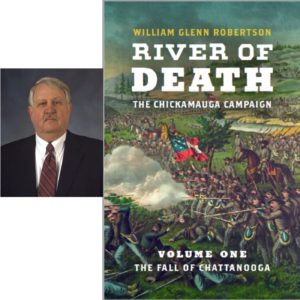
US Civil War history book – “River of Death” (University of North Carolina Press, 2018) – William Robertson interview

William Glenn Robertson has a PhD in History and has written books and numerous articles on the US Civil War. He became a faculty member of the Army Command and General Staff College at Fort Leavenworth, Kansas in 1981. There he revived the educational technique known as the Staff Ride and wrote the Army’s manual on the subject. He retired as the Director, Combat Studies Institute in 2011. We spoke about his latest US Civil War book on the Chickamauga campaign.

0:47 – William talks about how he got into studying military history. He grew up around it.

4:24 – William talks about the book itself. He talks about the motivation to write it.

7:27 – William talks about how his study differs from previous studies of the Chickamagua campaign. William talks about the personalities of the military leaders and also how they moved through and mapped the terrain they were fighting in.

16:05 – William talks about feeding and supplying large Civil War armies.

18:41 – William talks about the staffs of these armies.

23:49 – William talks about a southern family that had a son in the Union Army and who fed false information to the Confederate Army.

25:34 – William talks about the role of technology in the campaign.

32:04 – William talks about how no one had ever managed armies the size of those in the US Civil War.

34:43 – William talks about what documents he used for his research.

50:43 – William talks about some of the Civil War stories that saddened him.

59:26 – William talks about a serious problem he sees in the study of US Civil War history.

For more “Military History Inside Out” please follow me on Facebook at warscholar, on twitter at Warscholar, on youtube at warscholar1945 and on Instagram @crisalvarezswarscholar

Guests: William Glenn Robertson

Host: Cris Alvarez

Tags: military, history, military history, conflict, war, interview, non-fiction book, US history, US military history, US Civil War, Georgia, Chickamauga, Union, Confederacy
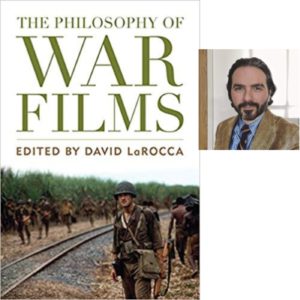
War films analysis book – “The Philosophy of War Films” (University Press of Kentucky, HC, 2014, PB, 2018) – David LaRocca interview

David LaRocca has studied philosophy, film, rhetoric, and religion. He’s worked with a number of institutions where he has studied and taught these subjects. We talk about his editing work on a recent book on war films.

0:42 – David talks about how he got into studying war films. He was first interested in war photography.

4:33 – David talks about the focus of the book and begins talking about Werner Herzog.

8:46 – David talks about the philosophy of war and war films.

17:27 – David talks about who and what war movies are for. Are they for veterans or for non-military audiences?

22:08 – David talks about how realistic war movies can be.

26:44 – David talks about how movies have a way of telling stories that may conflict with actual events.

37:06 – David talks about who makes war movies versus who undergoes the experience.

43:53 – David talks about serializing war stories.

45:19 – David talks about video games and war stories.

49:12 – David talks about the various disciplines applied in this book.

59:24 – David’s work can be found at DavidLaRocca.org.

Links of interest

http://davidlarocca.org/David_LaRocca.org/David_LaRocca.html

http://www.kentuckypress.com/live/title_detail.php?titleid=3324#.W_ypnzFReM9

For more “Military History Inside Out” please follow me on Facebook at warscholar, on twitter at Warscholar, on youtube at warscholar1945 and on Instagram @crisalvarezswarscholar

Guests: David LaRocca

Host: Cris Alvarez

Tags: military, history, military history, conflict, war, interview, non-fiction book, Werner Herzog, Jeff Wall, Christian Bale, Saving Private Ryan, veterans, Normandy, Spielberg, Restrepo, Chris Kyle, American Sniper, video games

Modern military analysis and history book – “Civil-Military Relations in Southeast Asia” (Cambridge University Press, 2018) – Aurel Croissant interview

Dr. Aurel Croissant is Professor of Political Science at the Institute of Political Science, Ruprecht-Karls-University, Heidelberg. His main research interests include the comparative analysis of political structures and processes in East- and Southeast Asia, the theoretical and empirical analysis of democracy, civil-military relations, terrorism and political violence. We discussed his latest book on civil-military relations in Southeast Asia.

0:55 – Aurel talks about how he got into studying Southeast Asian military affairs.

1:45 – Aurel talks about the countries that he focuses on in the book.

3:59 – Aurel talks about how these various countries developed their military institutions. Both the western model and the Soviet model have had an affect on these countries.

9:28 – Aurel talks about the military startegies of these countries.

10:21 – Aurel talks about these militaries roles in their respective societies.

13:53 – Aurel talks about which servies dominate the various militaries.

15:18 – Aurel talks about how he did the research for the book.

19:27 – Aurel talks about the influence that elites have in civil-military continuity.

27:34 – Aurel can be found on the Heidelberg University website.

Links of interest

https://www.uni-heidelberg.de/politikwissenschaften/personal/croissant/croissant_en.html

https://www.cambridge.org/core/elements/civilmilitary-relations-in-southeast-asia/6E22E7C9244503D345920BF7F44347A2

For more “Military History Inside Out” please follow me on Facebook at warscholar, on twitter at Warscholar, on youtube at warscholar1945 and on Instagram @crisalvarezswarscholar

Guests: Aurel Croissant

Host: Cris Alvarez

Tags: military, history, military history, conflict, war, interview, non-fiction book, Southeast Asia, independence, colonialism, Malaysia, Singapore, Vietnam, Indonesia