Podcast: Play in new window | Download
Subscribe:
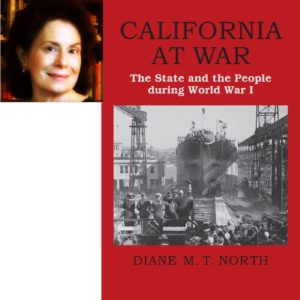
Dr. Diane North teaches history at the University of Maryland. She grew up in the Washington, DC area, fascinated by history. She earned her Ph.D. in History from the University of California, Davis and has recently written “California at War” about California’s experience during WWI. I interviewed her about the book.
2:05 – Diane was enthralled by history from an early age and from growing up in Washington, DC. She would listen to debate in the House and Senate after her chores.
3:09 – The WWI centennial was approaching when she began her research so she focused on the war. She wanted to understand what happens to people when the nation goes to war. California had a huge economy and was a trendsetter so she wanted to write on it.
8:01 – She created a new course at the University of Maryland on WWI because of her interest in the war.
9:11 – The book starts on the 1916 parade bombing in San Francisco with 40 injured and ten killed. The first chapter talks about the US men who fought in WWI before the US entered the war. Many Californians served in Siberia from 1918 to 1920.
11:45 – Chapter 2 looks at the women who served overseas during the war.
13:20 – Chapter 3 looks at how the army and navy spend considerable money building facilities in California. Chapter 4 looks at the economy of war. The war accelerated the process of corporate organization and a dramatic rise in industrial employment. She then looks at what people did in the home front to support the war.
14:40 – She also looks at how minorities participated in supporting the war in the home front. Then she touches on how the state and military dealt with the influenza problem.
15:57 – Chapters 7 and 8 deal with the rise of the security state and the role of government. Private organizations were given the power to spy on citizens without government oversight.
18:00 – California also promoted scientific and agricultural development. But these groups also spied on fellow citizens. Colleges, staff and students were also required to sign oaths of loyalty. German language and literature also could not be studied.
20:46 – Efforts were made to keep the press from writing about the IWW and also to get members arrested. Later rights of fre speech, press and assembly were restricted.
22:49 – The navy split the feet after the war and put the pacific fleet in San Diego. This helped in California’s post war boom.
24:01 – One of California’s Senators was a pacifist and he was appalled by US entry into WWI. Berkley enacted an anti-free speech ordinance. California had a real connection with the war effort before the US entered the war because of its trade with Europe.
26:30 – California did have a strong peace movement that quickly got squashed by Federal efforts. The Post office began curtailing free speech and free press by restricting the delivery of certain newspapers.
28:45 – She started her research with the National Archives in DC, Maryland and California.
30:37 – Hollywood was considered vital for the war effort by the Federal government and this boosted the film industry.
33:39 – Diane came across paintings done by an Army officer while in France. Some US forces didn’t return until 1921 or 22 because they were occupying the Rhine.
35:00 – Californians pushed the Federal government to pass many anti-Asian laws and there were many anti-Asian films put out by Hollywood at this time. There were also may pacifist films. But many were also very patriotic. Many of these films were distributed internationally.
37:20 – Diane found interesting documents from Sydney Coe Howard. He was an airplane pilot and he won an Oscar for his screenplay of Gone With the Wind. His letters are amazing and include vivid descriptions of dogfights and the war. She unearthed many journals, letters, photos and drawings from the war.
41:40 – California women do not get the recognition they deserve for their efforts in WWI.
44:00 – Ship and boat building increased considerably in California during this time. The two major universities were the University of California and Stanford University. A committee was formed to examine and organize scientific research at the time to help the California economy.
47:30 – California’s efforts to organize and improve statewide scientific research was held up as an example by the Federal government for other states to follow.
51:42 – Californians were strongly patriotic and believed President Wilson when he said the war would be the war to end all wars.
52:36 – HG Wells wrote a series of lectures before the war that a good war will end all wars and many people including Wilson bought this idea. However the country was very racist and Wilson had re-segregated parts of the Federal government that had been integrated so the soundness of this idea was questionable.
56:00 – The book will be discounted during the month of July.
Links of interest
https://www.californiaatwar.com/
From the Publisher: https://kansaspress.ku.edu/home/new-notable/978-0-7006-2646-5.html
From your local Independent Bookstore: https://www.indiebound.org/indie-bookstore-finder
From Amazon: https://www.amazon.com/California-War-State-People-during/dp/0700626468/ref=sr_1_1?s=books&ie=UTF8&qid=1527174595&sr=1-1&keywords=California+at+War&dpID=51C5WTuV4dL&preST=_SY291_BO1,204,203,200_QL40_&dpSrc=srch
From Target Books: https://www.target.com/p/california-at-war-the-state-and-the-people-during-world-war-i-by-diane-m-t-north-hardcover/-/A-53530392
For more “Military History Inside Out” please follow me on Facebook at warscholar, on twitter at Warscholar, on youtube at warscholar1945 and on Instagram @crisalvarezswarscholar
Guests: Diane North
Host: Cris Alvarez
Tags: military, history, military history, conflict, war, interview, non-fiction book, California, WWI world war one, Wilson, Berkley, Stanford, San Francisco, San Diego, Hollywood, US Navy
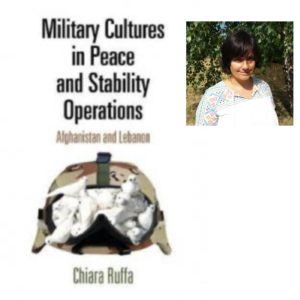 Dr. Chiara Ruffa has recently published a book about military culture. It’s based on her research with French and Italian military units that had deployed to Lebanon and Afghanistan. I spoke to her about the book.