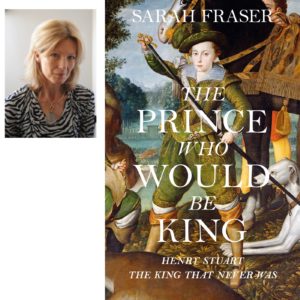
British 17th century history book – “The Prince Who Would Be King” (William Collins, 2018) – Sarah Fraser interview

Check out this book here   https://amzn.to/3aHc7KV

Sarah Fraser has written The Last Highlander and The Prince Who Would Be King. She holds a PhD in English Literature and also earned a degree in History where she focused on Celtic history in Scotland.

2:35 – Ms. Fraser enjoys history because it can be used a lens in which to view the present. She is also very drawn to the time period she wrote about and the people who inhabited that time period. The stakes were life and death and the survival of nations.

3:16 – Her first degree was a PhD in English Literature and then she moved into History when her children were getting a Gaelic education. She became interested in Celtic history in Scotland.

4:06 – Her first book about her husband’s ancestor, an old Highland chief.

4:38 – The book is a stepping is a stepping stone between Elizabeth I and James VI and I. Elizabeth was the last of the medieval rulers and James presided over a period of huge change. Henry is James’ oldest son.

6:50 – This period was the English period of religious of turmoil. It was a period of religious warfare. There’s a century in Europe when people fought over religion. Faith was something they lived or died for.

8:36 – The Guy Fawkes plot was of awesome ambition to destroy the English government and make Britain a group of Catholic puppet states of Spain. Henry was a target of the plot as much as James was. Protestants feared the popery.

10:51 – The plot made Henry feel that war was coming to England. Henry always cared about military affairs and this intensified the feeling. He was tutored by men who had fought in previous religious wars.

13:37 – From the moment the Renaissance hits, royal children begin being taught in a Renaissance way. Erasmus developed the education of the Christian prince. He influenced both Spain and England.

15:21 – Henry would wear Tudor colors to prove that he is the proper person to fill the Tudor throne. He wore symbols depicting being a Christian solder whereas his father was more about peace and learning.

17:21 – Denmark was wealthy and had the best Navy. Christian IV of Denmark was Henry’s uncle and he gave Henry an impressive warship, the Vice-Admiral.

19:59 – The Royal Navy is decrepit at this time and the Royal shipyards are very corrupt. Walter Raleigh complained about English ships at this time. Henry wants to fix that. He was also learning military affairs from the famous Maurice of Nassau. Maurice dedicated his book to Henry.

22:11 – Henry is not so much anti-Catholic as he is pro-Protestant. Henry’s tutors are more puritan, they’re militant and they’re internationalist. They see an international brotherhood of Protestants. Spain had started suffering from overreach by the end of the 1500s but are becoming more militant about Catholicism. Many of Henry’s allies fear Spain. Both the Catholics and Protestants had international leagues.

24:53 – Henry was focused on founding a new Jerusalem in North America. A purely Protestant country. A lot of the people around Henry were at the godly end of Protestantism and were very political.

28:04 – The Mayflower Puritans left England because James I didn’t like them. They wouldn’t recognize him as the head of the Church on Earth. Charles dislikes them even more when he takes the throne.

30:11 – Henry was the patron of the Virginia Company. Henry wanted to control the seas and exploit North America for the Protestants. Spain was angry at this plan.

31:31 – Henry had to deal with massive royal debts. He wanted to work with Parliament to solve his problems. He wanted to be made Prince of Wales in Parliament so that everyone in London and in power would see him as king. He also begins collecting artwork with spiritual value, coins, italios, suits of armor, statues, etc. at a massive scale.

35:25 – The military wing of England gathers at Henry’s court since James isn’t as interested in military matters. Some of those who gather around him later join the Parliament during the English Civil War.

37:30 – Ms. Fraser used both primary and secondary sources. She went to the British Library, the Royal Archives, the National Library of Scotland and so on to find the letters and drafts from that period. The British Library also has the first map made of the Chesapeake Bay area. It was made in 1607 by Henry’s gunner. The expedition founded Henrico in Virginia. Henrico College was also named after Henry and was supposed to convert indigenous people.

41:03 – Henry’s letters haven’t been consulted much because he didn’t become king. He wrote formal letters in Latin and then many daily quick notes to people written in English or French.

43:14 – Henry’s effigy was the most interesting artifact Ms. Fraser came across. It was very elaborate and realistic. It was on his bier and was ravaged by souvenir hunters during the months after his death. People thronged to his funeral and there was an enormous amount of sorrow.

45:36 – Ms. Fraser loved bringing Henry back to life with the letters. But some events she knows happened but you can’t find Henry talking about it. Other letters refer to his actions.

48:05 – Henry and his friends grew up quickly. Henry was attending to diplomats at the age of ten. He and his friends were thinking of going to war when they were young. For Henry, he went from being a child to an adult at age 13. His household became a collegiate court.

50:32 – His sister Elizabeth became known as the Winter Queen, Elizabeth of Bohemia. She and her husband kicked off the Thirty Years’ War. Charles and Elizabeth was tutored too but not as intensely as Henry. Charles was part of Henry’s military salon at the court.

52:28 – The whole book was difficult because Henry didn’t become king. Ms. Fraser had to create a James Dean moment for Henry. The end of the golden boy moved Ms. Fraser. Writing his death was very difficult. Ms. Fraser was heartbroken for Henry.

55:21 – Henry had the biggest state funeral for a while. It was bigger than Elizabeth’s. His parents didn’t attend because of grief. His bier had his pennants and mottos. He had eight black warhorses and the one motto was “He Delights to go upon the Deep,” from his father. The other motto was “Glory is the Torch of the Upright Mind.” The third was “It is Right to Seek for Other Countries.”

57:16 – Ms. Fraser would like to put Henry back into history. She also wants to highlight the slow rise of militant Puritanism.

58:23 – Ms. Fraser wanted to write about James VI and I but HarperCollins said they had a book on him and wanted one on Henry so she did that. She is now working on Jacobite fiction.

59:38 – Shakespeare was a part of Henry’s household with the King’s Players. They were ushers at the tables went not doing plays. Shakespeare learned a lot about kings and courts from this work. Ben Johnson wrote during this period too.

1:01:25 – King Lear is about a king who’s done with ruling and goes off hunting. This is just what James VI and I did too. Shakespeare wrote King Lear almost saying to the king to not leave the court and the country. But works were censored so contentious pieces were set in Ancient Rome to circumvent censorship issues. Englishmen at this time are discussing civil liberties and opposing tyranny.

1:05:20 – Ben Johnson worked for Henry a lot but Shakespeare didn’t work for Henry.

1:05:40 – The Last Highlander has been out a while. The biography Ms. Fraser wrote is about the real grandfather of the fictional hero Jamie Fraser in the Outlander series. Her website is Sarahfraser.co.uk. She’s also on twitter at @Sarah_FraserUK.

Links

https://amzn.to/3aHc7KV

https://en.wikipedia.org/wiki/Outlander_(TV_series)

https://www.sarahfraser.co.uk/


For more “Military History Inside Out” please follow me on Facebook at warscholar, on twitter at Warscholar, on youtube at warscholar1945 and on Instagram @crisalvarezswarscholar


Guests: Sarah Fraser

Host: Cris Alvarez

Tags: Stuart, Tudor, Prince of Wales, Catholic, Protestant, Puritan, Erasmus, Thirty Years War, James, Charles, james VI, Winter Queen, Bohemia, Denmark, Sterling castle, Henrico, Chesapeake bay, Virginia, Spain, Britain, England, Scotland, Royal Navy, Royal shipyard, Walter Raleigh, Guy Fawkes, Gunpowder Plot, Calvinist, Henry

Check out this book here   https://amzn.to/3aHc7KV

As an Amazon Associate I earn from qualifying purchases.
WWII history book – “The General Who Wore Six Stars” (Potomac Books, 2018) – Hank Cox interview


Hank Cox has been writing in various capacities for many years. He’s written a book on the Sioux Uprising of 1862 and now on General JCH Lee of WWII.

1:39 – Hank Cox discusses how he got into writing history. He first wrote “Lincoln and the Sioux Uprising of 1862”. There hadn’t been much written on the subject in many decades.

3:27 – He’s also a big WWII fan and wanted to write about Lt. Gen. John C.H. Lee. Many of his colleagues didn’t like him though he was very successful being in charge of Army supplies in Europe.

5:03 – Lee did have unusual characteristics. He was very military and something of a martinet.

6:24 – The book goes into Lee’s pre WWII life. He fought in WWI and then joined the Corps of Engineers. He worked on the great Vicksburg flood of 1927. He developed many contacts that helped dictate what he ended up doing during WWII.

9:38 – Lee was put in charge of the great buildup of supplies in Great Britain for the invasion of Europe. One of the big issues was the train Lee wanted.

12:09 – Lee was also criticized heavily for being very religious and going to church often and his staff had to attend with him. He also didn’t have drinking buddies.

14:28 – He was also a strong advocate of African-American soldiers and thought they should be put to better use.

15:19 – Many of the US Generals in Europe also refused to be part of a centralized supply effort controlled by Lee.

16:42 – By the time of the Battle of the Bulge, the US was running out of troops and Lee changed the rules to allow black soldiers into combat. This bothered a lot of US Army leaders but Lee didn’t back down. White troops in the field accepted them at the time of combat.

18:38 – When Patton raced across Europe, the US supply lines weren’t in place to properly support him with fuel, food and ammo. Lee created the Red Ball Express – trucks driven mostly by black drivers racing across Europe to supply Patton.

20:26 – Lee moved his command into Paris when it was liberated. But Eisenhower had said Paris should only be for soldiers on leave. Lee argued that Paris was the central communications point across Europe and he had to put his headquarters there. Troops resented the great accommodations Lee and his staff had in Paris.

24:22 – Near the end of the war. Bradley and others refused to report how many supplies they had to Lee. The Germans also tried to attack US supply depots around Europe and Lee worked on removing all these supplies and out of the hands of the Germans.

26:33 – When Lee allowed black soldiers into combat, they had to lose rank to do that but thousands went into combat roles anyway.

27:40 – After the war, Lee was put in charge of Italy despite all the negative comments made about him.

31:18 – Lee has been unfairly criticized by historians as well. After the war he joined the Episcopalian group the Brotherhood of Saint Andrew.

33:08 – Benjamin Davis was sent over to allay fears of black soldiers and he became good friends with Lee.

34:30 – Lee had a large staff to run his operations. Twenty-five percent of US forces were in Lee’s command. But many of the combat forces refused to let supply people inventory their supplies.

37:03 – US generals were constantly stabbing each other in the back politically speaking.

38:49 – Lee was in charge of building air bases and supplying them but air force supply control was held by others. Lee requisitioned many air force personnel at times.

40:47 – Hank went to Carlisle for some historical records and also used Lee’s memoirs.

44:10 – Keeping track of and sourcing all the information in the book was the hardest part of writing it.

47:47 – Learning about the hardships the soldiers went through was the hardest thing to study while writing the book. Lee tried his hardest to get winter clothing to the soldiers in Bastogne and other areas. There was a lot of chaos in supplying soldiers.

51:03 – Omar Bradley was much more petty than Hank had expected and that bothered him. Omar Bradley has always been known as the GI’s General.

54:43 – Hank’s website is http://www.hankhcox.com/


Links

http://www.hankhcox.com/

For more “Military History Inside Out” please follow me on Facebook at warscholar, on twitter at Warscholar, on youtube at warscholar1945 and on Instagram @crisalvarezswarscholar


Guests: Hank Cox

Host: Cris Alvarez


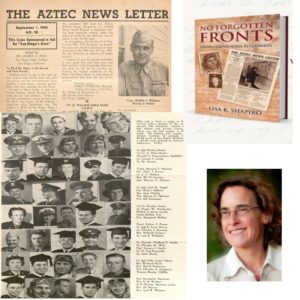
WWII history book – “No Forgotten Fronts” (Naval Institute Press, 2018) – Lisa Shapiro interview

Professor Lisa Shapiro holds masters degrees in literature and management and teaches at San Diego Mesa College. She has previously taught creative writing. She’s written a book based on thousands of archived letters sent by San Diego State students who were in WWII to their professor Dr. Post. I interviewed Professor Shapiro about the book titled “No Forgotten Fronts.”

1:54 – Professor Shapiro talks about her first historical project. It dealt with European medieval historical fiction. Her interest in WWII came out of her work with community college students in San Diego.

3:57 – She began studying war literature and got a second degree in that subject. In the school archives she found letters written to a professor during WWII.

5:46 – Professor Shapiro explains the basis and details of the book. It’s a collection of student letters written to their professor, Dr. Post. He turned the letters into a regular newsletter. He did this through the entire war.

10:16 – Several hundred students participated in writing to Dr. Post. This includes men and women and many wrote repeatedly. People also provided funds to support him. The original documents are in the San Diego State college archives.

12:16 – Professor Shapiro discusses how the US military censors worked with Dr. Post. He took care to keep out sensitive information out of his newsletters.

16:35 – Sometimes students wrote things only for Dr. Post and not the newsletter.

17:16 – Dr. Post was also able to connect two brothers, one of whom was a prisoner of war during the war. Dr. Post even visited their mother to provide reassurance about her sons. One student who was at Anzio wrote that he had lost his marbles and Dr. Post knew he needed some mental comfort. Dr. Post notified a nearby chaplain in Europe from San Diego State to visit this soldier and also gave comfort to the student’s father.

22:54 – Professor Shapiro explains how Dr. Post got information on killed or injured students and how he dealt with that information. Dr. Post would also update information he had published.

27:57 – Dr. Post didn’t have any children. Professor Shapiro discusses how Dr. Post met his wife in college. But both were active in the lives of their students. He also did trick roping and performed for his students. His wife was a singer. Dr. Post did have a nephew in the Marines who would write to Dr. Post.

30:36 – There don’t seem to have been any other people who collected letters from specific groups during WWII. Others have created letter collections after wars.

34:43 – The students loved getting the newsletters.

36:07 – Professor Shapiro focused on the letters that captivated her. The emotion of the letters touched her. She was able to track the stories of specific individuals.

40:28 – Professor Shapiro reads a letter from Herman Adelson who nicknamed himself Little Geronimo since he was a paratrooper. He and the others really believed in what they were fighting for. For good, freedom and democracy.

43:22 – A letter arrived for Dr. Post saying that Herman had died during D-Day and included a eulogy for him. San Diego State lost three members of their championship basketball team during the war. But the community found comfort in knowing what their loved ones had been doing.

48:29 – Professor Shapiro did a lot of reading to brush up on her knowledge of WWII and current events at the time the letters were written. She used Anthony Deevers’ history. She also read a lot of San Diego history. San Diego had a lot of women participate in the war. A lot of San Diego State students became pilots.

53:40 – Professor Shapiro had few problems getting the book published. She had to shorten the book since it was very long at first.

55:02 – Grif Williams was one of the students and was famous for being on the Doolittle Raid. He was taken prisoner eventually and he was eventually a cellmate with another San Diego State student who had been captured in Germany.

59:26 – The website for the book is NoForgottenFronts.com.


For more “Military History Inside Out” please follow me on Facebook at warscholar, on twitter at Warscholar, on youtube at warscholar1945 and on Instagram @crisalvarezswarscholar


Guests: Lisa Shapiro

Host: Cris Alvarez

Tags: war, military, WWII, WWII history, san diego, san diego state, pacific war, d-day, north africa, europe, germany, doolittle raid, anzio