Podcast: Play in new window | Download
Subscribe:
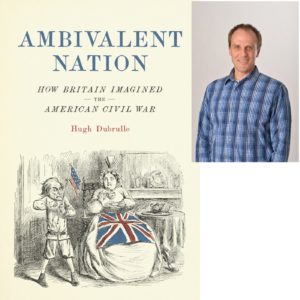
Dr. Hugh Dubrulle is a Professor in the Department of History at Saint Anselm College in New Hampshire. He has studied British history and US Civil War history extensively and has written a new book about British attitudes towards the US Civil War. I interviewed Dr. Dubrulle about the book and his findings.
2:00 – Dr. Dubrulle’s family grew up in France during WWII. The stories they told of that time inspired him to study history. When he grew up in the US, his family took trips including one to Vicksburg when he was a small child that inspired him. He then began studying British history and eventually became interested in studying British history alongside the American Civil War.
5:00 – He wrote a dissertation on this subject some time ago and that began to turn into the book.
7:17 – Past scholars have divided the British into two factions – pro-North and pro-South. Dr. Dubrulle wanted to write about the complexities of British attitudes towards Americans and the war. During the war, America was still heavily dependent on Britain economically and in other ways. The war was very disruptive to British trade.
10:47 – John Bright, pro-North, was one of the few British leaders who were whole-heartedly behind one side. But most leaders were of two minds during the war.
13:38 – Some British thought that middle-class Yankees would just pay Irish and Germans to do their fighting for them. They thought that the American middle class reflected their own middle class.
16:25 – Many British people thought New York was the financial and cultural capital of the US.
18:52 – The British were very concerned with Canadian security during the Civil War. They worried that if the North lost, they would turn north and attack Canada.
20:44 – Several British military missions traveled to the US during the war to observe. These were overwhelming Army officers and few Navy officers.
22:52 – The UK contemplated getting involved in the war on the side of the South at various times.
25:23 – After the war, the British were worried about what the US would do next. The US had raised an army larger than any that could be sent to protect Canada. But some British also worried the US would become a military dictatorship. They wondered if it would pay its debts and so on.
27:04 – Many British people were critical of Lincoln. But many lower class British people liked that a working man could become President. The British press liked Jefferson Davis. They saw a Northern middle class attacking a government of gentlemen in the South.
29:37 – British people were ambivalent about Sherman’s campaigns. They admired the military maneuvers but they were also appalled by the material destruction of the campaign. Sherman was liked more than Grant was.
31:32 – Dr. Dubrulle read many books and newspapers that were contemporary to that period. He also read personal correspondence. He found materials all over Britain for documents. The British Library has a huge collection of historic newspapers.
33:40 – The London Times was the most important newspaper at the time right before the war. But then paper became cheap and then a number of newspapers for the middle and working class rose up during the war. The Illustrated London News was the pioneer newspaper in the UK for illustrated news. Their artist worked in the North at first and then in the South afterwards. Emory University has a lot of his work.
38:48 – Dr. Dubrulle found a number of Southern newspapers and a diary of a British person who visited New York during the war.
40:49 – Dr. Dubrulle was surprised at how divergent British opinions were in public and in private.
42:31 – Frank Lolley was a very pro-South British person in public but in private he was very troubled about the Confederacy.
48:37 – The British had a problem with Northern nationalism. They didn’t believe there was a basis for American unity. They thought it was all based on the size of the country.
51:45 – He’s hoping that the discussion of British attitudes towards the US Civil War will focus more on the bigger picture than on who thought what.
Links
http://iln.digitalscholarship.emory.edu/
For more “Military History Inside Out” please follow me on Facebook at warscholar, on twitter at Warscholar, on youtube at warscholar1945 and on Instagram @crisalvarezswarscholar
Guests: Dr. Hugh Dubrulle
Host: Cris Alvarez
Tags: military, history, military history, conflict, war, interview, non-fiction book, US, Civil War, Grant, Lincoln, Sherman, Davis, North, South, London, New York, antebellum
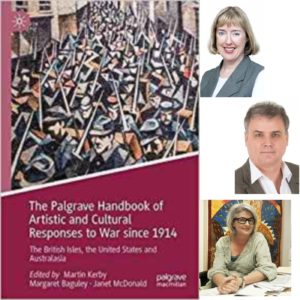 Martin Kirby and Margaret Baguley are two of three Australian academics who have been editing a new book exploring how war since 1914 has been represented in the arts in Australasia, the US, and in the British Isles. I spoke with Margaret and Martin about the book.
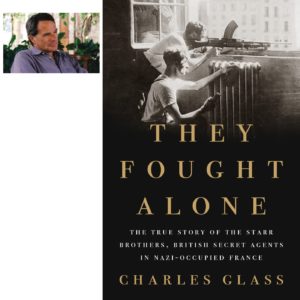 Charles Glass is a broadcaster, journalist and writer. Early in his career he worked in the ABC News Beirut bureau with Peter Jennings. He covered the October Arab-Israeli War on the Egyptian and Syrian fronts and the civil war in Lebanon. He was ABC News Chief Middle East correspondent from 1983 to 1993. He’s been a freelance writer since then covering hot spots around the world. He spoke to me about his latest book on two British spies who operated in WWII France.