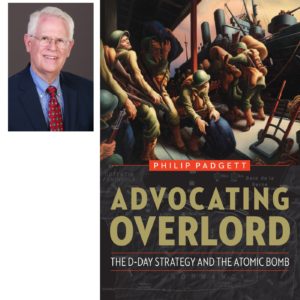
Phil Padgett has worked as a political scientist in the field of security studies for much of his career. He turned his skills to writing a book on the WWII Operation Overlord, the atomic bomb, and the relationship between the US and UK during the war.
2:21 – Phil Padgett is a political scientist and has long been fascinated by a meeting between Churchill and Roosevelt during WWII.
4:30 – Phil found a letter by a Naval officer who said big things were being discussed by Roosevelt on a small boat on a lake in Canada during WWII.
6:15 – The book goes over Overlord more than on the discussions for cooperation between the US and UK on the Manhattan Project.
8:10 – The crux of the book is about the UK and the US reestablishing trust during the war.
10:00 – The US Joint Chiefs of Staff had to deal with many military leaders turning against Overlord in favor of a Mediterranean strategy.
12:45 – The US wanted a quick war and a quick strike in order to then move against Japan.
14:48 – Phil talks about the secrecy and knowledge of all parties about atomic bomb research.
19:53 – Both the US and UK knew the atomic bomb was a very powerful weapon and both were concerned about who would control atomic bombs after the war. Nations also felt that strategic bombing could have strong political effect on warring nations.
22:42 – Churchill liked to feed information to Roosevelt before the US joined the war that British bombing was having an effect on Germany.
23:55 – Canada is involved heavily in Overlord. General thinking about the[n] war was that a major amphibious assault would not work.
29:49 – His quid pro quo idea is very controversial. He used primary records at the US National Archives and at the British National Archives.
31:54 – Phil found one of Churchill’s papers with a scorch mark from a cigar burn and it brought him to the moment when history was happening. He also enjoyed going to the war rooms, Hyde Park and being on the battleship Texas.
34:45 – Phil was surprised by the amount that WWI influenced WWII. Especially with air power and a fear of repeating trench warfare.
36:16 – There didn’t seem to be a contingency plan if D-Day didn’t go well. If it failed, they probably would only have been able to conduct a Mediterranean operation afterwards. In late 1943, there was a US threat of a railroad strike over wages and hours. If it occurred, D-Day would have been delayed six months.
39:33 – Roosevelt was pretty much his own Secretary of State on these issues. The Secretary of State ran day-to-day diplomatic operations.
43:33 – Transcripts of the phone calls between Churchill and Roosevelt would be useful to historians. The Germans had cracked the allied system from 1940 to 1943 and kept transcripts of the calls. The records were kept in Berlin and appear to have been destroyed during the bombing of Berlin.
46:42 – Phil is happy he’s started the conversation about the quid pro quo idea.
48:44 – Phil has a website at www.philpadgett.com for the book. The website also has answers to frequently asked questions plus it has more photos.
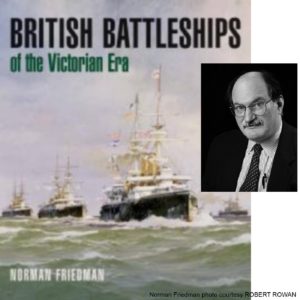
Norman Friedman is a physicist and historian who has written extensively on naval matters especially the US and UK navies. I interviewed him about his latest book.
1:27- Mr. Friedman has been interested and writing about navies for some time. He’s written about 40 books, 30 of them in history.
3:29 – He had written on later battleships and became interested in the ships that came before the world wars. One of the themes in technological surprise.
5:14 – The French tried to beat the British with technological change but the British simply didn’t want to spend money. Steam propulsion is an early technological race between the French and British.
7:29 – For much of this period, British statesman didn’t believe war would happen. But the Franco-Prussian war shocks them. In 1877, the British think they have to fight the Russians when Russia goes to war with Turkey.
9:14 – The British find they can’t man the fleet properly and that their intelligence service is weak. But they still scare the Russians by sailing into the Black Sea in a storm. But the British are unable to keep a fleet in the Baltic Sea.
12:32 – The British financial sector had great sway over British politics. Their influence affected the British Navy. They wanted parts of China, Argentina and the United States protected by the British Navy for trade reasons.
16:44 – Underwater weapons have a great effect on worldwide naval strategy in this period. They’re cheap weapons that can destroy expensive ships. In 1885, people begin to wonder if the sea can be controlled by anyone. These weapons help fleets escape from their own ports easier and it’s harder for big fleets to control smaller fleets. The British try to tabulate information and learn their fleet isn’t big enough for sea control.
19:29 – Steel comes in between 1870 and 1880. The French build new ships in 1875. Sails disappeared in the 1880s.
21:36 – British engineers say that sails should be discarded but many people fear that coal won’t be available in sufficient quantities abroad at coaling stations to get rid of sails.
23:15 – The British made their own steel. But the French made better steel at the time. Most countries bought British steel for armor and guns. Krupp in Germany made excellent steel and excellent guns.
26:14 – He extensively used documents from the British Archives. The National Maritime Museum has ship covers.
31:04 – In 1882, the US formed a naval intelligence organization that wrote about information from abroad and that included UK material.
33:44 – reading technology books contemporary to that period was helpful.
35:08 – The French held a World’s Fair where naval capabilities were one thing showcased.
37:43 – He was most surprised about the effect of underwater weapons on how worried naval thinkers were about them. He also didn’t feel he fully understood the development of heavy guns and on the effects of exports. He’d like to know who was buying British heavy guns and why.
48:31 – His works can be found on Amazon and Seaforth publishes his books in the UK.
49:32 – The Victorian period is an interesting time that a lot of people have forgotten. There are a lot of parallels between that period and now. It also tells us about where the modern world came from.
Sarah Fraser has written The Last Highlander and The Prince Who Would Be King. She holds a PhD in English Literature and also earned a degree in History where she focused on Celtic history in Scotland.
2:35 – Ms. Fraser enjoys history because it can be used a lens in which to view the present. She is also very drawn to the time period she wrote about and the people who inhabited that time period. The stakes were life and death and the survival of nations.
3:16 – Her first degree was a PhD in English Literature and then she moved into History when her children were getting a Gaelic education. She became interested in Celtic history in Scotland.
4:06 – Her first book about her husband’s ancestor, an old Highland chief.
4:38 – The book is a stepping is a stepping stone between Elizabeth I and James VI and I. Elizabeth was the last of the medieval rulers and James presided over a period of huge change. Henry is James’ oldest son.
6:50 – This period was the English period of religious of turmoil. It was a period of religious warfare. There’s a century in Europe when people fought over religion. Faith was something they lived or died for.
8:36 – The Guy Fawkes plot was of awesome ambition to destroy the English government and make Britain a group of Catholic puppet states of Spain. Henry was a target of the plot as much as James was. Protestants feared the popery.
10:51 – The plot made Henry feel that war was coming to England. Henry always cared about military affairs and this intensified the feeling. He was tutored by men who had fought in previous religious wars.
13:37 – From the moment the Renaissance hits, royal children begin being taught in a Renaissance way. Erasmus developed the education of the Christian prince. He influenced both Spain and England.
15:21 – Henry would wear Tudor colors to prove that he is the proper person to fill the Tudor throne. He wore symbols depicting being a Christian solder whereas his father was more about peace and learning.
17:21 – Denmark was wealthy and had the best Navy. Christian IV of Denmark was Henry’s uncle and he gave Henry an impressive warship, the Vice-Admiral.
19:59 – The Royal Navy is decrepit at this time and the Royal shipyards are very corrupt. Walter Raleigh complained about English ships at this time. Henry wants to fix that. He was also learning military affairs from the famous Maurice of Nassau. Maurice dedicated his book to Henry.
22:11 – Henry is not so much anti-Catholic as he is pro-Protestant. Henry’s tutors are more puritan, they’re militant and they’re internationalist. They see an international brotherhood of Protestants. Spain had started suffering from overreach by the end of the 1500s but are becoming more militant about Catholicism. Many of Henry’s allies fear Spain. Both the Catholics and Protestants had international leagues.
24:53 – Henry was focused on founding a new Jerusalem in North America. A purely Protestant country. A lot of the people around Henry were at the godly end of Protestantism and were very political.
28:04 – The Mayflower Puritans left England because James I didn’t like them. They wouldn’t recognize him as the head of the Church on Earth. Charles dislikes them even more when he takes the throne.
30:11 – Henry was the patron of the Virginia Company. Henry wanted to control the seas and exploit North America for the Protestants. Spain was angry at this plan.
31:31 – Henry had to deal with massive royal debts. He wanted to work with Parliament to solve his problems. He wanted to be made Prince of Wales in Parliament so that everyone in London and in power would see him as king. He also begins collecting artwork with spiritual value, coins, italios, suits of armor, statues, etc. at a massive scale.
35:25 – The military wing of England gathers at Henry’s court since James isn’t as interested in military matters. Some of those who gather around him later join the Parliament during the English Civil War.
37:30 – Ms. Fraser used both primary and secondary sources. She went to the British Library, the Royal Archives, the National Library of Scotland and so on to find the letters and drafts from that period. The British Library also has the first map made of the Chesapeake Bay area. It was made in 1607 by Henry’s gunner. The expedition founded Henrico in Virginia. Henrico College was also named after Henry and was supposed to convert indigenous people.
41:03 – Henry’s letters haven’t been consulted much because he didn’t become king. He wrote formal letters in Latin and then many daily quick notes to people written in English or French.
43:14 – Henry’s effigy was the most interesting artifact Ms. Fraser came across. It was very elaborate and realistic. It was on his bier and was ravaged by souvenir hunters during the months after his death. People thronged to his funeral and there was an enormous amount of sorrow.
45:36 – Ms. Fraser loved bringing Henry back to life with the letters. But some events she knows happened but you can’t find Henry talking about it. Other letters refer to his actions.
48:05 – Henry and his friends grew up quickly. Henry was attending to diplomats at the age of ten. He and his friends were thinking of going to war when they were young. For Henry, he went from being a child to an adult at age 13. His household became a collegiate court.
50:32 – His sister Elizabeth became known as the Winter Queen, Elizabeth of Bohemia. She and her husband kicked off the Thirty Years’ War. Charles and Elizabeth was tutored too but not as intensely as Henry. Charles was part of Henry’s military salon at the court.
52:28 – The whole book was difficult because Henry didn’t become king. Ms. Fraser had to create a James Dean moment for Henry. The end of the golden boy moved Ms. Fraser. Writing his death was very difficult. Ms. Fraser was heartbroken for Henry.
55:21 – Henry had the biggest state funeral for a while. It was bigger than Elizabeth’s. His parents didn’t attend because of grief. His bier had his pennants and mottos. He had eight black warhorses and the one motto was “He Delights to go upon the Deep,” from his father. The other motto was “Glory is the Torch of the Upright Mind.” The third was “It is Right to Seek for Other Countries.”
57:16 – Ms. Fraser would like to put Henry back into history. She also wants to highlight the slow rise of militant Puritanism.
58:23 – Ms. Fraser wanted to write about James VI and I but HarperCollins said they had a book on him and wanted one on Henry so she did that. She is now working on Jacobite fiction.
59:38 – Shakespeare was a part of Henry’s household with the King’s Players. They were ushers at the tables went not doing plays. Shakespeare learned a lot about kings and courts from this work. Ben Johnson wrote during this period too.
1:01:25 – King Lear is about a king who’s done with ruling and goes off hunting. This is just what James VI and I did too. Shakespeare wrote King Lear almost saying to the king to not leave the court and the country. But works were censored so contentious pieces were set in Ancient Rome to circumvent censorship issues. Englishmen at this time are discussing civil liberties and opposing tyranny.
1:05:20 – Ben Johnson worked for Henry a lot but Shakespeare didn’t work for Henry.
1:05:40 – The Last Highlander has been out a while. The biography Ms. Fraser wrote is about the real grandfather of the fictional hero Jamie Fraser in the Outlander series. Her website is Sarahfraser.co.uk. She’s also on twitter at @Sarah_FraserUK.
 Norman Friedman is a physicist and historian who has written extensively on naval matters especially the US and UK navies. I interviewed him about his latest book.