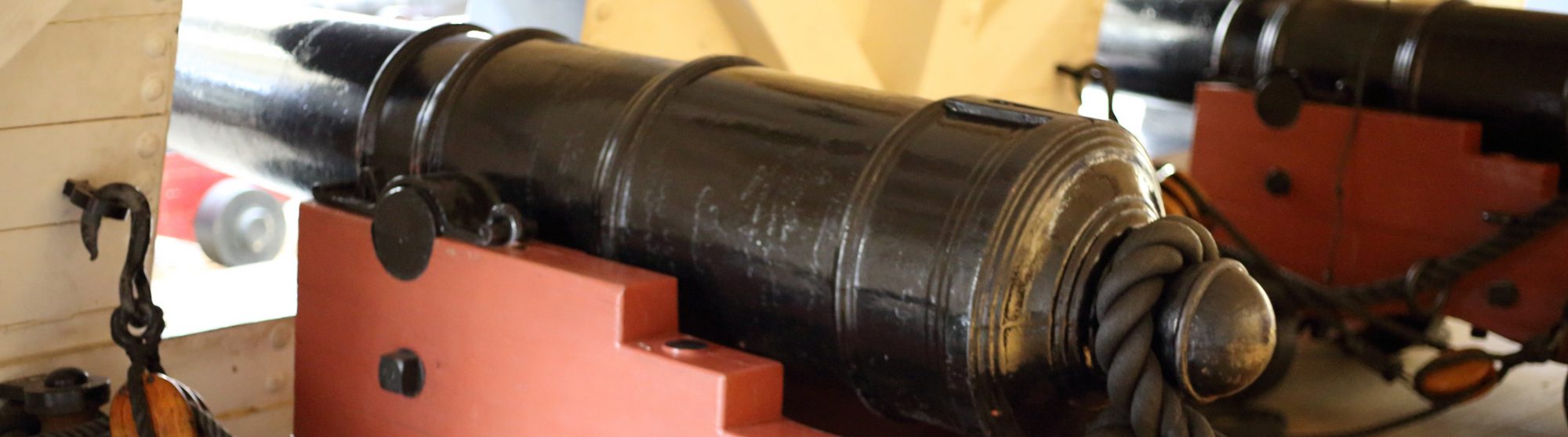
Battles of January 24 summaries plus museums, artwork, books

Battles of January 24 including descriptions of the battles, geographic locations, associated artwork, and museums where a person can find associated artifacts and artwork.

1. Battle of Turnhout

Date: January 24, 1597

War: Eighty Years’ War (also part of the Anglo-Spanish War)

Cause: Dutch forces led by Maurice of Nassau (Prince of Orange) sought to surprise and intercept a Spanish army column commanded by the Count of Varax, which was moving through the Turnhout area in the Spanish Netherlands.

Result: Decisive Dutch and English victory. The Spanish cavalry was driven off, and their infantry was routed with heavy casualties. The battle confirmed the effectiveness of Maurice’s military reforms and modern cavalry tactics.

Paintings & Art Painting: The Battle of Turnhout (Engraving) Artist: Jacques de Gheyn II Year: 1597

Painting: View of the Battle of Turnhout (Etching) Artist: Jan Luyken Year: Circa 1679

Museums & Artifacts

  • Rijksmuseum (Amsterdam, Netherlands): Holds original prints and engravings by Jacques de Gheyn II depicting the battle, as well as weaponry from the Eighty Years’ War era.
  • The British Museum (London, United Kingdom): Collections include the rare 1597 engraving of the battle by Jacques de Gheyn II, commissioned by the States General immediately after the victory.
  • Taxandria Museum (Turnhout, Belgium): Focuses on the history of the Turnhout region, including archaeological finds and information regarding the 1597 battle.

Location General: Turnhout, Belgium (specifically the Tielenheide heathland south of the town).

Coordinates: 51°19′21″N 04°56′41″E

Recommended Book The Dutch Army and the Military Revolution, 1588–1688 by Olaf van Nimwegen.


2. Battle of Spion Kop

Date: January 23–24, 1900 (The battle climaxed and the British retreated on the 24th)

War: Second Boer War

Cause: British forces under General Sir Redvers Buller launched an offensive to break through the Boer defensive line along the Tugela River to relieve the besieged town of Ladysmith. The seizure of the hill Spion Kop was seen as key to commanding the area.

Result: Boer victory. After a bloody and confused battle on the cramped summit involving intense close-quarters fighting and shelling, the British withdrew, suffering heavy casualties.

Paintings & Art Painting: Going Out to the Attack on Spion Kop on January 24, 1900 Artist: Richard Caton Woodville II Year: 1900

Painting: The Battle of Spion Kop (Chromolithograph) Artist: Kurz and Allison Year: 1900

Museums & Artifacts

  • KwaMuhle Museum (Durban, South Africa): Contains exhibits and artifacts relating to the history of the region and the Boer War.
  • Imperial War Museum (London, United Kingdom): Holds extensive collections of uniforms, weaponry, and personal letters from soldiers who fought in the Boer War.
  • Spion Kop Battlefield Memorials (KwaZulu-Natal, South Africa): An open-air museum site with trenches, mass graves, and memorials to the British and Boer soldiers who fell there.
  • War Museum of the Boer Republics (Bloemfontein, South Africa): Dedicated to the Boer experience of the war, housing art and artifacts.

Location General: Spioenkop hill, near Ladysmith, KwaZulu-Natal, South Africa.

Coordinates: 28°39′00″S 29°30′59″E

Recommended Book Hill of Squandered Valour: The Battle for Spion Kop, 1900 by Ron Lock.


3. Battle of the Dogger Bank

Date: January 24, 1915

War: World War I

Cause: British naval intelligence intercepted and decoded German radio signals revealing a plan by the German High Seas Fleet to raid the British fishing fleet and coast. The British Grand Fleet sortied to intercept the German squadron in the North Sea.

Result: British tactical victory. The German armored cruiser SMS Blücher was sunk, and the German flagship Seydlitz was heavily damaged. The British flagship HMS Lion was also damaged, but the German fleet was forced to retreat.

Paintings & Art Painting: The Sinking of the Blücher Artist: William Lionel Wyllie Year: Circa 1915

Painting: Dogger Bank 1915 Artist: Willy Stoewer Year: 1915

Museums & Artifacts

  • National Maritime Museum (Greenwich, United Kingdom): Holds the papers of Admiral David Beatty (British commander at the battle) and various naval paintings of the engagement.
  • Imperial War Museum (London, United Kingdom): Houses naval guns, ship models, and photographic archives of the battle, including dramatic photos of the sinking Blücher.
  • Marine-Ehrenmal Laboe (Laboe, Germany): The German Naval Memorial which commemorates sailors of all nationalities lost at sea, with specific history regarding the High Seas Fleet.

Location General: The Dogger Bank, a large sandbank in the middle of the North Sea.

Coordinates: 54°33′28″N 05°27′50″E

Recommended Book The Battle of the Dogger Bank: The First Dreadnought Engagement by Tobias R. Philbin.

Books for sale

WarScholar Press

Contact Information

For more “Military History Inside Out” please follow me at www.warscholar.org, on Facebook at warscholar, on twitter at Warscholar, on youtube at warscholar1945 and on Instagram @crisalvarezswarscholar. Or subscribe to the podcast on Apple Podcasts | Google Podcasts | Stitcher | Spotify

Tags: military museum, military artwork, battles, Military History, War History, Battle Art, War Paintings, War Art, Military Art, Museum Visit, Art History, Historical Artifacts, Museum Collection, Battlefield Tours, History Museum, Museum Life, History In Art, Historic Preservation, January 24, On This Day, History, Military History, War History, Historical Events, History Buff, World History, Spion Kop, Boer War, Dogger Bank, WWI, Naval History, Battle Of Turnhout, Eighty Years War, Royal Navy, Dutch History, South African History

As an Amazon Associate I earn from qualifying purchases.
Military History Inside Out banner

Battles of January 21 summaries plus museums, artwork, books

Battles of January 21 including descriptions of the battles, geographic locations, associated artwork, and museums where a person can find associated artifacts and artwork.

  1. Battle of Khe Sanh
    Date: January 21-July 9, 1968

War: Vietnam War

Cause: The People’s Army of Vietnam (PAVN) launched a massive artillery bombardment and ground siege against the U.S. Marine Corps combat base at Khe Sanh, aiming to seize the strategic location near the DMZ and divert U.S. attention before the Tet Offensive.

Result: Tactical U.S. victory; the base held out through the 77-day siege due to massive air support (Operation Niagara), though it was voluntarily abandoned by American forces shortly after the siege was lifted, making it a strategic subject of debate.

Paintings & Art Painting: Helmets at Que Sanh II (also known as Khe Sanh, Tet, Hue City) Artist: Colonel Peter Michael Gish

Year: 1976 (Approximate completion)

Museums & Artifacts

National Museum of the Marine Corps (Triangle, Virginia, USA): Features an immersive “Siege of Khe Sanh” exhibit where visitors walk through a CH-46 helicopter into a reconstructed bunker environment. Khe Sanh Victory Museum (Quảng Trị Province, Vietnam): Located at the former Ta Con Airfield, this open-air museum preserves original bunkers, aircraft, and trenches on the actual battlefield.

Location General: Khe Sanh Combat Base, Quảng Trị Province, Vietnam

Coordinates: 16.6554° N, 106.7286° E

Recommended Book

Valley of Decision: The Siege of Khe Sanh by John Prados and Ray W. Stubbe.

  1. British Capture of Tobruk

    Date: January 21, 1941 (Attack commenced; city fell Jan 22)

War: World War II (Western Desert Campaign)

Cause: As part of Operation Compass, British and Commonwealth forces (spearheaded by the Australian 6th Division) attacked the Italian-fortified port of Tobruk to secure a vital supply hub and drive Axis forces out of Cyrenaica (Libya).

Result: Decisive Allied victory; the port was captured along with over 25,000 Italian prisoners, securing the logistics needed to continue the advance west, though the town would later become famous for the subsequent siege.

Paintings & Art Painting: Central Square, Tobruk Artist: Ivor Hele

Year: 1941

Museums & Artifacts

Australian War Memorial (Canberra, Australia): Holds the cited painting by official war artist Ivor Hele, along with extensive diaries, uniforms, and weaponry from the “Rats of Tobruk.” Imperial War Museum (London, UK): Houses significant collections related to the Western Desert Campaign, including captured Italian equipment and British desert gear.

Location General: Tobruk, Libya

Coordinates: 32.0772° N, 23.9603° E

Recommended Book

Operation Compass 1940–41: Wavell’s Whirlwind Offensive by Jon Latimer.

  1. Third Battle of Dijon

    Date: January 21-23, 1871

War: Franco-Prussian War

Cause: The Prussian Army, seeking to protect the flank of their forces besieging Belfort, attacked the city of Dijon which was defended by the “Army of the Vosges”—a volunteer corps of French partisans and international volunteers commanded by the Italian revolutionary Giuseppe Garibaldi.

Result: French (Republican) victory; Garibaldi’s forces successfully repelled the Prussian attacks over three days and captured a German regimental flag, marking one of the few French successes in the war before the armistice.

Paintings & Art Painting: Garibaldi a Digione (Garibaldi in Dijon) Artist: Sebastiano De Albertis

Year: 1877

Museums & Artifacts

Museo del Risorgimento (Milan, Italy): Houses the painting by Sebastiano De Albertis and various artifacts belonging to Garibaldi and his volunteers. Musée de la Vie Bourguignonne (Dijon, France): Contains local history exhibits that cover the occupation and defense of Dijon during the war.

Location General: Dijon, France

Coordinates: 47.3220° N, 5.0415° E

Recommended Book

The Franco-Prussian War: The German Conquest of France in 1870-1871 by Geoffrey Wawro.

Books for sale

WarScholar Press

Contact Information

For more “Military History Inside Out” please follow me at www.warscholar.org, on Facebook at warscholar, on twitter at Warscholar, on youtube at warscholar1945 and on Instagram @crisalvarezswarscholar. Or subscribe to the podcast on Apple Podcasts | Google Podcasts | Stitcher | Spotify

Tags: military museum, military artwork, battles, Military History, War History, Battle Art, War Paintings, War Art, Military Art, Museum Visit, Art History, Historical Artifacts, Museum Collection, Battlefield Tours, History Museum, Museum Life, History In Art, Historic Preservation, January 21, On This Day, History, Military History, War History, Historical Events, History Buff, World History, Khe Sanh, Vietnam War, USMC, Tobruk, WWII, Operation Compass, Rats Of Tobruk, Battle Of Dijon, Franco Prussian War, Garibaldi

As an Amazon Associate I earn from qualifying purchases.
Military History Inside Out banner

WORLD WAR II – Battle of the Bulge December 16, 1944 – January 28, 1945 – An introduction and timeline of major events

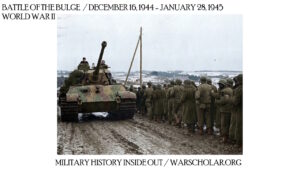
Colorized historic photo of US prisoners of the Germans at the Battle of the Bulge

This podcast episode is a work of historical fiction written to teach listeners, in an entertaining way, about the background and major events that happened during the battle.

Youtube link for the episode with colorized versions of historic black and white battle photos:

https://youtu.be/X3xKisA808k

Books for sale

Ardennes 1944: The Battle of the Bulge by Antony Beever

Battle: The Story of the Bulge by John Toland

The Longest Winter: The Battle of the Bulge and the Epic Story of WWII’s Most Decorated Platoon by Alex Kershaw

WarScholar Press

Contact Information

For more “Military History Inside Out” please follow me at www.warscholar.org, on Facebook at warscholar, on twitter at Warscholar, on youtube at warscholar1945 and on Instagram @crisalvarezswarscholar. Or subscribe to the podcast on Apple Podcasts | Google Podcasts | Stitcher | Spotify

Tags: WWII, US, Germany, Battle of the Bulge

As an Amazon Associate I earn from qualifying purchases.

Military History Inside Out banner