Medieval knight art and history book – “A Knight for the Ages” (J. Paul Getty Museum, 2018) – Elizabeth Morrison interview

Dr. Elizabeth Morrison holds a PhD in Medieval art and is senior curator of manuscripts at the J. Paul Getty Museum of Los Angeles.  We spoke about her recent book on a manuscript extolling the life of famous medieval Knight Jacques de Lalaing.

1:01 – Elizabeth talks about how she got into studying medieval art and knights.

2:42 – Elizabeth talks about the book and the manuscript that the book is about. The knight that the manuscript is about represents a transition from medieval to Renaissance warfare.

6:45 – Elizabeth talks about chivalric biographies.

15:57 – Elizabeth talks about the historical background and historical accuracy of the manuscript.

19:56 – Elizabeth talks about the resources used for the research for the book.

34:35 – Elizabeth talks about how the Getty realized that the manuscript had a different creation date than what had been originally believed.

37:33 – Elizabeth talks about the Getty’s conservationist scientists and technologies.

47:00 – Elizabeth’s works can be found at the Getty bookstore online.

Links of interest

http://blogs.getty.edu/iris/author/emorrison/

For more “Military History Inside Out” please follow me on Facebook at warscholar, on twitter at Warscholar, on youtube at warscholar1945 and on Instagram @crisalvarezswarscholar

Guests: Elizabeth Morrison

Host: Cris Alvarez

Tags: military, history, military history, conflict,war, interview, non-fiction book, Burgundy, art history, library history,medieval art, French knights, knights, 15th century, artillery,renaissance, Simon Bening, Jacques de Lalaing, Ghent wars, France, French history, Burgundian court

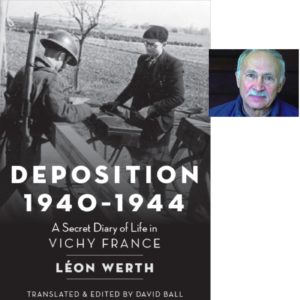
WWII and Vichy France history book – “Deposition 1940-1944” (Oxford University Press, 2018) – David Ball interview

David Ball has studied the French language and French life for many years and has taught it as a Professor. We talk about the book he recently translated, a memoir by Jewish Frenchman and acclaimed author Leon Werth about his life hiding in occupied France.

1:04 – David Ball talks about how he got into translating French and translating this work.

4:11 – David talks about he edited a 700 page diary down to elements English readers would be interested in. He focuses on daily life in Vichy France.

6:00 – David compares this work to a memoir titled “The Dark Years.”

8:40 – David talks about participation in the French Resistance.

10:32 – David talks about how Leon Werth ended up in the village in which he was hiding.

14:20 – David talks about leon’s attitudes towards the crushing defeat in 1940.

18:54 – David talks about the language used in the diary and how he translated it.

23:45 – David talks about what kind of man Leon Werth was.

31:05 – David talks about Leon’s experiences and writings in WWI.

32:24 – David talks about how Leon recorded the Battle of Stalingrad.

39:03 – David talks about how Leon was worried about Hitler’s New World Order. He was also worried about a post-war civil war in France.

46:54 – David talks about Leon’s early awareness of the existence of the concentration camps.

58:13 – David talks about the passages on the liberation of Paris and reads them. The Germans and the Vichy government called the Resistance fighters terrorists.

Links of interest

https://global.oup.com/academic/product/deposition-1940-1944-9780190499549?cc=us&lang=en&

https://global.oup.com/academic/product/diary-of-the-dark-years-1940-1944-9780199970865?cc=us&lang=en&

For more “Military History Inside Out” please follow me on Facebook at warscholar, on twitter at Warscholar, on youtube at warscholar1945 and on Instagram @crisalvarezswarscholar

Guests: David Ball

Host: Cris Alvarez

Tags: military, history, military history, conflict, war, interview, non-fiction book, leon Werth, Vichy France, Occupied France, Germany, WWII, World War 2, de Gaulle, concentration camps, Liberation of Paris

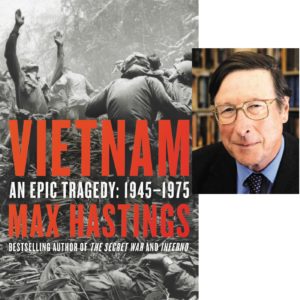
Vietnam War history book – “Vietnam An Epic Tragedy: 1945-1975” (Harper, 2018) – Sir Max Hastings interview

Sir Max Hastings reported on the Vietnam War early in his prolific career as a journalist. He’s been a BBC correspondent, editor-in-chief of The Daily Telegraph, and editor of The Evening Standard. He’s written numerous books on military matters and has won numerous awards. We spoke about his most recent book on the Vietnam War.

1:01 – Sir Max explains how he got into writing on the Vietnam War. When he first reported on the war he didn’t think he’d end up writing a book on the war.

4:30 – Sir Max wants to make sure that readers understand the atrocities that the North Vietnam was inflicting on people that were hidden from view during the war.

6:39 – Sir Max discusses the problems with South Vietnam leadership.

9:00 – Sir Max talks about how Ho Chi Minh was able to control the situation in Vietnam. He also talks about the mistakes the French made in Vietnam.

12:43 – Sir Max talks about what he chose to tell in this 30 year story. He talks about he drove around the US to interview people who had been in the war, both veterans and Vietnamese.

15:01 – Sir Max talks about interviewing former Air Force navigator and Vietnam POW Norm McDaniel. He also discusses the touching reminisces of a nurse who was in Vietnam.

18:02 – Sir Max talks about the main themes of the book. He believes in the use of force to protect national interest but cultural and social links are needed between the US and the place they are operating in.

20:33 – Sir Max talked to retired Marine General Walt Boomer who provided Sir Max with important thoughts on Vietnam.

22:44 – Sir Max talks about the problems with sustaining public support for the Vietnam War.

24:42 – Sir Max compares British support for the Falklands Islands War to American support for Vietnam.

27:24 – Sir Max talks about the research he did. He used the Marine Corps and the Army historical archives. He also consulted with a retired CIA officer and Vietnamese linguist who has been translating Vietnamese documents, North and South, on the war for decades. Sir Max talks about Vietnamese information he got on a disastrous Marine battle at Di-do. He also came across a North Vietnam novel which was a thinly veiled history of the war from the North Vietnamese side.

31:38 – Sir Max has included material on what was going on in North Vietnam too. All the North Vietnamese thought about was food since they had so many problems with getting it.

33:10 – Sir Max also interviewed Doug Ramsey who was a Vietnam POW for seven years. Despite the ordeal, Doug had a couple of amusing anecdotes about his time.

35:14 – His favorite part of the research was talking to people.

36:48 – Sir Max talks about an interview he did with a former corpsman who often goes to the Vietnam War memorial in Washington, DC.

40:18 – Sir Max mentions having a good interpreter in Hanoi when he did research there.

42:24 – Sir Max mentions a sobering talk with a Holocaust victim.

45:00 – The Chinese and Soviets wanted out of Vietnam almost as much as the US did.

46:53 – Both North and South Vietnam became police states.

49:22 – Sir Max talks about how the media was handled during the war.

50:27 – Sir Max talks about the time he saw a dead soldier’s guts spilling out and how it affected him.

55:23 – Sir Max talks about the Troubles in Ireland which he covered extensively as a journalist. He mentions how US troops had not been taught street fighting even though they ended up having to do it.

1:02:45 – Sir Max had help from a Russian translator who helped with getting information on Russian air defense units in Vietnam.

For more “Military History Inside Out” please follow me on Facebook at warscholar, on twitter at Warscholar, on youtube at warscholar1945 and on Instagram @crisalvarezswarscholar

Guests: Sir Max Hugh Macdonald Hastings

Host: Cris Alvarez

Tags: military, history, military history, conflict, war, interview, non-fiction book, vietnam war, ho chi minh, france, United States, Irleand, the Troubles, POWs