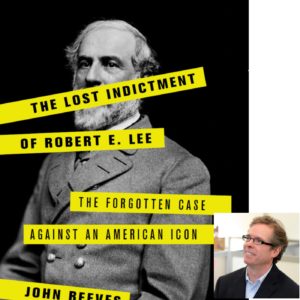
US Civil War history book – “The Lost Indictment of Robert E. Lee” (Rowman & Littlefield, 2018) – John Reeves interview

John Reeves has taught history and written about financial matters. He’s written a new US Civil War book on the indictment of Robert E. Lee after the war. I interviewed him about it.

1:38 – John Reeves taught history for 15 years. He also wrote on finance for some time.

3:15 – Robert E. Lee tried to bring North and South together after the war. But Northerners wanted to punish him for treason and bring charges against him.

5:36 – Lee applied for amnesty against the charges and studied ways to defend himself.

9:14 – Lee kept his letters privates because he didn’t want to seem to be playing politics.

12:38 – Lee and his fellow defendants weren’t jailed during the trial because of Grant’s insistence that he had made a deal for the Southern leaders to be free until the war was officially over. The war officially ended in August 1866. Jefferson Davis didn’t have this protection though.

16:35 – The defendants were indicted in Virginia because they were accused of making treasonous war in Virginia.

19:37 – Lee defended himself on the merits of the case. He also had to go to DC to testify before a Congressional committee about treason. He was advised by a lawyer, Senator Johnson from Maryland.

23:52 – Lee was called as a witness for the Davis trial.

27:32 – John’s first step was to find the indictment itself. They seemed to have been lost but John discovered they were in the state library of Virginia in Richmond.

33:32 – John found many documents at the Library of Congress including Lee’s papers. But people don’t have permission to look in one box of Lee’s papers. Andrew Johnson’s papers are there too.

38:37 – Lee was accused of treating his slaves brutally.

44:34 – The defense of Lee became entwined with the Lost Cause movement. Robert E. Lee was even in a stained glass window in the National Cathedral.

49:40 – The failure of the indictments provides an idea as to why Reconstruction failed.

56:19 – John is on twitter at reevesjw. His website is john-reeves.com.

Links

http://www.john-reeves.com/

For more “Military History Inside Out” please follow me on Facebook at warscholar, on twitter at Warscholar, on youtube at warscholar1945 and on Instagram @crisalvarezswarscholar

Guests: John Reeves

Host: Cris Alvarez

Tags: military, history, military history, conflict, war, interview, non-fiction book, robert e. lee, civil war, confederates, union, lost cause, arlington, gettysburg, lincoln, andrew johnson, jefferson davis

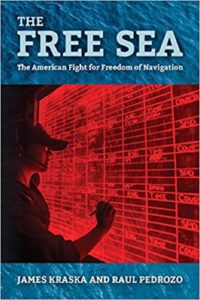
US Naval history book – “The Free Sea” (Naval Institute Press, 2018) – James Kraska interview

James Kraska was a Judge Advocate General for the US Navy and has extensive experience on defense issues and Freedom of Navigation issues. He’s currently a visiting Professor of Law at the Naval War College. He has co-authored a book on the history of US enforcement of Freedom of Navigation and we spoke about the book.

1:56 – Professor. Kraska was a Navy Judge Advocate lawyer and in this capacity he learned and practiced the law regarding Freedom of Navigation. He taught at the Naval War College and completed a degree on the subject. Raul Pedroza, the other author, is also a retired Navy JAG and a professor of law.

3:55 – It has been imperative for the US to protect the sea for economic and security purposes. The book is a mix of history and law on Freedom of Navigation. The book starts with the Quasi-War with France and continues all the way through the current Chinese attempts to assert unlawful control of regional seas.

6:55 – The US defends Freedom of Navigation globally because no one else will do it. Many countries depend on the US to maintain order at sea. The Dutch enforced freedom of the seas in the 1500s and then the British took over enforcing these global rights.

8:57 – The US took over from the British around the 1880s. By 1945, the US had fully assumed the role of protecting freedom of the seas.

11:00 – Freedom of navigation is a continuous struggle to maintain these freedoms. The Gulf of Tonkin and Pueblo incidents are examples of violent conflict involving freedom of navigation.

12:37 – Political will and military capability are needed to maintain freedom of navigation. Territorial seas are part of the global commons. The US has operated on territorial seas and also on high seas to protect navigation freedoms. Surveillance aircraft are also used to maintain freedom of navigation on the seas.

17:31 – Using international airspace to protect the seas has been developing for the last hundred years. The International Civil Aviation organization also supports airspace use to protect Freedom of Navigation.

19:00 – The threat of piracy greatly declined by the 20th century as states have cohered into stronger entities. Piracy existed around Somalia because it was a failed state. Before the Treaty of Paris in 1856, many states used privateers to attack enemy shipping. After the treaty, states agreed to stop using privateers. Since then, threats to freedom of navigation come from nation states.

21:40 – Chinese actions now are the greatest threats to freedom of navigation since Germany’s U-boat wars. During the Cold War, the US and Soviet Union worked in tandem to preserve navigational freedoms.   The Soviet Union needed it more than the US due to the location of their bases. China wants to undo parts of the international agreements on freedom of navigation and keep others out of the waters close to their territory. They want to dominate the seas within the first island chain including the South China Sea and the East China Sea.

27:56 – During WWII, Japan wanted to control the seas around East Asia through war. China is trying to achieve the same goal but through a “Finlandization” of its neighbors. China has used fishing claims to try to assert control in these areas but that doesn’t work within the existing international agreements.

32:57 – The main focus of the book is that freedom of the seas is not a condition that [exists] can exist without promotion and protection. If the US stops exercising rights over global seas, then these rights will erode for all nations.

34:45 – Wilson called for a protection of freedom of navigation by all nations and for all nations. Roosevelt also insisted on maintaining these global rights. A group of united nations met during WWII to maintain rights and later they met after the war to form the United Nations.

37:27 – Both authors have extensive experience in this field especially for events over the last 15 years and beyond. They used CIA archives and presidential libraries to do some research.

39:00 – Washington saw the US as a liberal actor that supported all nations and conducted trade with all as well. But European politics continued to drag the US into conflict and affected trade.

42:50 – He was most moved by the sacrifices made to protect US interests. John Negroponte made an impassioned speech on freedom of the seas to remind people how much US security depended on freedom of the seas.

44:58 – His next writing project might be on the free seas from the British perspective. He’s also working on a project about Japan’s relationship with sea.

45:35 – Many of his articles are on the SSRN.

Links

https://www.ssrn.com/en/

For more “Military History Inside Out” please follow me on Facebook at warscholar, on twitter at Warscholar, on youtube at warscholar1945 and on Instagram @crisalvarezswarscholar

Guests: James Kraska

Host: Cris Alvarez

Tags: military, history, military history, conflict, war, interview, non-fiction book, freedom of the seas, freedom of navigation, China, US, Britain, Germany, Japan, East China Sea, South China Sea, Quasi-War, Pueblo incident, WWII
WWII history book – “No Forgotten Fronts” (Naval Institute Press, 2018) – Lisa Shapiro interview


Professor Lisa Shapiro holds masters degrees in literature and management and teaches at San Diego Mesa College. She has previously taught creative writing. She’s written a book based on thousands of archived letters sent by San Diego State students who were in WWII to their professor Dr. Post. I interviewed Professor Shapiro about the book titled “No Forgotten Fronts.”
1:54 – Professor Shapiro talks about her first historical project. It dealt with European medieval historical fiction. Her interest in WWII came out of her work with community college students in San Diego.
3:57 – She began studying war literature and got a second degree in that subject. In the school archives she found letters written to a professor during WWII.
5:46 – Professor Shapiro explains the basis and details of the book. It’s a collection of student letters written to their professor, Dr. Post. He turned the letters into a regular newsletter. He did this through the entire war.
10:16 – Several hundred students participated in writing to Dr. Post. This includes men and women and many wrote repeatedly. People also provided funds to support him. The original documents are in the San Diego State college archives.
12:16 – Professor Shapiro discusses how the US military censors worked with Dr. Post. He took care to keep out sensitive information out of his newsletters.
16:35 – Sometimes students wrote things only for Dr. Post and not the newsletter.
17:16 – Dr. Post was also able to connect two brothers, one of whom was a prisoner of war during the war. Dr. Post even visited their mother to provide reassurance about her sons. One student who was at Anzio wrote that he had lost his marbles and Dr. Post knew he needed some mental comfort. Dr. Post notified a nearby chaplain in Europe from San Diego State to visit this soldier and also gave comfort to the student’s father.
22:54 – Professor Shapiro explains how Dr. Post got information on killed or injured students and how he dealt with that information. Dr. Post would also update information he had published.
27:57 – Dr. Post didn’t have any children. Professor Shapiro discusses how Dr. Post met his wife in college. But both were active in the lives of their students. He also did trick roping and performed for his students. His wife was a singer. Dr. Post did have a nephew in the Marines who would write to Dr. Post.
30:36 – There don’t seem to have been any other people who collected letters from specific groups during WWII. Others have created letter collections after wars.
34:43 – The students loved getting the newsletters.
36:07 – Professor Shapiro focused on the letters that captivated her. The emotion of the letters touched her. She was able to track the stories of specific individuals.
40:28 – Professor Shapiro reads a letter from Herman Adelson who nicknamed himself Little Geronimo since he was a paratrooper. He and the others really believed in what they were fighting for. For good, freedom and democracy.
43:22 – A letter arrived for Dr. Post saying that Herman had died during D-Day and included a eulogy for him. San Diego State lost three members of their championship basketball team during the war. But the community found comfort in knowing what their loved ones had been doing.
48:29 – Professor Shapiro did a lot of reading to brush up on her knowledge of WWII and current events at the time the letters were written. She used Anthony Deevers’ history. She also read a lot of San Diego history. San Diego had a lot of women participate in the war. A lot of San Diego State students became pilots.
53:40 – Professor Shapiro had few problems getting the book published. She had to shorten the book since it was very long at first.
55:02 – Grif Williams was one of the students and was famous for being on the Doolittle Raid. He was taken prisoner eventually and he was eventually a cellmate with another San Diego State student who had been captured in Germany.
59:26 – The website for the book is NoForgottenFronts.com.

For more “Military History Inside Out” please follow me on Facebook at warscholar, on twitter at Warscholar, on youtube at warscholar1945 and on Instagram @crisalvarezswarscholar

Guests: Lisa Shapiro
Host: Cris Alvarez
Tags: war, military, WWII, WWII history, san diego, san diego state, pacific war, d-day, north africa, europe, germany, doolittle raid, anzio