Renaissance warfare history book – “Renaissance Mass Murder” (Oxford University Press, 2019) – Stephen Bowd interview

Dr. Stephen Bowd studied and Medieval and Renaissance studies now teaches at the University of Edinburgh.  We talked about his latest book on military mass murders committed during the Italian Wars of the early 16th century.

0:46 – Stephen talks about how he got into writing on massacres during the italian Wars.

2:25 – The book covers the years 1494 to about 1530.

3:18 – The book is broken into sections on mass murder events, what the soldiers thought of murders, what the civilian thought, theories behind mass murder in war, and comparisons to other mass murders.

6:37 – Stephen talks about massacres associated with military activity and those that were between military activities.

9:05 – Stephen talks about the attitudes of soldiers towards civilians.

11:15 – Stephen talks about the nationalities of the various armies involved in these massacres.

13:45 – Stephen talks about the plunder taken in towns during these wars.

15:00 – Stephen talks about the sack of Rome.

16:19 – Stephen talks about the levels of lawlessness in these massacres and seiges.  But there also sometimes plans drawn up for these massacres.

19:30 – Some soldiers feared that peace talks would lead to less plunder for them after the siege or battle ends.

21:47 – Stephen talks about what weapons were used for these massacres.

23:38 – Stephen talks about the numbers of people massacred.

26:30 – Stephen talks about women who trained in arms to defend their towns.

41:00 – Stephen talks about Machiavelli’s views on the murder of civilians.

45:52 – Stephen talks about Protestant-Catholic divisions and these massacres.

48:27 – Stephen discusses how these massacres shape art and the Renaissance.

55:55 – Stephen’s work can be found by googling “Shadow Agents of War.”

 Links of interest

https://global.oup.com/academic/product/renaissance-mass-murder-9780198832614?cc=us&lang=en&
https://www.ed.ac.uk/history-classics-archaeology/about-us/staff-profiles/profile_tab1_academic.php?uun=sbowd

For more “Military History Inside Out” please follow me on Facebook at warscholar, on twitter at Warscholar, on youtube at warscholar1945 and on Instagram @crisalvarezswarscholar

Guests: Stephen Bowd

Host: Cris Alvarez

Tags: military, history, military history, conflict, war, interview, non-fiction book, German landsknechts, italian wars, massacres, soldiers, French, Barbarians, Spanish,

Institute of Historical research, Hugo Grotius, Machiavelli, Rome, Raphael, Leonardo da Vinci
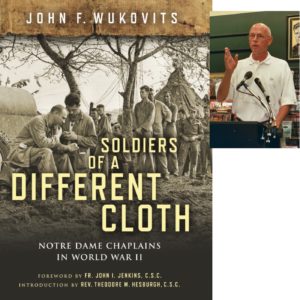
WWII history book – “Soldiers of a Different Cloth” (University of Notre Dame Press, 2018) – John Wukovits interview

John Wukovits has been studying, teaching, and writing history for over thirty years. His focus is WWII and we spoke about his latest book on Notre Dame chaplains who served in WWII.

1:17 – John talks about how he got into writing this book. He’s been writing books on WWII for 25 years. These chaplains were on many fronts and one even parachuted into Normandy. He tells the story of 35 Notre Dame missionaries and chaplains.

4:00 – John focused on 4 or 5 main [characters] chaplains but he also touches on the rest of the chaplains.

6:30 – John talks about the civilian capacities of these chaplains before they entered the war.

9:00 – The chaplains had to do the same basic training as all the younger soldiers they’d be serving.

14:30 – Father Joe Barry is one of the main persons discussed in the book. He went through many battles and ended up in prison. He received lots of praise from his fellow soldiers.

25:55 – The chaplains’ letters were often not very censored when sent back to the US. John found that many of these letters hadn’t been read by other historians.

27:00 – John talks about a parachute rescue of some missionaries in the Philippines. A couple of chaplains were on the Bataan Death march.

31:15 – John talks about a chaplain who jumped into France with the 101st and what he encountered. The chaplain met one of the Niland brothers and found the grave of another brother.

47:30 – John tells a story about Father Barry hearing a soldier talk the night before a big battle. The next day Father Barry held the same dying soldier in his arms.

58:17 – John has a website, johnwukovits.com. He’ll also sign books bought from his website.

Links of interest

https://johnwukovits.com/

For more “Military History Inside Out” please follow me on Facebook at warscholar, on twitter at Warscholar, on youtube at warscholar1945 and on Instagram @crisalvarezswarscholar

Guests: John Wukovits

Host: Cris Alvarez

Tags: military, history, military history, conflict, war, interview, non-fiction book, WWII, World War II, Notre Dame, chaplains, diocese, Los Banos, Philippines

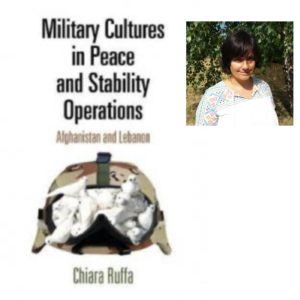
Modern warfare history book – “Military Cultures in Peace and Stability Operations” (University of Pennsylvania Press, 2018) – Chiara Ruffa interview

Dr. Chiara Ruffa has recently published a book about military culture. It’s based on her research with French and Italian military units that had deployed to Lebanon and Afghanistan. I spoke to her about the book.

2:20 – In 2006, Chiara was working for the UN in the Central African Republic in support of the peacekeeping mission. This inspired her interest in the topic this book is about and in her graduate studies.

4:04 – While the book focuses on current events, it traces the military cultures of France and Italy from the 19th century. These cultures affects how militaries carry out their mandates.

8:00 – Peacekeeping operations are a very particular type of operation in that there is much more latitude in interpreting the mission and how to carry it out.   This is important because of the high volume of peacekeeping operations being carried out.

13:53 –Chiara would like multi-national forces to be more open in talking about cultural characteristics of units that are deployed.

17:00 – Military culture is most important at the service level.

25:00 – NATO has standardized much of the ways in which peacekeeping is done however cultures create variations.

26:05 – French military culture has revolved around assertiveness since the Revolution. But this was modified when de Gaulle in 1962 reaffirmed the idea of civilian control over the military.

30:18 – Italy had a shift in military culture that was affected by WWII and by the Cold War. Italian officers push for using the Italian military for peacekeeping. Italy has a change in the culture in the 1990s.

34:13 – Chiara’s first problem in the research was how she would collect data on these militaries. She didn’t have much access to begin with. She started by going to Lebanon and working with French and Italian troops.

46:50 – Chiara had to learn about military organizations from scratch when she started her research.

48:30 – Chiara still wonders how cultures shape Standard Operating Procedures.

1:01:00 – The book will hopefully cross the gap between security studies and peace studies in Europe.

1:05:45 – She’s on twitter at Ruffa.Chiara.

For more “Military History Inside Out” please follow me on Facebook at warscholar, on twitter at Warscholar, on youtube at warscholar1945 and on Instagram @crisalvarezswarscholar

Guests: Chiara Ruffa

Host: Cris Alvarez

Tags: military, history, military history, conflict, war, interview, non-fiction book, France, Italy, Afghanistan, Lebanon, peacekeeping, stability, operations