Battles of January 28 summaries plus museums, artwork, books and songs

Battles of January 28 including descriptions of the battles, geographic locations, associated artwork, and museums where a person can find associated artifacts and artwork.

Songs of the day:

Morgan’s Way to Panama variation 1 (Sea Shanty English point of view)

Morgan’s Way to Panama variation 2 (Sea Shanty English point of view)

Panama’s Golden Cup variation 1 (Spanish Baroque Spanish point of view)

Panama’s Golden Cup variation 2 (Spanish Baroque Spanish point of view)

1. Battle of Aliwal

Date: January 28, 1846

War: First Anglo-Sikh War

Cause: The battle was triggered by the Sikh army, led by Ranjodh Singh Majithia, crossing the Sutlej River into British-held territory to cut off British supply lines. The British forces, under Sir Harry Smith, moved to intercept them.

Result: A decisive British victory. The British charge broke the Sikh infantry squares, leading to a rout across the river and the capture of the Sikh camp and artillery. This victory was a turning point in the war.

Paintings & Art

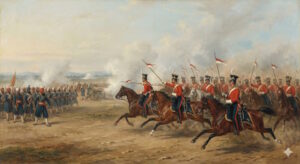
  • Painting: Charge of the 16th (Queen’s Own) Lancers at the Battle of Aliwal, 28 January 1846
  • Artist: Henry Martens (engraved by J. Harris)
  • Year: c. 1847

Museums & Artifacts

  • National Army Museum (London, United Kingdom): Holds the original watercolors and aquatints by Henry Martens and Michael Angelo Hayes depicting the battle, as well as uniforms and weaponry from the 16th Lancers.
  • The Queen’s Royal Lancers and Nottinghamshire Yeomanry Museum (Nottinghamshire, United Kingdom): Houses specific artifacts related to the 16th Lancers’ famous charge at this battle.

Location

  • General: Aliwal, Ludhiana District, Punjab, India.
  • Coordinates: 30°56′38″N 75°37′16″E

Recommended Book

Above: A painting in the style of Henry Martens depicting the decisive charge of the 16th Lancers against Sikh infantry at the Battle of Aliwal.

2. The January 28 Incident (First Battle of Shanghai)

Date: January 28, 1932

War: Undeclared Sino-Japanese War (Interwar Period)

Cause: Tensions boiled over after a staged incident where Japanese monks were beaten in Shanghai. Using this as a pretext, Japanese marines launched an attack on the Zhabei district of Shanghai to expand their control and suppress Chinese anti-Japanese boycotts.

Result: A military standoff that lasted over a month. While the Japanese eventually captured positions after heavy reinforcement, the fierce Chinese resistance forced a negotiated demilitarization of Shanghai rather than a total occupation at that time.

Paintings & Art

  • Painting/Print: Japan Invasion: January 28 or Shanghai Incident (Political Cartoon/Lithograph)
  • Artist: Bernard Partridge (for Punch Magazine)
  • Year: 1932

Museums & Artifacts

  • Shanghai Songhu Memorial Hall for the Anti-Japanese War (Shanghai, China): A massive museum located at the site of the battle, dedicated entirely to the 1932 and 1937 battles of Shanghai, featuring excavated weapons, uniforms, and extensive photographic archives.
  • National Museum of China (Beijing, China): Contains documents and artifacts relating to the 19th Route Army which defended the city.

Location

  • General: Zhabei District (now Jing’an District), Shanghai, China.
  • Coordinates: 31°15′00″N 121°27′00″E

Recommended Book

  • Shanghai 1932: The First Sino-Japanese War by Donald A. Jordan.

Imagined painting
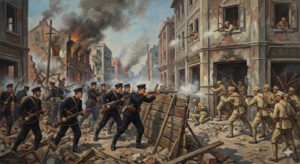
Above: A social realist painting from the 1930s depicting intense street fighting between Japanese marines and Chinese soldiers in the Zhabei district during the January 28 Incident.

3. Action of 28 January 1945

Date: January 28, 1945

War: World War II

Cause: A Royal Navy squadron comprising the cruisers HMS Diadem and HMS Mauritius intercepted a German destroyer flotilla attempting to move from Norway to the Baltic Sea to support the defense of the German homeland. Result: A strategic British success. One German destroyer was heavily damaged and the flotilla was forced to return to port, delaying their redeployment and exposing them to further air attacks, although no ships were sunk during the engagement itself.

Paintings & Art

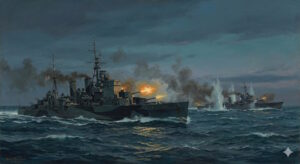
  • Painting: HMS Diadem (Naval portrait often associated with her late-war service)
  • Artist: Generic naval photography and draftsmanship from the Admiralty
  • Year: c. 1944–1945

Museums & Artifacts

  • Imperial War Museum (London, United Kingdom): Houses logs, reports, and photographic records of HMS Diadem and the Home Fleet’s actions off Norway.
  • Royal Naval Museum (Portsmouth, United Kingdom): Contains general artifacts related to the Dido-class and Fiji-class cruisers involved in the battle.

Location

  • General: North Sea, approximately 35 miles northwest of Bergen, Norway.
  • Coordinates: 60°48′00″N 4°30′00″E

Recommended Book

4. Seizure of Helsinki (Start of Finnish Civil War)

Date: January 28, 1918

War: Finnish Civil War

Cause: Following growing class tensions and the collapse of the Russian Empire, the Red Guards (socialist paramilitary) mobilized to seize control of the capital, Helsinki, from the conservative Senate.

Result: The Red Guards successfully took control of Helsinki on January 28, forcing the Senate to flee to Vaasa. This event effectively marked the outbreak of full-scale civil war in Finland.

Paintings & Art

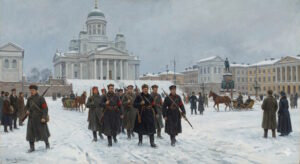
  • Painting: Red Guards on the March (Representative of the era/subject)
  • Artist: Various contemporary artists (e.g., works by Jalmari Ruokokoski depicting the Red side, though often later)
  • Year: c. 1918

Museums & Artifacts

  • Military Museum of Finland (Helsinki, Finland): Features a dedicated exhibition on the Civil War, including uniforms of both the Red and White Guards and weaponry used during the seizure of the capital.
  • The Lenin Museum (Tampere, Finland): Holds artifacts and history regarding the socialist movement and the revolution that sparked the war.

Location

  • General: Helsinki, Finland (Senate Square and Government Palace).
  • Coordinates: 60°10′10″N 24°57′09″E

Recommended Book

5. Battle of Mata Asnillos (Sack of Panama)

Date: January 28, 1671 (Old Style / Julian Calendar)

War: Anglo-Spanish Privateer Wars (Unofficial)

Cause: The famous privateer Henry Morgan led a massive expedition of buccaneers across the Isthmus of Panama. His goal was to capture Panama City (Panama Viejo), which was the richest city in the Spanish New World and the transit point for Peruvian silver. The Spanish governor, Don Juan Pérez de Guzmán, deployed his forces on the plains of Mata Asnillos outside the city to stop the pirates.

Result: Privateer/English Victory. Morgan’s forces used superior tactics to shatter the Spanish cavalry and infantry. The Spanish attempt to use a herd of oxen to stampede the pirates failed. Following the battle, Panama City was looted and burned to the ground (either by the Spanish to deny it to Morgan, or by the pirates), leading to the abandonment of the site and the founding of the modern Panama City (Casco Viejo) nearby.

Paintings & Art

  • Painting: The Sack of Panama (Illustration)
    • Artist: Howard Pyle
    • Year: c. 1900
  • Engraving: Battle of Mata Asnillos (Featured in The Buccaneers of America)
    • Artist: Jan Luyken (attributed)
    • Year: 1678
  • Painting: Morgan at Panama
    • Artist: Unknown (19th-century engraving)
    • Year: c. 1850

Museums & Artifacts

  • Patronato Panamá Viejo (Panama City, Panama): An open-air archaeological museum preserving the ruins of the original city destroyed after the battle. It contains weapons, ceramics, and items recovered from the ashes.
  • National Maritime Museum (Greenwich, United Kingdom): Houses maps and navigational instruments from the era of privateers and Henry Morgan.

Location

  • General: Panama Viejo, Panama City, Panama
  • Coordinates: 9.0075° N, 79.4850° W

Recommended Book

  • Empire of Blue Water: Captain Morgan’s Great Pirate Army, the Epic Battle for the Americas, and the Catastrophe That Ended the Outlaws’ Bloody Reign by Stephan Talty.
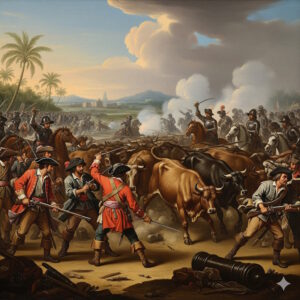
  • Imagined Painting
  • The Visualized Moment: The Failure of the Spanish Oxen Charge

    This painting depicts the decisive and most famous tactical moment of the battle on the plains outside Panama City. The Spanish defenders, outmatched by Henry Morgan’s battle-hardened privateers, attempted a desperate stratagem: they drove a massive herd of oxen and bulls toward the pirate lines, hoping the stampede would break their ranks and allow the Spanish cavalry to cut them down.

    The image captures the moment this tactic spectacularly backfired. Morgan’s sharpshooters fired volleys into the approaching herd. The noise and pain caused the animals to panic, turn aside, and stampede directly into the Spanish right wing, causing chaos among their own horsemen.

    Explanation of Pictorial Elements

    • The Stampeding Herd (Center): The bulls are the central focus of the action. They are shown mid-stampede, kicking up dust and creating a physical barrier between the two forces. Their direction—pushing toward the right side of the frame—visually represents them turning against their Spanish handlers.
    • Henry Morgan’s Privateers (Left Foreground):
      • Uniforms/Attire: They are dressed not in standardized military uniforms, but in the practical, motley attire of buccaneers of the era: loose trousers, rough shirts, waistcoats, and various headwear like bandanas and slouch hats. The prominent red coats worn by some figures represent common imported clothing of the time, often adopted by privateer leaders to denote status.
      • Action: They are shown holding their ground, firing muskets at the herd or preparing for close-quarters combat with cutlasses, representing the discipline Morgan managed to instill in his irregular force.
    • Spanish Cavalry (Right & Midground):
      • Attire: The Spanish forces are depicted with more formal military gear typical of European colonial garrisons, including metal breastplates, helmets (resembling late-era morions or burgonets), and high leather boots.
      • Action: They are shown in disarray. The horsemen on the right are struggling to control their mounts amid the stampeding bulls, illustrating the confusion that led to their defeat.
    • Background Elements:
      • Panama Viejo (Distance): In the far background, the walled city of Panama Viejo is visible. This establishes the high stakes of the battle—the richest city in the Spanish Main. The prominent tower hints at the cathedral tower that still stands as a ruin today.
      • Geography: The flat, dusty terrain represents the savanna of Mata Asnillos where the battle took place. Palm trees are included to emphasize the tropical location on the Isthmus of Panama.
    • Artistic Style: The painting emulates the Baroque battle painting style prevalent in the late 17th century. It uses dramatic lighting (chiaroscuro) to highlight the central action, thick smoke to convey the “fog of war,” and a somewhat stylized, theatrical composition meant to glorify the chaotic spectacle of the engagement.

Books for sale

WarScholar Press

Contact Information

For more “Military History Inside Out” please follow me at www.warscholar.org, on Facebook at warscholar, on twitter at Warscholar, on youtube at warscholar1945 and on Instagram @crisalvarezswarscholar. Or subscribe to the podcast on Apple Podcasts | Google Podcasts | Stitcher | Spotify

Tags: military museum, military artwork, battles, Military History, War History, Battle Art, War Paintings, War Art, Military Art, Museum Visit, Art History, Historical Artifacts, Museum Collection, Battlefield Tours, History Museum, Museum Life, History In Art, Historic Preservation, January 28, On This Day, History, Military History, War History, Historical Events, History Buff, World History, Battle Of Aliwal, Sikh Wars, Shanghai Incident 1932, 19th Route Army, WWII, Naval History, Royal Navy, Finnish Civil War, Helsinki 1918, Henry Morgan, Pirate History, Panama Viejo, National Army Museum, Imperial War Museum, Shanghai History

As an Amazon Associate I earn from qualifying purchases.

Military History Inside Out banner

Battles of January 25 summaries plus museums, artwork, books and songs

Battles of January 25 including descriptions of the battles, geographic locations, associated artwork, and museums where a person can find associated artifacts and artwork.

Songs of the day:

The Bulge Blues Variation 1 (1940s Swing)

The Bulge Blues Variation 2 (1940s Swing)

The Watch is Failed (1940s German Cabaret)

1. Battle of the Bulge (Conclusion)

Date: December 16, 1944 – January 25, 1945

(Note: January 25 marks the official end of the offensive as designated by the U.S. Army, when German forces were pushed back to their original lines.)

War: World War II (Western Front)

Cause: Nazi Germany launched a massive, surprise counter-offensive through the dense Ardennes forest, attempting to split the Allied lines, capture the port of Antwerp, and encircle four Allied armies to force a negotiated peace.

Result: Allied victory. The German offensive was repelled, exhausting their reserve forces and paving the way for the final Allied invasion of Germany.

Paintings & Art

  • Painting: Battle for Monte in the Ardennes
    • Artist: Robert Noel Blair
    • Year: 1945 (Painted in January during the campaign)
  • Painting: Thunder in the Ardennes
    • Artist: Anthony Saunders
    • Year: Contemporary (c. 2000s)

Museums & Artifacts

  • Bastogne War Museum (Bastogne, Belgium): Features immersive 3D scenarios, tanks, and extensive personal artifacts from the battle.
  • National Museum of Military History (Diekirch, Luxembourg): Houses one of the largest collections of vehicles and weapons from the Battle of the Bulge, including rare German tank destroyers.
  • Bulge Relics Museum (Vielsalm, Belgium): Displays items recovered directly from the northern face of the battlefield.

Location

  • General: The Ardennes region, Belgium and Luxembourg.
  • Coordinates: 50.0036° N, 5.7196° E (Bastogne, a central hub of the battle).

Recommended Book

2. Action of 25 January 1797

Date: January 25, 1797

War: French Revolutionary Wars (Anglo-Spanish War)

Cause: A British frigate squadron under Commodore George Stewart intercepted the Spanish ship of the line San Francisco de Asís in the Gulf of Cádiz, attempting to capture the larger but isolated vessel.

Result: Spanish victory. The San Francisco de Asís successfully fought off the three British frigates, inflicting damage on them before retreating safely to Cádiz.

Paintings & Art

  • Painting: Combate entre el San Francisco de Asís y tres fragatas inglesas (Battle between San Francisco de Asís and three British frigates)
    • Artist: Unknown (Spanish Naval School)
    • Year: c. 1800s
  • Painting: Rescue of the Santísima Trinidad at the Battle of Cape St Vincent (The San Francisco fought here shortly after)
    • Artist: Antonio de Brugada Vila
    • Year: Mid-19th Century

Museums & Artifacts

  • Museo Naval de Madrid (Madrid, Spain): Holds the specific oil painting of this action as well as models and logs from the Spanish navy of the era.

Location

  • General: Gulf of Cádiz, off the coast of Andalusia, Spain.
  • Coordinates: 36.5333° N, 6.2833° W.

Recommended Book

3. Battle of Spion Kop (Conclusion)

Date: January 23–25, 1900 (Note: While the fighting peaked on the 24th, the British retreated overnight, and Boer forces reoccupied the summit on the morning of January 25, marking the definitive end of the engagement.)

War: Second Boer War

Cause: British forces under General Sir Redvers Buller attempted to break the Boer siege of Ladysmith by capturing the strategic hilltop of Spion Kop to command the surrounding area.

Result: Boer victory. The British suffered heavy casualties in the “acre of massacre” and were forced to withdraw, leaving the Boers in control of the heights.

Paintings & Art

  • Painting: General view of the field of battle before Spion Kop
    • Artist: Frank Dadd
    • Year: 1900
  • Painting: Louis Botha & the Battle of Spion Kop
    • Artist: James E. McConnell
    • Year: 1974

Museums & Artifacts

  • Ditsong National Museum of Military History (Johannesburg, South Africa): Houses Boer War artillery, uniforms, and art.
  • Ladysmith Siege Museum (Ladysmith, South Africa): Focuses specifically on the siege and the relief battles, including Spion Kop.
  • Spion Kop Battlefield (KwaZulu-Natal, South Africa): The site itself is an open-air museum with monuments, mass graves, and the original trenches.

Location

  • General: Spion Kop hill, near Ladysmith, KwaZulu-Natal, South Africa.
  • Coordinates: 28.6500° S, 29.5167° E.

Recommended Book

Books for sale

WarScholar Press

Contact Information

For more “Military History Inside Out” please follow me at www.warscholar.org, on Facebook at warscholar, on twitter at Warscholar, on youtube at warscholar1945 and on Instagram @crisalvarezswarscholar. Or subscribe to the podcast on Apple Podcasts | Google Podcasts | Stitcher | Spotify

Tags: military museum, military artwork, battles, Military History, War History, Battle Art, War Paintings, War Art, Military Art, Museum Visit, Art History, Historical Artifacts, Museum Collection, Battlefield Tours, History Museum, Museum Life, History In Art, Historic Preservation, January 25, On This Day, History, Military History, War History, Historical Events, History Buff, World History, Battle Of The Bulge, WWII, Ardennes 1944, Spion Kop, Boer War, South African History, Naval Warfare, Age Of Sail, Museo Naval, Bastogne War Museum, Historical Artifacts

As an Amazon Associate I earn from qualifying purchases.
Military History Inside Out banner

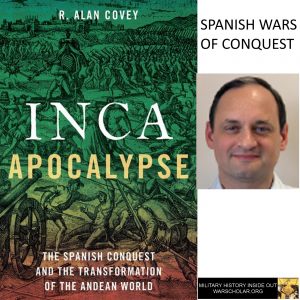
Alan Covey interview – Spanish wars of conquest – Inca Apocalypse (Oxford University Press, 2020)

Spanish wars of conquest – An interview with Alan Covey about his new book Inca Apocalypse published by Oxford University Press. The book discusses the Spanish conquest of the Incas. Check out the book here https://amzn.to/2EAvVFj

How did you become interested in studying and writing on the subject of your book?

The Spanish conquest of the Incas has always been an important aspect of the work that I do in the Andes.  It lies between the two lines of evidence that I work with:  prehistoric archaeology and colonial archival documents.  The conquest story stands apart from those two records, and the Spanish chronicles that provide the most vivid detail aren’t always easy to line up with the other evidence, so I was always a little intimidated about trying to work them all together.

What is the book about and what major themes do you focus on?

The book features the religious worldview of the Incas and Spaniards, presenting the conquest of the Andes as a drawn-out transformation that could be interpreted as the end of the world, or the start of a new era.  I focus on the ways that the Inca and Spanish empires were both engaged in building civilizations, and how the Spanish conquest was only possible with indigenous support.  Even though most of the Incas became Christians and supported the Spanish crown, it took decades for the Spaniards to establish dominance over much of what remained of the Inca world.

Did any of the evidence you found address whether either the Spaniards or Incas were surprised to have discovered each other?  In other words, in their respective worldviews did either expect a cataclysmic clash of civilizations at some point as their empires grew?

The Spaniards were probably less surprised to encounter the Incas than the other way around.  When Columbus sailed, he thought he would reach the Mongol Empire and seek an alliance against Spain’s Muslim enemies, and in the 40 years that followed, Spaniards recognized that many native societies had hereditary leaders who could be quite powerful.  Pizarro sailed south from Panama to follow the rumor of a wealthy lord living just beyond where other Spaniards had explored.  The Incas probably expected that their world would end in natural disasters (earthquakes, tsunamis, volcanoes) rather than a foreign invasion.

What did you find to be the biggest culture clashes between the two empires?  Both obviously were ready to engage in war to protect themselves but were there approaches that stood in stark contrast to each other?

Although there were a lot of ways that the two empires were alike, there were also important ways that they differed, which created misunderstandings about each other.  For example, the Spaniards thought that the Pope had granted them dominion over half of the world, so they felt comfortable taking food and clothing and native porters from the communities they passed through.  The Incas saw them as a lawless men who didn’t know the land or even how to eat properly, and when the Spaniards ate Inca food and drank Inca beer, it signaled that they were Inca subjects, rather than the other way around.  As Spaniards and Andean lords worked to forge alliances and gain the greatest advantage as the world changed, their interactions could be ambiguous, interpreted in different ways by European and Andean people.  When it came to fighting, the Incas had shown that they were capable of brutal campaigns that relied on shock troops and violent retribution to bring frontier peoples in line.  The Spaniards didn’t fight by the same rules–they attacked without warning, tortured and burned their allies, and brought new weapons to the battlefield (like horses and firearms).  Over time, native people acquired those weapons and learned to fight against them successfully, and they learned guerilla tactics that worked when Spaniards were few in number and in remote places.

Were the smaller groups that had been previously conquered by the Incas ready to turn against them and why?  Or were the Incas seen as the better alternative to the new Spanish Empire?

The Inca civil war that was wrapping up when Pizarro went into the Andean highlands had forced local lords to choose sides, and Atahuallpa (the victorious Inca prince) had passed through the north Pacific coast where Pizarro arrived just months earlier, killing local people and taking their women.  Atahuallpa’s captains had occupied Cuzco, the Inca capital, where they wiped out some royal families and declared an intent to force the nobility to migrate to Quito.  And there were provinces that had ceased to pay Inca tribute during the war, which Atahuallpa planned to visit and punish.  So the Spaniards turned up on a landscape where lots of Andean people were either looking for revenge, trying to survive, or hoping to maintain newfound independence.  The Spaniards didn’t seem like an especially formidable force when it came to fighting across the entire Andean region, but they were dangerous and violent, and when they offered to fight for native lords, or to protect them, it was an appealing offer.

What resource materials or archives did you primarily use for your research?

To discuss the Inca Empire and its claims to civilize the Andes, I used recent archaeological evidence alongside colonial descriptions of the Inca world.  For other parts of the book, I used published chronicles, as well as a large body of unpublished manuscripts from libraries and archives in South America and Europe.  I also consulted scholarly studies of literature that was beyond my own expertise.

What did you discover in your research that most surprised you?

I think the thing that surprised me most was how much the first-hand descriptions differ from the popular versions of the story that have been published in recent years.  One theme that really stood out was how Pizarro and his allies knowingly violated the terms that they had agreed to with royal officials, and how the Spanish crown had to spend decades trying to figure out how to rein in unruly conquistadores–often with the Incas and other Andean lords as their allies.

Was there a particularly difficult issue to research because of lack of information or access to information?

Probably the biggest challenge to assembling this book was the sheer scale of documents and other evidence that could be used for a big-picture story like the one I wanted to tell.  As a social scientist, I went into the project trying to bring in as much evidence as possible, but I realized that I could fill a book (and more) just with a bibliography of publications and archival manuscripts.

Did you have any difficulties in finishing or publishing and how did you overcome those?

I was fortunate to have support from the University of Texas to devote a semester to writing, which allowed me to build a momentum that I was able to keep for the rest of the project.  My wife, who is also a professor, was really supportive and patient at times when the project required more time and focus.  The folks at Oxford University Press were really accommodating, and I felt like I had room to write the book that needed to be written.

What is your current or next writing project?

Right now, I am in the early stages of a project that builds on some of the things I learned writing Inca Apocalypse.  The Incas became an important point of debate among early modern Europeans, and I am working on a book that explores how representations of the Incas evolved as Europeans moved out of medieval modes of thought, through the Enlightenment, and into the theories that drive the social sciences today.

Where can people find you online?

I don’t do social media, so my page at the University of Texas is the best place to keep up with my work.

Biographical information

Name:  Professor Alan Covey

Bio:  AB Dartmouth College (1996), PhD University of Michigan (2003), postdoctoral training at the American Museum of Natural History.  I’ve held tenure at Southern Methodist University and Dartmouth College before coming to my present position.

Position and specialty:  Professor of Anthropology

Affiliation:  University of Texas at Austin

Project/work being discussed:  Inca Apocalypse

Links of interest

Check out the book here https://amzn.to/2EAvVFj

https://global.oup.com/academic/product/inca-apocalypse-9780190299125?cc=us&lang=en&

https://liberalarts.utexas.edu/anthropology/faculty/rc39628

As an Amazon Associate I earn from qualifying purchases.