Battles of January 16 summaries plus museums, artwork, and books

Battles of January 16 including descriptions of the battles, geographic locations, associated artwork, and museums where a person can find associated artifacts and artwork.

Song of the day: The Arrival (Jan 16, 378) Latin Pop Song

1. Battle of Corunna (Battle of Elviña)

Date: January 16, 1809

War: The Peninsular War (Part of the Napoleonic Wars)

Cause: The British army, led by Lieutenant-General Sir John Moore, had been retreating across northern Spain in harsh winter conditions, pursued closely by French forces under Marshal Soult. The British needed to hold off the French long enough to evacuate their exhausted troops by sea from the port of Corunna (A Coruña).

Result: Tactical British Victory / Strategic French Success. The British successfully repelled the French attacks, allowing their army to embark and escape to England. However, the British commander, Sir John Moore, was mortally wounded by a cannonball during the battle. The French took control of the region after the British departure.

Paintings & Art

  • Painting: The Death of Sir John Moore at Corunna
    • Artist: Henry James Richter (also depicted by various “English School” artists and Thomas Lawrence)
    • Year: c. 1810s (Lawrence’s portrait of Moore was earlier, but death scenes appeared shortly after the battle).

Museums & Artifacts

  • National Army Museum (London, United Kingdom): Holds uniforms, letters, and lithographs depicting the death of Moore and the retreat.
  • Museo Militar Regional de Coruña (A Coruña, Spain): Located on the actual site of the battle, this museum houses artifacts, weapons, and dioramas specific to the engagement.
  • St. Paul’s Cathedral (London, United Kingdom): Contains a prominent monument and statue dedicated to Sir John Moore.

Location

  • General: Elviña, on the outskirts of A Coruña, Galicia, Spain.
  • Coordinates: 43.3333° N, 8.4167° W

Recommended Book


2. Battle of Cape St. Vincent (The “Moonlight Battle”)

Date: January 16, 1780

War: American Revolutionary War (Anglo-Spanish War)

Cause: A British fleet under Admiral Sir George Rodney was sailing to relieve the Great Siege of Gibraltar, which was being blockaded by Spanish forces. En route, they encountered a Spanish squadron under Don Juan de Lángara off the coast of Portugal.

Result: Decisive British Victory. The battle was unique because it was fought at night (rare for the Age of Sail), earning it the nickname “The Moonlight Battle.” Rodney captured four Spanish ships and destroyed two others, successfully breaking the blockade to resupply Gibraltar.

Paintings & Art

  • Painting: The Moonlight Battle off Cape St Vincent, 16 January 1780
    • Artist: Thomas Luny
    • Year: 1781

Museums & Artifacts

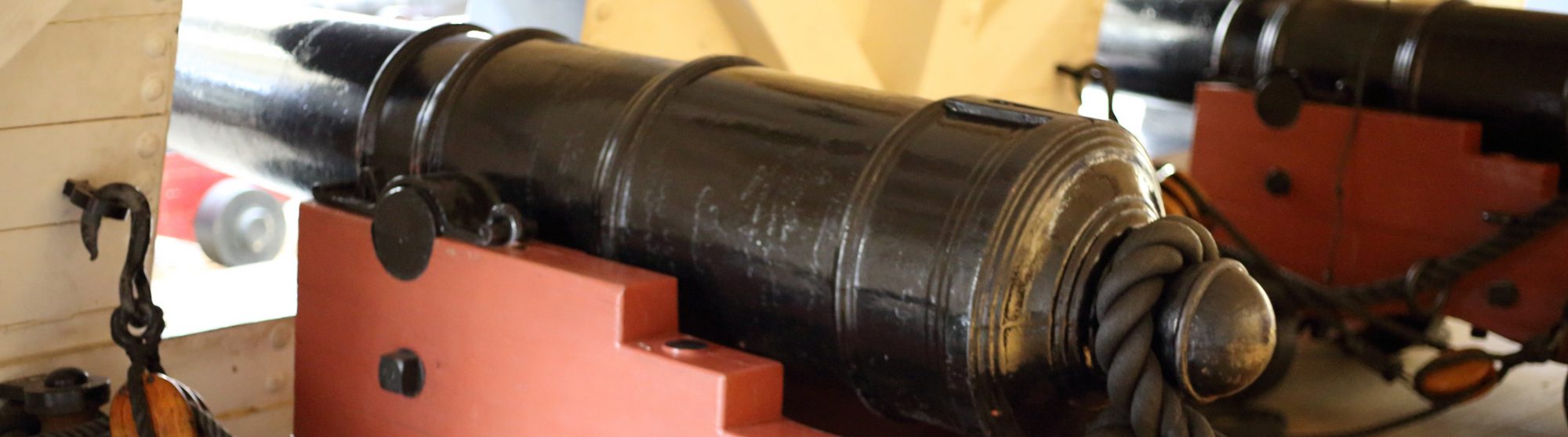
  • National Maritime Museum (Greenwich, United Kingdom): Houses Thomas Luny’s famous painting of the battle, as well as ship models and logs from Admiral Rodney’s fleet.
  • Museo Naval (Madrid, Spain): Contains naval records and artifacts regarding the Spanish fleet and the blockade of Gibraltar.

Location

  • General: Atlantic Ocean, off the coast of Cape St. Vincent, Algarve, Portugal.
  • Coordinates: 37.0231° N, 8.9964° W

Recommended Book


3. The Arrival (The Takeover of Tikal)

Date: January 16, 378

War: Teotihuacan-Maya Conflict (Internal Mesoamerican Power Shift)

Cause: This “battle” was a calculated military intervention (or coup). Forces from the central Mexican metropolis of Teotihuacan, led by a warlord named Sihyaj Kʼahkʼ (“Fire is Born”), marched into the Maya city of Tikal to install a new dynasty and bring the city into Teotihuacan’s sphere of influence.

Result: Teotihuacan Victory. The reigning king of Tikal, Chak Tok Ich’aak I, died on the exact same day Sihyaj Kʼahkʼ arrived (likely executed). A new dynasty was established, launching Tikal into a golden age of dominance under Mexican-influenced leadership.

Paintings & Art

  • Artwork: Stela 31 (The Ballcourt Marker)
    • Artist: Ancient Maya/Teotihuacan Sculptors
    • Year: c. 378–380 AD (Commissioned shortly after the event).

Museums & Artifacts

  • Tikal National Park (Flores, Guatemala): The site itself serves as an open-air museum where the stelae recording this specific date (8.17.1.4.12 in the Long Count) were found.
  • Museo Nacional de Arqueología y Etnología (Guatemala City, Guatemala): Houses many of the finest original jade artifacts and ceramics from Tikal demonstrating the shift in style after 378 AD.

Location

  • General: Tikal, Petén Department, Guatemala.
  • Coordinates: 17.2220° N, 89.6237° W

Recommended Book

Books for sale

WarScholar Press

Contact Information

For more “Military History Inside Out” please follow me at www.warscholar.org, on Facebook at warscholar, on twitter at Warscholar, on youtube at warscholar1945 and on Instagram @crisalvarezswarscholar. Or subscribe to the podcast on Apple Podcasts | Google Podcasts | Stitcher | Spotify

Tags: military museum, military artwork, battles, Military History, War History, Battle Art, War Paintings, War Art, Military Art, Museum Visit, Art History, Historical Artifacts, Museum Collection, Battlefield Tours, History Museum, Museum Life, History In Art, Historic Preservation, January 16, On This Day, History, Military History, War History, Historical Events, History Buff, World History, Battle Of Corunna, Sir John Moore, Peninsular War, Napoleonic Wars, Cape St Vincent, Moonlight Battle, Royal Navy, Admiral Rodney, Tikal, Maya History, Teotihuacan, Pondicherry, Seven Years War, Maya Archaeology

As an Amazon Associate I earn from qualifying purchases.
Military History Inside Out banner

Battles of December 22 summaries plus museums, artwork, and books

Battles of December 22 including descriptions of the battles, geographic locations, associated artwork, and museums where a person can find associated artifacts and artwork.

1. Siege of Ismail

Date: December 22, 1790 (New Style Calendar)

War: Russo-Turkish War (1787–1792)

Cause: The Russian Empire sought to secure control over the Black Sea and the Danube River. The fortress of Ismail (modern-day Izmail, Ukraine) was considered impregnable by the Ottoman Empire and was a key obstacle to the Russian advance.

Result: A decisive Russian victory. Under the command of General Alexander Suvorov, Russian forces stormed the fortress walls in a brutal assault. The capture of Ismail shocked the Ottoman Empire and European powers, leading to the Treaty of Jassy in 1792, which confirmed Russian dominance in the region.

Paintings & Art

  • Painting: The Capture of Ismail
    • Artist: Francesco Casanova
    • Year: c. 1791
  • Painting: Storming of the Fortress of Izmail (Etching/Engraving)
    • Artist: S. Shiflyar (after original drawings)
    • Year: Early 19th Century

Museums & Artifacts

  • State Russian Museum (St. Petersburg, Russia): Holds various artworks and portraits of Suvorov related to the campaigns.
  • Suvorov Museum (St. Petersburg, Russia): Dedicated entirely to the Generalissimo, containing weapons, trophies, and diagrams of the storming of Ismail.
  • Diorama of the Storming of Ismail (Izmail, Ukraine): A museum housed in a former mosque featuring a massive diorama depicting the assault.

Location

  • General: Izmail, Odesa Oblast, Ukraine
  • Coordinates: 45.3499° N, 28.8364° E

Recommended Book

2. Siege of Rhodes

Date: December 22, 1522 (Acceptance of Surrender Terms) (June 16 – December 22, 1522)

War: Ottoman–Hospitaller Wars

Cause: Sultan Suleiman the Magnificent aimed to eliminate the Knights Hospitaller (Knights of St. John) from Rhodes. The Knights used the island as a base for corsair activities against Ottoman shipping, disrupting trade and pilgrimage routes in the Eastern Mediterranean.

Result: Ottoman victory. After a bloody six-month siege, Grand Master Philippe Villiers de L’Isle-Adam accepted Suleiman’s terms of surrender on December 22. The Knights were allowed to leave the island with their weapons and religious icons, eventually relocating to Malta.

Paintings & Art

  • Painting: Siege of Rhodes (Miniature)
    • Artist: Matrakçı Nasuh (from the Süleymannâme)
    • Year: 1558
  • Painting: The Siege of Rhodes of 1522
    • Artist: Pat Nicolle (Historical Illustrator)
    • Year: 20th Century (Modern illustration often used in texts)

Museums & Artifacts

  • Palace of the Grand Master of the Knights of Rhodes (Rhodes, Greece): The original fortress and headquarters of the Knights, containing architecture and artifacts from the siege era.
  • Istanbul Naval Museum (Istanbul, Turkey): Houses Ottoman naval artifacts, maps, and weapons from the era of Suleiman the Magnificent.
  • Musée de l’Armée (Paris, France): Contains cannons and armor from the Knights Hospitaller.

Location

  • General: Rhodes (Old Town), Greece
  • Coordinates: 36.4457° N, 28.2240° E

Recommended Book

3. Battle of the Bulge (Siege of Bastogne)

Date: December 22, 1944 (December 20-26, 1944. Germans demand surrender on December 22)

War: World War II (Western Front)

Cause: As part of the massive German counteroffensive (Operation Wacht am Rhein), German forces surrounded the critical road junction town of Bastogne. On December 22, German envoys demanded the immediate surrender of the encircled American forces.

Result: American moral victory and continuation of the siege. Brigadier General Anthony McAuliffe famously replied to the German surrender demand with one word: “NUTS!” The 101st Airborne Division held the town despite heavy shelling and freezing conditions until relieved by General Patton’s Third Army days later.

Paintings & Art

  • Painting: Nuts!
    • Artist: Michael G. Nate
    • Year: 2000s (Contemporary Military Art)
  • Painting: Battle of the Bulge
    • Artist: H. Charles McBarron Jr.
    • Year: c. 1950s (U.S. Army Art Collection)

Museums & Artifacts

  • Bastogne War Museum (Bastogne, Belgium): The primary museum dedicated to the battle, featuring immersive exhibits and artifacts from the siege.
  • 101st Airborne Museum (Bastogne, Belgium): Located in the former officers’ mess building, focused specifically on the paratroopers’ defense.
  • National World War II Museum (New Orleans, USA): Contains extensive exhibits on the Ardennes Counteroffensive.

Location

  • General: Bastogne, Belgium
  • Coordinates: 50.0085° N, 5.7185° E

Recommended Book

4. Japanese Invasion of Lingayen Gulf

Date: December 22, 1941 (December 21-23, 1944. Landing on December 22)

War: World War II (Pacific Theater)

Cause: The Japanese Empire launched a major amphibious invasion of Luzon to capture Manila and eliminate American air and naval forces in the Philippines, securing the flank for their expansion into Southeast Asia.

Result: Japanese victory. The main Japanese 14th Army landed at Lingayen Gulf on December 22. Despite some resistance, the American and Filipino forces were outmaneuvered and forced to retreat toward the Bataan Peninsula, leading to the eventual fall of the Philippines.

Paintings & Art

  • Painting: Japanese Landing at Lingayen Gulf
    • Artist: U.S. Navy Combat Art Collection (Various Artists)
    • Year: c. 1942–1945
  • Painting: Defense of the Philippines (General Series)
    • Artist: Gary Zawadzki
    • Year: Late 20th Century

Museums & Artifacts

  • National Museum of the Pacific War (Fredericksburg, Texas): Comprehensive exhibits on the Pacific War, including the Philippines campaign.
  • Mt. Samat National Shrine (Bataan, Philippines): While focused on the later Bataan campaign, it holds artifacts related to the initial invasion.
  • Intramuros Administration (Manila, Philippines): Holds artifacts related to the defense of Luzon.

Location

  • General: Lingayen Gulf, Pangasinan, Philippines
  • Coordinates: 16.2833° N, 120.2333° E

Recommended Book

5. Battle of Iron Works Hill (Battle of Mount Holly)

Date: December 22, 1776 (Skirmishes began) (December 22-23, 1776)

War: American Revolutionary War

Cause: An American militia force under Colonel Samuel Griffin engaged Hessian troops to draw them away from their posts at Bordentown and Trenton. This was a diversionary effort to support George Washington’s planned crossing of the Delaware River.

Result: Strategic American success. The skirmishes on December 22 and 23 drew Colonel von Donop’s 2,000 Hessians south to Mount Holly. This left the Hessian garrison at Trenton unsupported, contributing to Washington’s stunning victory at the Battle of Trenton a few days later.

Paintings & Art

  • Painting: Washington Crossing the Delaware (Associated Context)
    • Artist: Emanuel Leutze
    • Year: 1851
  • Painting: Battle of Iron Works Hill (Local historical illustrations)
    • Artist: Unattributed/Local Historians
    • Year: Various

Museums & Artifacts

  • Old Barracks Museum (Trenton, New Jersey): Preserves the history of the Hessian occupation and the battles of Trenton and Princeton.
  • Armed Forces Heritage Museum (Wrightstown, New Jersey): Preserves the military history of New Jersey.
  • Museum of the American Revolution (Philadelphia, Pennsylvania): Holds artifacts related to the 1776 campaign.

Location

  • General: Mount Holly, New Jersey, USA
  • Coordinates: 39.9919° N, 74.7899° W

Recommended Book

Books for sale

WarScholar Press

Contact Information

For more “Military History Inside Out” please follow me at www.warscholar.org, on Facebook at warscholar, on twitter at Warscholar, on youtube at warscholar1945 and on Instagram @crisalvarezswarscholar. Or subscribe to the podcast on Apple Podcasts | Google Podcasts | Stitcher | Spotify

Tags: military museum, military artwork, battles, Military History, War History, Battle Art, War Paintings, War Art, Military Art, Museum Visit, Art History, Historical Artifacts, Museum Collection, Battlefield Tours, History Museum, Museum Life, History In Art, Historic Preservation December 21, On This Day, History, Military History, War History, Historical Events, History Buff, World History, Siege Of Ismail, Suvorov, Russo Turkish War, Siege Of Rhodes, Knights Hospitaller, Ottoman Empire, Battle Of The Bulge, Bastogne, Nuts, WWII, Pacific War, Lingayen Gulf, Revolutionary War, Iron Works Hill

As an Amazon Associate I earn from qualifying purchases.
Military History Inside Out banner

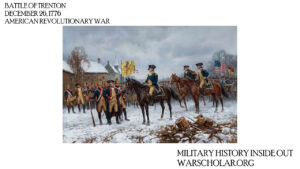
American Revolutionary War – Battle of Trenton December 26, 1776 – An introduction and timeline of major events

Colorized version of Colonel Rall’s surrender to Washington

This podcast episode is a work of historical fiction written to teach listeners, in an entertaining way, about the background and major events that happened during the battle.

Youtube link for the episode with colorized versions of a historic painting:

https://youtu.be/R2Ecxr1q4KU

Books for sale

WarScholar Press

Contact Information

For more “Military History Inside Out” please follow me at www.warscholar.org, on Facebook at warscholar, on twitter at Warscholar, on youtube at warscholar1945 and on Instagram @crisalvarezswarscholar. Or subscribe to the podcast on Apple Podcasts | Google Podcasts | Stitcher | Spotify

Tags: American Revolution, US, Hessians, Britain, Battle of Trenton

As an Amazon Associate I earn from qualifying purchases.

Military History Inside Out banner