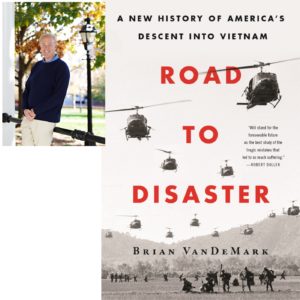
Vietnam War history book – “Road to Disaster” (Custom House, 2018) – Brian VanDeMark interview

Dr. Brian VanDeMark is a historian who has assisted two US Secretaries of Defense with their autobiographies. He teaches history at the US Naval Academy. We spoke about his latest book on decision making by senior leaders during the Vietnam War.

1:16 – Brian talks about how he became interested in writing on the Vietnam War starting from his childhood. He helped former Secretary of Defense Clark Clifford write his autobiography. He taught at the Naval Academy and then helped Robert McNamara with his autobiography.

5:45 – Brian talks about the book and how he organized it. Organizational behavior is one of the things he analyzes in this history.

11:00 – Brian talks about the decision making environments in the White House and the Pentagon.

18:00 – Brian talks about how he determined what the most important turning points of the period were.

26:57 – Brian talks about the materials he used to do his research.

31:44 – Brian explains how he interviewed senior decision makers who had been involved with the Vietnam War.

40:24 – We talk about security measures for public figures then and now.

For more “Military History Inside Out” please follow me on Facebook at warscholar, on twitter at Warscholar, on youtube at warscholar1945 and on Instagram @crisalvarezswarscholar

Guests: Brian VanDeMark

Host: Cris Alvarez

Tags: military, history, military history, conflict, war, interview, non-fiction book, Robert McNamara, Cuban Missile Crisis, Vietnam War, Operations Research, leadership
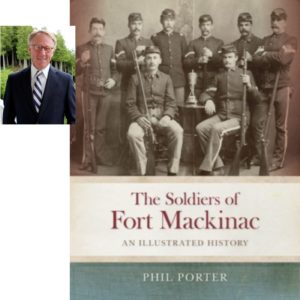
18th and 19th C US Army history book – “The Soldiers of Fort Mackinac” (Michigan State University Press, 2018) – Phil Porter interview

Phil Porter is director of Mackinac State Historic Parks and has studied the Mackinac area extensively. We talk about his latest book on the soldiers of Fort Mackinac.
1:49 – Phil talks about how he got into Mackinac history 46 years ago. He’s written about US military authority after the American Revolution and he’s written another book on Fort Mackinac history.

5:27 – The book is a collection of images of soldiers who served at Fort Mackinac but also discusses the life of these soldiers and why they were at the Fort.

8:30 – Phil talks about some of the history of the British retaking of the fort in the War of 1812.

11:00 – Phil talks about the importance of the fort in the region.

18:05 – Phil talks about images of soldiers at the fort during the pre-War of 1812 period.

20:00 – We talk about uniform variations among soldiers at the Fort from the rest of the US Army.

23:31 – Phil talks about famed medical Dr. Beaumont who was a pioneer on digestive processes.

29:30 – Phil talks about relations between Native American and he soldiers of the fort over time.

31:07 – Phil talks about Civil War soldiers who had served at Fort Mackinac. One was Confederate officer John Pemberton.

36:00 – Phil talks about a soldier that served in the First Barbary War.

37:30 – Phil talks about three wealthy Confederates who were imprisoned at Fort Mackinac for a few months.

45:55 – Getting permissions to use images was a long and tedious process.

47:20 – They found a photo of soldiers playing baseball at the fort. They still play baseball at the fort at the same field.

54:43 – The parks’ books can be found on Amazon and on their website mackinacparks.com.

55:35 – Phil explains why the spelling is Mackinac but is pronounced Mackinaw.

Links of interest

Mackinac State Historic Parks

For more “Military History Inside Out” please follow me on Facebook at warscholar, on twitter at Warscholar, on youtube at warscholar1945 and on Instagram @crisalvarezswarscholar

Guests: Phil Porter

Host: Cris Alvarez

Tags: military, history, military history, conflict, war, interview, non-fiction book, Revolutionary War, War of 1812, US Civil War, Mexican-American War, Native American, british, militia, First Barbary War, military prison, Michigan history

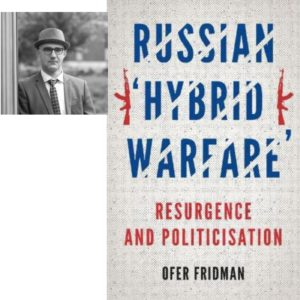
Russian and modern war history book – “Russian Hybrid Warfare” (Oxford University Press, 2018) – Ofer Fridman interview

Ofer Fridman is an academic who has studied Russian military thinking for many years. We discussed his latest book on the concept of Russian Hybrid Warfare.

1:45 – Ofer talks about how he got into studying this topic of Hybrid Warfare. He found that Russia and the West saw hybrid warfare in two different ways.

7:39 – The term hybrid warfare is relatively new, maybe ten years old. The word is new but the phenomena is not.

10:02 – Ofer doesn’t like the term the term hybrid warfare. Three different concepts fall uner the term hybrid warfare.

12:20 – Partisans used to have access to the same weapons the armies had. But now the technology used by each is very different.

17:10 – In WWII, Russian partisans were fighting in different spaces than the regular Army.

20:35 – Ofer talks about the problem with the term in that it covers everything and thus nothing.

24:00 – War is a very definite concept. To call economic sanctions a war helps with politics but it confuses people as far as what a military can do.

25:45 – Ofer discusses the Ukraine example.

32:20 – Ofer talks about how he did his research.

34:30 – Russians believe they lost the Cold War in a very non-military way. The best students of the last war are those who were defeated but not conquered as the Russians experienced and the Germans after WWI.

40:30 – Ofer discusses a funny story about an early NATO documentary on hybrid warfare.

43:00 – Ofer discusses an interesting person named Yevgeny Messner. He was born in the late 19th century and did a lot of research on military matters. He was a Russian who fought the communists and then joined the Nazis in WWII. He then escaped to Argentina. Ofer talks about how his writings led to formal thinking about hybrid warfare.

50:30 – The purpose of war has become an undermining the adversary’s society since nuclear war has limited other military options.

58:07 – Putin is very clear as to what he plans to do. The West seems to miss his messages.

1:03:46 – Russians have their own version of Clausewitz. Western analysis of Russia often doesn’t look before the Soviet Union. The Russians have three ways of thinking about war. Soviet, Russian Imperial and Russian exiles way of thinking. Many Westerners are unaware of lots of this writing.

1:08:55 – He has a page on academia.edu.

For more “Military History Inside Out” please follow me on Facebook at warscholar, on twitter at Warscholar, on youtube at warscholar1945 and on Instagram @crisalvarezswarscholar

Guests: Ofer Fridman

Host: Cris Alvarez

Tags: military, history, military history, conflict, war, interview, non-fiction book, hybrid warfare, Russia, the West, Ukraine, 2014, WWII, partisans, Hoffman, Cold War, Russian Revolution