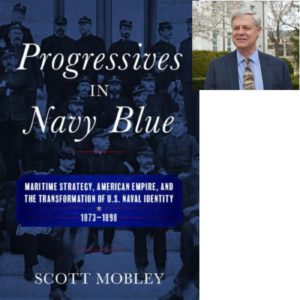
19th C Naval Warfare book – “Progressives in Navy Blue” (Naval Institute Press, 2018) – Scott Mobley interview

Dr. Scott Mobley studied history at the US Naval Academy and stayed in the Navy until retirement. He then went to the University of Wisconsin-Madison to earn a PhD in history. The work for his PhD led to the publication of his book “Progressives in Navy Blue.”

1:23 – Scott talks about how he got into writing and history. He majored in history at the US Naval Academy. He stayed in the Navy until retirement and then got a PhD in history afterwards at the University of Wisconsin. He became interested in the book’s subject matter while pursuing his PhD. The book comes from his dissertation.

3:55 – The main themes of the book are maritime strategy, American Empire and the transformation of US Navy professional culture from 1873 to 1898.

5:35 – The modern Navy was born at the end of the 19th century from a Navy of mariner-warriors to warrior-engineers.

7:05 – The backdrop of an American empire changes much of what the Navy is about. The role and missions of the Navy changes.

9:46 – During the US Civil War, the US Navy went from a commercial mission to a whole new War Navy but it returns to the commercial mission after the war. But the commercial mission eventually moves to second place in the 1880s and becomes more of a war fighting Navy.

13:26 – Two groups of Navy thinkers emerged after the Civil War. One was based on technology. They were dissatisfied with the direction the Navy went during the 1870s.

17:18 – The other group of thinkers were strategic in focus. They worried more about planning for wars. They focused on policy and strategy rather than technology. Mechanism was the term used in the 19th century for technology.

19:07 – Bradley Fiske was on both sides of this debate. But in the 1890s these factions were fighting for limited resources.

26:06 – Torpedo technology is the one technology Congress supported right after the US Civil War. Technical subjects were taught to Navy officers at the new Torpedo School in Newport, Rhode Island.

30:26 – Fears of international turmoil and advancing technology abroad got Navy officers worried about future war involving the US.

32:05 – The Endicott Board was a joint board between the Army and Navy to discuss coastal fortifications. They discussed how to defend the US against modern mechanized threats.

36:43 – Navy officers embraced progressive methods and ideas quicker than other professionals in the 1880s and 1890s.

38:19 – Peacetime war planning efforts, contingency planning, began at this time for the first time in the US. There was no Naval plan for the US Civil War until the war started.

40:25 – Scott possibly found the first strategic peacetime war plan in the papers of a junior Naval officer. The plan was focused on a possible war with Canada. The plan was read by Mahan and possibly incorporated into Naval War College classes.

45:25 – Scott was surprised to learn that the building of modern warships was not motivated by empire as many scholars have claimed. Naval growth was spurred by a desire to defend the US. Some wanted empire but the majority wanted to protect US shores.

51:46 – The US did not have an empire-focused Navy until after 1898. The US had to quickly acquire gunboats, logistics ships, and other vessels to control its new empire.


For more “Military History Inside Out” please follow me on Facebook at warscholar, on twitter at Warscholar, on youtube at warscholar1945 and on Instagram @crisalvarezswarscholar


Guests: Dr. Scott Mobley

Host: Cris Alvarez

Tags: military, history, military history, conflict, war, interview, non-fiction book, navy, empire, mahan, civil war
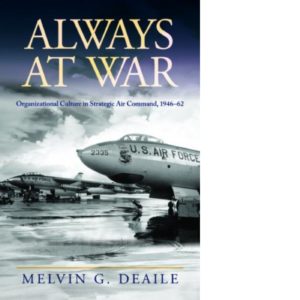
Cold War history book – “Always at War” (Naval Institute Press, 2018) – Mel Deaile interview

Dr. Mel Deaile attended the US Air Force Academy. He then became a bomber pilot and earned his PhD with the Air Force. He know teaches nuclear deterrence related subjects for the Air Force. He’s written a number of pieces and this is his latest book, Always at War about the Strategic Air Command.
1:30 – Dr. Deaile talks about his early writing. He’s spent 26 years in the Air Force and is retired. During this time he did a master’s thesis on nuclear weapons. Then the Air Force had him get a PhD in the field.

3:30 – In 1984 he reported to the Air Force Academy. He graduated from pilot training in 1989 and then given a B-52. Later he joined Strategic Air Command.

4:36 – The book was focused on explaining what was unique about the SAC’s organizational structure. Curtis LeMay was the originator of much of what made SAC different. He took it over in October 1948 and stayed for almost 9 years. His experience came from being a bomber pilot in WWII. His charge was to create and run strategic level force of bombers carrying nuclear bombs. He decided to create a force that was always ready for war.

8:23 – Competition among his personnel was one way he kept them sharp. LeMay kept a totem pole that ranked all his wing commanders. He also used bomb competitions.

9:46 – Bomber generals tended to be people who led the Air Force. The path to higher level command went through SAC. However, LeMay was opposed to general training and preferred on the job flight training.

11:45 – SAC was stood up in 1946 to do independent strategic bombing. They were to be kept out of the hands of theater commanders. Twentieth Air Force was the first and was converted to SAC.

13:53 – The Soviet Union affected how SAC did its job. They didn’t send their best assets to the Korean War so that the Russians wouldn’t learn what SAC’s best assets were like. They also worried about a US fifth column that would sabotage US national assets, so LeMay created red cells to test base security.

16:40 – When the Soviet Union put up Sputnik, SAC had its first alert under General Thomas Power three days before Sputnik went up. Truman created the Atomic Energy Commission to hold atomic materials for nuclear weapons. Eisenhower transferred custody of the weapons back to the military.

19:16 – Several things happened in 1962 that affected SAC. The Cuban Missile Crisis was one. SAC reached its highest personnel level in 1962. It was a huge part of the Air Force. It’s also the last year that a bomber was built for the US for many years afterwards. Lastly, the US turned to more flexible responses in war.

22:32 – Dr. Deaile explains why SAC had two legs of the nuclear triad. Missiles didn’t perform as well as bombs. Missiles were inaccurate and couldn’t always be fired when needed.

29:24 – He did research at Maxwell Air Force base and used many of the oral histories they have. He used the National Archives in Maryland to look at Air Force administrative records. He also interviewed General Dougherty who had been in charge of SAC. He also attended SAC reunions.

32:26 – Survival training at the Air Force Academy came from programs started by General LeMay for his pilots and crews. Auto hobby shops on Air Force bases came from General LeMay who loved working on cars. Aero clubs on bases also came from LeMay. LeMay also started gun clubs since he enjoyed shooting. He also instituted the dorm system on bases to replace Army style barracks.

37:42 – Dr. Deaile’s favorite part of the research was talking to old SAC members. They really respected General LeMay. They also loved all things Boeing.

40:11 – Dr. Deaile was surprised by how much in SAC came from what General LeMay learned in WWII.

44:17 – SAC was a command created to form a deterrent force. This book should be able to educate us how to create and hone a deterrent force.

49:55 – Dr. Deaile explains his record setting 44.3 hour bombing mission after 9/11.

54:14 – The book can be pre-ordered through Amazon or Naval Institute Press. You can order a signed copy through facebook or linkedin. He will also be teaching advanced nuclear deterrence studies.


For more “Military History Inside Out – Serious history for the critical thinker” please follow me on Facebook at warscholar, on twitter at Warscholar, on youtube at warscholar1945 and on Instagram @crisalvarezswarscholar


Guests: Dr. Mel Deaile

Host: Cris Alvarez

Tags: US Air Force, air force, bombers, B-52, Strategic Air Command, General LeMay, nuclear deterrence, Sputnik, airmen, air force bases, nuclear triad

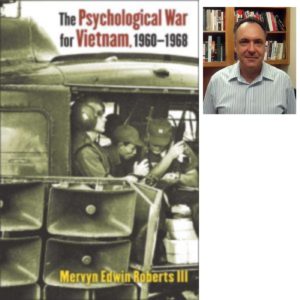
Vietnam War history book – “The Psychological War for Vietnam” (University Press of Kansas, 2018) – Merv Roberts interview


Dr. Merv Roberts has worked on psychological operations in Afghanistan. His work there inspired him to write a history of psychological operations in the Vietnam War and I interviewed him about this book “The Psychological War for Vietnam, 1960-1968.”

2:07- Dr. Roberts decided on studying Information Operations in Vietnam after he returned from a deployment to Afghanistan. No one had done an over arching study of Psychological Operations in the Vietnam War.

3:38 – The book is on joint operations and looked at both North and South Vietnam. He used the Foreign Broadcast Information Service collections.

5:25 – The North Vietnam program was modeled on the Soviet program. It’s about agitation and propaganda. The American system evolved over the course of the war. It came from the American advertising culture that used subjective truth.

8:38 – North Vietnamese leadership was divided over whether to focus on the North or to spread the revolution to the South. The US started trying to divide these factions in 1967 but then [we] the US ends psy war against the North after the Tet Offensive.

12:14 – The North became ineffective at waging psychological warfare against the South but was very effective in it’s worldwide campaign to get countries against the war.

17:11 – Dr. Roberts compares psychological operations and civil affairs activities. In Vietnam civil affairs fell under psychological operations.

21:31 – Edward Landsdale was good at psychological operations in the region.

23:55 – The North Vietnamese used some anti-war activists to spread their message.

27:03 – FBIS is a largely untapped resource for information on the Cold War and events during this period. He also wants to use Geographic Information Systems in conjunction with FBIS information. He also used the Hamlet level evaluations which he admits many people consider a subjective assessment of villages. There were also terrorist activity reports with geographic data attached. The Friendly Forces file provides data on where friendly forces were during the war.

34:04 – Most Psy Ops guys aren’t trained very well during Vietnam.

35:35 – Going through all the captured documents was fascinating for Dr. Roberts. Much of them haven’t been looked at more than once since capture.

37:03 – There are indications the program was effective in 1968.

39:08 – The Vietnamese go to Texas Tech when they want to research the Vietnam War because of how many documents Tech has from the war. FBIS is harder to get a hold of.

42:25 – There are very few books looking at psychological operations across various wars so this book will help fill that gap.

47:34 – There were problems between various US government organizations on how to do psy op in Vietnam. The State Department had the primacy on what messaging would be done in Vietnam.


For more “Military History Inside Out” please follow me on Facebook at warscholar, on twitter at Warscholar, on youtube at warscholar1945 and on Instagram @crisalvarezswarscholar


Guests: Merv Roberts

Host: Cris Alvarez

Tags: vietnam war, psychological operations, north vietnam, tet offensive, hamlet program