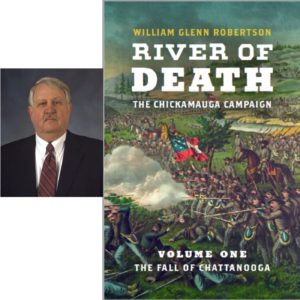
US Civil War history book – “River of Death” (University of North Carolina Press, 2018) – William Robertson interview

William Glenn Robertson has a PhD in History and has written books and numerous articles on the US Civil War. He became a faculty member of the Army Command and General Staff College at Fort Leavenworth, Kansas in 1981. There he revived the educational technique known as the Staff Ride and wrote the Army’s manual on the subject. He retired as the Director, Combat Studies Institute in 2011. We spoke about his latest US Civil War book on the Chickamauga campaign.

0:47 – William talks about how he got into studying military history. He grew up around it.

4:24 – William talks about the book itself. He talks about the motivation to write it.

7:27 – William talks about how his study differs from previous studies of the Chickamagua campaign. William talks about the personalities of the military leaders and also how they moved through and mapped the terrain they were fighting in.

16:05 – William talks about feeding and supplying large Civil War armies.

18:41 – William talks about the staffs of these armies.

23:49 – William talks about a southern family that had a son in the Union Army and who fed false information to the Confederate Army.

25:34 – William talks about the role of technology in the campaign.

32:04 – William talks about how no one had ever managed armies the size of those in the US Civil War.

34:43 – William talks about what documents he used for his research.

50:43 – William talks about some of the Civil War stories that saddened him.

59:26 – William talks about a serious problem he sees in the study of US Civil War history.

For more “Military History Inside Out” please follow me on Facebook at warscholar, on twitter at Warscholar, on youtube at warscholar1945 and on Instagram @crisalvarezswarscholar

Guests: William Glenn Robertson

Host: Cris Alvarez

Tags: military, history, military history, conflict, war, interview, non-fiction book, US history, US military history, US Civil War, Georgia, Chickamauga, Union, Confederacy
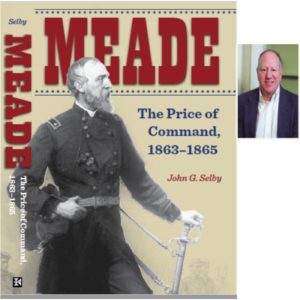
US Civil War history book – “Meade The Price of Command” (Kent State University Press, 2018) – John Selby interview

Dr. John Selby is a professor of history at Roanoke College. His concentrations are American 19th century history, the US Civil War, and he Vietnam War as well as American history in general. We discussed his latest book on General Meade.
0:50 – John talks about how he got into writing about the US Civil War. His first study was on the lives of seven Confederate soldiers. He then co-edited a volume on Confederate papers.

4:16 – John talks about the theme of this book.

8:01 – John talks about the Meade memorial in Washington, D.C.

12:34 – John mentions Meade’s work on lighthouses.

22:33 – John talks about the two people who caused Meade the most problems.

23:04 – John talks about general Sickles and his problems with General Meade.

30:38 – John talks more about why Meade doesn’t get credit for the victory at Gettysburg.

36:57 – John talks about the resources he used for his research. It included Meade’s voluminous number of letters.

45:55 – John talks about two questions he grappled with while doing his research.

For more “Military History Inside Out” please follow me on Facebook at warscholar, on twitter at Warscholar, on youtube at warscholar1945 and on Instagram @crisalvarezswarscholar

Guests: John Selby

Host: Cris Alvarez

Tags: military, history, military history, conflict, war, interview, non-fiction book, US Civil War, George Meade, Robert E. Lee, Army of the Northern Virginia, Army of the Potomac, leadership, Union, Confederate

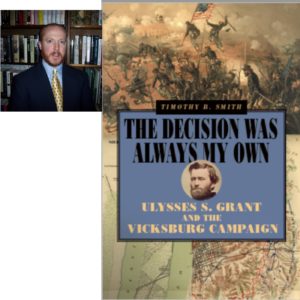
US Civil War history book – “The Decision Was Always My Own” (Southern Illinois University Press, 2018) – Timothy Smith interview

Dr. Tim Smith has worked for the National Park Service and now teaches history at the University of Tennessee – Martin. He’s always been interested in the Civil War and he’s written close to 20 books on the subject. We talked about his latest book on Grant at Vicksburg.

1:24- Dr. Smith talks about how he got into history. A course on the Old South at Ole Miss got him interested in Civil War history.

2:47 – The last book on Grant at Vicksburg was Myers book in the 1960s. Dr. Smith is editing a series on Grant so he wrote this book.

4:51 – This book looks at Vicksburg from Grant’s point of view. One of his big gambles was to cross the river south of Vicksburg. Few people approved of his decision.

7:30 – Grant had a lot of soul searching during the 9 months of the Vicksburg campaign. He nearly gives up and commits to a suicidal attack but then he chooses a gamble type of move instead.

10:54 – Grant corresponded to a lot of different people and Dr. Smith had a huge amount of correspondence to go through to write this book.

13:10 – Sherman was willing to call Grant out when he doesn’t agree with him. But Grant said he never held a council of war even though he got opinions and ideas from other officers.

22:22 – Politicians and newspaper editors pressured Grant to warp up the Vicksburg campaign. People wanted him removed.

27:45 – Grant made plenty of mistakes giving orders at the Vicksburg campaign. He was good at organizing his forces but not perfect. Grant actually didn’t have a good staff and they weren’t very professional. He picked a lot of old Army friends for his staff.

31:06 – Grant was a micro-manager and probably got involved in too much of the menial issues of his army. Grant was a tender-hearted and kind person though.

38:21 – Twenty years ago you had to go to archives for research but now everything is online and at a researcher’s fingertips. One little used source is the two volume history of Grant’s post-war world tour where he discussed the war with a newspaper reporter.

42:44 – Dr. Smith grew up around Vicksburg so he has a lot of experience with the terrain there.

53:15 – His next book is on Grant’s May assaults at Vicksburg. It’ll be a major battle book with plenty of details. He is worried about the interest in the US Civil War but he hopes and thinks it might revive again as this generation gets older.

For more “Military History Inside Out” please follow me on Facebook at warscholar, on twitter at Warscholar, on youtube at warscholar1945 and on Instagram @crisalvarezswarscholar

Guests: Dr. Timothy Smith

Host: Cris Alvarez

Tags: military, history, military history, conflict, war, interview, non-fiction book, US civil war, grant, sherman, confederates, union, Halleck, Lincoln, Vicksburg, Jayhawks, cavalry, attacks, july 4th