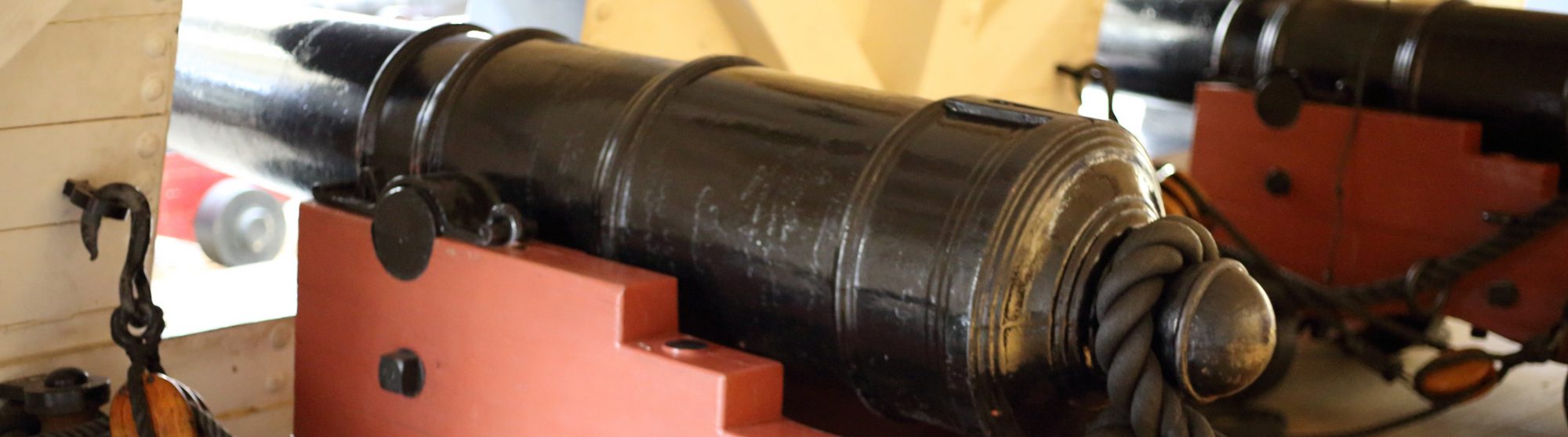
Battles of January 30 summaries plus museums, artwork, books

Battles of January 30 including descriptions of the battles, geographic locations, associated artwork, and museums where a person can find associated artifacts and artwork.

1. Battle of Rennell Island

Date: January 30, 1943 (Final phase of the naval engagement)

War: World War II (Guadalcanal Campaign)

Cause: The U.S. Navy was escorting a troop transport convoy to reinforce Guadalcanal while also attempting to lure Japanese naval forces into a decisive engagement. The Japanese, meanwhile, were preparing to evacuate their remaining troops from the island (Operation Ke) and launched land-based torpedo bombers to strike the U.S. task force.

Result: Japanese Victory. On January 30, Japanese torpedo bombers succeeded in sinking the heavy cruiser USS Chicago and severely damaging the destroyer USS La Vallette. This forced the U.S. task force to retreat from the area, allowing the Japanese to successfully complete their evacuation of Guadalcanal a week later.

Paintings & Art

Painting: Naval Battle off Rennell Island (レンネル島沖海戦) Artist: Santa Yasushi (三田康) Year: 1943

Museums & Artifacts

National Museum of the U.S. Navy (Washington, D.C.): Houses the official action reports, photographs, and artifacts related to the USS Chicago, including pieces of the ship’s silver service and the Admiral’s flag flown during the Solomon Islands campaign.

National Museum of the Solomon Islands (Honiara): Displays wreckage recovered from the area and artifacts belonging to both Japanese and American airmen involved in the engagement.

Location

General: South of Rennell Island, Solomon Islands (Pacific Ocean) Coordinates: 11.4167° S, 160.3333° E

Recommended Book Guadalcanal: The Definitive Account of the Landmark Campaign by Richard B. Frank.


2 The Tet Offensive (Opening Phase) Date: January 30, 1968 (January 30, 1968-September 23, 1968)

War: Vietnam War

Cause: North Vietnamese and Viet Cong forces launched a massive, coordinated surprise attack during the Tet (Lunar New Year) holiday. The objective was to spark a popular uprising in South Vietnam, shatter the South Vietnamese military, and force the United States to withdraw.

Result: Military Defeat but Political Victory for North Vietnam. While the Communist forces suffered devastating casualties and failed to hold most of their targets, the scale of the offensive shocked the American public and became the turning point that led to the eventual U.S. withdrawal.

Paintings & Art

Painting: The Battle for Hue (Sketch series) Artist: Various Combat Artists (U.S. Marine Corps Combat Art Program) Year: 1968

Museums & Artifacts

Vietnam Military History Museum (Hanoi, Vietnam): Contains the “War Remnants” collection, including North Vietnamese battle plans for the Tet Offensive, captured American weaponry, and large-scale dioramas of the attacks on Saigon and Hue.

National Museum of the Marine Corps (Triangle, Virginia, USA): Features an immersive exhibit on the Battle of Hue (a central part of the offensive) with uniforms, gear, and combat art created by Marines on the front lines.

Location

General: Nationwide across South Vietnam (Saigon, Hue, Da Nang) Coordinates: 10.7769° N, 106.7009° E (Saigon/Ho Chi Minh City coordinates)

Recommended Book Hue 1968: A Turning Point of the American War in Vietnam by Mark Bowden.

Books for sale

WarScholar Press

Contact Information

For more “Military History Inside Out” please follow me at www.warscholar.org, on Facebook at warscholar, on twitter at Warscholar, on youtube at warscholar1945 and on Instagram @crisalvarezswarscholar. Or subscribe to the podcast on Apple Podcasts | Google Podcasts | Stitcher | Spotify

Tags: military museum, military artwork, battles, Military History, War History, Battle Art, War Paintings, War Art, Military Art, Museum Visit, Art History, Historical Artifacts, Museum Collection, Battlefield Tours, History Museum, Museum Life, History In Art, Historic Preservation, January 30, On This Day, History, Military History, War History, Historical Events, History Buff, World History, WWII, World War 2, Pacific War, Rennell Island, Vietnam War, Tet Offensive, Cold War History, USS Chicago

As an Amazon Associate I earn from qualifying purchases.
Military History Inside Out banner

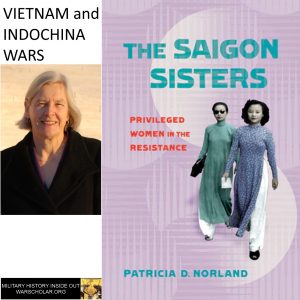
Patricia Norland interview – Vietnam War and Indochina War military history book – “Saigon Sisters” (Cornell University Press, 2020)

Check out this book here   https://amzn.to/392NdWN

Patricia worked for many years in the US Foreign Service. Before this time, she was with a non-profit organization and met nine women who fought against the French and the Americans in the Vietnam War. Patricia kept in touch with these women and after retiring from the foreign service she wrote a book about these women’s wartime experiences. We spoke about the book, Saigon Sisters, these women, and the Indochina and Vietnam Wars.

(THE AUDIO PLAYER IS AT THE BOTTOM OF THE POST.)

Editor’s note: Patricia Norland sent an email clarifying a statement she made during the Interview: “Separately, I should clarify my statement about “managing” the Fulbright program while serving in HCMC; my job was to manage exchange programs, but Fulbright, wisely, establishes a Commission in each country (with ED) that — while coordinating with others– runs the program.”

0:42 – Patricia talks about why she wrote this book and how she met the women she wrote about.

5:09 – We talk about how these nine women gave up privileged lives to fight the French and Americans in the Indochina Wars.

7:04 – Patricia talks about how she breaks the book into two parts- the lives they had before war to 1950 and then 1954, the war years to post 1975.

13:07 – Patricia reads an excerpt from the book discussing the patriotic zeal of the women the book is about.

15:13 – Patricia talks about the conservative nationalism that motivated the Vietnamese Communist revolution.

16:59 – Patricia shares some of the revolutionary poems that these fighters wrote.

19:51 – Patricia talks about how these teenagers were recruited into the revolution.

23:39 – Patricia reads a passage regarding the Japanese occupation of Vietnam and their misuse of rice by troops.

25:59 – Patricia talks about where these women ended up once they joined up with the revolution.

30:42 – Patricia reads a passage from the first woman in the group who joined the Vietnamese Maquis.

33:14 – Patricia talks about the research she did for the book and the interviews she did.

38:19 – Patricia talks about the personal items from the war that these women showed her.

41:41 – Patricia talks about how these women could have had much easier lives if they had turned away from the war. She also addresses how there is disappointment about what happened after 1975.

44:06 – Patricia talks more about the disillusionment of their struggle.

46:21 – Patricia talks about the American presence in Vietnam.

49:53 – Patricia talks about how these women continued fighting against the Americans once they replaced the French.

51:20 – Patricia talks about gender inequality within the revolutionary ranks.

52:28 – Patricia talks about some moving moments in their story.

1:04:05 – Information on the book can be found on the Cornell University Press website.


Links of interest

https://amzn.to/392NdWN

https://www.cornellpress.cornell.edu/book/9781501749735/the-saigon-sisters/

https://www.cornellpress.cornell.edu/vietnamese-women-privilege-and-persistence/


For more “Military History Inside Out” please follow me at www.warscholar.org, on Facebook at warscholar, on twitter at Warscholar, on youtube at warscholar1945 and on Instagram @crisalvarezswarscholar. Or subscribe to the podcast on Apple Podcasts | Google Podcasts | Stitcher | Spotify


Guests: Patricia Norland

Host: Cris Alvarez

Tags: military, history, military history, conflict, war, interview, non-fiction book, Cornell University Press, Vietnam War, church world service, Saigon, French colonial, black pajamas, French, Saigon, double lives, resistance, maquis, National day of the student, US Navy, International Workers day, Communism, French Lycee, Japan, WWII, Viet Cong, French Army, United States, US Embassy, double agent, Afghanistan, NIU, Ken Burns

Check out this book here   https://amzn.to/392NdWN

As an Amazon Associate I earn from qualifying purchases.
How the NIH developed US scientists like Anthony Fauci and Nobel Prize winners during the Vietnam War – Interview with Raymond Greenberg

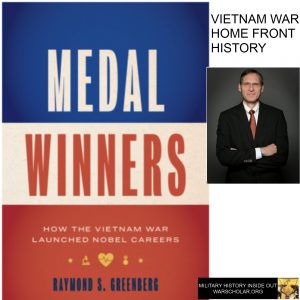
How the NIH developed US scientists like Anthony Fauci and Nobel prize winners during the Vietnam War – Interview with Raymond Greenberg

Check out this book here   https://amzn.to/3hMKfcL

Interview Timeline

Raymond Greenberg has spent decades in the field of medicine. He recently wrote a book on Nobel prize winners who worked at the National Institutes of Health during the Vietnam War. We spoke about the book, military medicine, WWII, the Vietnam War, and the process of getting the book published. Medal Winners (University of Texas Health Press, 2020)

0:52 – Ray talks about his interest in the history of Nobel laureates.

2:26 – Ray talks about the term “Yellow Beret”

6:30 – Ray talks about the research that these scientists worked on at NIH.

7:29 – Ray talks about the Naval Medical Hospital.

8:07 – Ray talks about Dr. Anthony Fauci’s connection to these programs.

8:44 – Ray talks about tropical diseases and war.

9:52 – Ray talks about the obligations these doctors had when drafted.

12:09 – Ray talks about the “golden age” of physicians doing research.

15:39 – Ray talks about the unintended effects of the draft in developing new scientists and medicine.

18:11 – Ray talks about Dr. Fauci’s involvement with anthrax issues after 9/11.

19:46 – Ray talks about alternatives the military created to the doctors’ draft including the Uniformed Services Medical School.

22:00 – Ray talks about how the book is divided into pre-NIH years, the time the scientists spent at the NIH, and then their Nobel prizes.

24:44 – Ray talks about medical advances made during the Vietnam War including rapid evacuation.

26:00 – Ray talks about how he researched the book including interviews with the Nobel prize winners.

27:52 – Ray talks about when people understood the nexus between NIH and the Nobel prize winners.

31:24 – Ray talks about how the end of the Vietnam War negatively affected the NIH.

34:20 – Ray talks about applications to the Uniformed Health Services.

36:20 – Ray talks about foreign doctors at NIH.

37:30 – Ray talks about Vietnamese scientists during the Vietnam War.

38:18 – Ray talks about the interviewing process.

38:56 – Ray talks about the winners’ feelings about having been in the program.

42:29 – Ray talks about the cultural benefits of working at the NIH during the Vietnam War.

45:26 – Ray talks about the purpose of the NIH and how it was expanded during WWII to develop combat advantages. One concern was German biomedical advances to create better fighters.

49:09 – Ray talks about how WWII was a major turning point in the development of smart warfare.

53:03 – Ray differentiates between doctors and scientist-doctors.

57:28 – More information on Ray’s can be found on the University of Texas Press website.

Links of interest

https://amzn.to/3hMKfcL

https://utpress.utexas.edu/books/greenberg-medal-winners

For more “Military History Inside Out” please follow me at www.warscholar.org, on Facebook at warscholar, on twitter at Warscholar, on youtube at warscholar1945 and on Instagram @crisalvarezswarscholar. Or subscribe to the podcast on Apple Podcasts | Google Podcasts | Stitcher | Spotify

Guests: Raymond Greenberg

Host: Cris Alvarez

Tags: military, history, military history, conflict, war, interview, non-fiction book, National Institutes of Health, Nobel laureates, Yellow Beret, Korean War, doctors’ draft, Naval Medical Hospital, Walter Reed, wounded warriors, Dr. Anthony Fauci, WWII, malaria, genetic code, anthrax, 9/11, Uniformed Services medical School, field evacuation, protests, MLK assassination, military, Jewish scientists, world war two, Cold War, coronavirus, biomedicine, applied research, basic research, medicine, home front

Check out this book here   https://amzn.to/3hMKfcL

As an Amazon Associate I earn from qualifying purchases.
Military History Inside Out banner