Podcast: Play in new window | Download
Subscribe: RSS
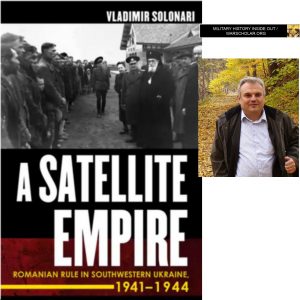 Dr. Vladimir Solonari is a history professor at the University of Central Florida. He has written extensively on ethnic cleansing in Romania during WWII and we discussed his latest book on Romanian occupation of Transnistria in Ukraine during WWII. Check out the book here.
0:45 – Vladimir talks about why he is writing about Romanian occupation of Ukraine during WWII.
2:43 – Vladimir talks about the geography of the Ukrainian region the book focuses on.
5:58 – Vladimir talks about German post-WWII plans for this Ukrainian region had Germany won the war. Romania was trying to get Transylvania back.
8:18 – Vladimir talks about how the progress of Operation Barbarossa affected Romanian strategic plans for this region.
12:19 – Vladimir talks about how Romanian troops were deployed around the Eastern Front and used.
14:42 – Vladimir talks about Romanian elite troops known as “mountain shooters”.
15:30 – Vladimir talks about Romanian policing of the Transnistria region. He discusses Soviet created terrorist groups used to harass the Romanians. He also discusses local partisan groups.
22:35- Vladimir talks about how Romania conducted ethnic cleansing of Jews, Roma, Ukrainians, Bulgarians, and Hungarians and moved them to Transnistria. He also discusses how typhus spread through the camps.
27:05 – Vladimir talks about whether the Romanians used specialized troops to massacre ethnic prisoners.
29:55 – Vladimir talks about how some Romanian officers opposed ethnic cleansing. Ethnic German villages were willing to conduct ethnic cleansing in this region.
33:30 – Vladimir talks about how Romania wanted to show its power on the world stage and to Europe.
36:30 – Vladimir talks about German perceptions of Eastern Europe as an empty space that needed order.
38:07 – Vladimir talks about the archives he used for his research.
39:31 – Vladimir relates a story about an aspiring composer in Odessa who was living a double life and pining over a lost love.
46:05 – Vladimir talks about how the Romanian government withdrew their approval for him to use certain photographs in his book.
47:46 – Vladimir talks about visiting a museum and the catacombs of Odessa.
57:14 – Vladimir talks about the complexity of the whole situation.
59:58 – Vladimir tried to determine how much the German and Romanian occupation attitudes depended on racist ideas.
1:07:30 – Vladimir talks about the legalities that the Romanians applied to conducting their ethnic cleansing.
Links of interest
https://www.cornellpress.cornell.edu/book/9781501743184/a-satellite-empire/
https://history.cah.ucf.edu/faculty-staff/?id=318
For more “Military History Inside Out” please follow me at www.warscholar.org, on Facebook at warscholar, on twitter at Warscholar, on youtube at warscholar1945 and on Instagram @crisalvarezswarscholar
Guests: Vladimir Solonari
Host: Cris Alvarez
Tags: military, history, military history, conflict, war, interview, non-fiction book, Romania, ukraine, world war ii, wwii, ethnic cleansing, Odessa, Russia, USSR, Germany, fascism, communism, transylvania, transnistria, Moldova, operation barbarossa, crimea, sevastopol, stalingrad, eastern front, Hitler, mountain shooters, spy networks, terrorists, intelligence, partisan, stukas, jewish, hungary, bulgaria, roma, typhus, Antonescu, police, gendarme, colonialism, US Holocaust Museum, Sviatoslav Richter, NKVD, cannibalism, Stalin, cornell
 Stephen Harding is currently editor of Military History Magazine. He’s been an Army staff historian, a magazine writer and editor and he’s written numerous popular books on World War II. We talk about his latest book “Escape from Paris” which focuses on three B-17 gunners shot down over France and the young French woman and her family who help them evade capture in German-held Paris.