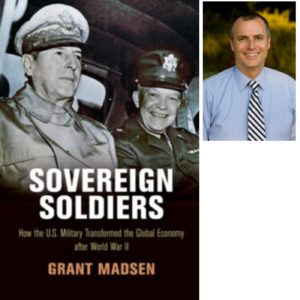
Cold War history book – “Sovereign Soldiers” (University of Pennsylvania Press, 2018) – Grant Madsen interview

Dr. Grant Madsen has long been interested in history and this led him to earn a PhD in History. Sovereign Soldiers is his first book and explains how the US military transformed the global economy with the economic policies it applied to the occupation of Germany and Japan after WWII.

2:03 – Dr. Madsen talks about how he got into studying and writing about history. He grew up with historians and he felt he made sense of the world historically. He decided to get a PhD in history and the book stems from his dissertation research.

5:10 – Dr. Madsen talks about the details of the book. After WWII, the US military men found that they needed to understand how to run the economies of Germany and Japan. Joseph Dodge was instructed to fix the economy of Japan.

7:28 – There is agreement that these military leaders succeeded in developing the occupied territories and helped the economy of the West. Dr. Madsen examined economic theories and practice in his research.

9:43 – Economic stability seemed to be the key to success. Dr. Madsen feels there was no Keynesian approach to how these economies were developed.

12:03 – The military had economic policies in place as soon as the occupation periods started. These policies were based on New Deal policies but disappeared over the time of the occupations. Germany had cartels and Japan had zaibatsus which had to be worked with to develop these economies.

15:28 – The military dropped its military economic policies quickly in Germany and used a new approach to build that economy. Japan took a little longer to develop.

17:24 – Though the US held all military power in Japan and Germany, it wasn’t useful in imposing US economic will. Clay in Germany and MacArthur in Japan had to be careful on how they used their military power.

20:48 – About 1947, the US military was focused on making Japan and Germany capable of helping to resist the Soviets.

22:46 – There was a fight between State and Defense on who would pay for the occupations. The military was stuck with the bill. Many military leaders didn’t want to be blamed for failure in the occupations since they didn’t think they would succeed. They didn’t want to look bad like it had in earlier decades.

26:06 – In 1947-48, the US strategically decided to make Germany and Japan perimeter defenders against the Soviets. The initial plan was to jointly control Germany with four nations to create worldwide peace and cooperation, but by 1947, Germany became a country that would be a perimeter. Military bases became a way to funnel US money into Germany and Japan.

30:38 – The book starts with the Spanish-American War where the US begins controlling other territories. The US had governance issues when they planned to stay in places only temporarily. The book first focuses mainly on the Philippines during the early occupation. The middle chapters talk about Germany and Japan. The final chapters focus on Eisenhower’s military-economic focus.

35:41 – Joseph Dodge left many useful historical papers to the Detroit Public Library. Mr. Madsen also used the various Presidential libraries for his research. The Eisenhower address took on a different tone as he did his research.

40:36 – One question Dr. Madsen had was how were US leaders using the word democracy. He decided that the word was a stand in for the term economic policy.

43:44 – It’s around WWI that countries realize that military power and industrial economy became strongly linked. Eisenhower jumped up in the ranks quickly because he understood combined arms and industrial conversion of a peacetime economy to a wartime economy.

47:19 – Right after the war, the US and the Soviets discussed what economic system they would impose on Germany. The Soviets planned to just let the Germans starve and had no plan for an economic system there. By 1947, the Soviets imposed communism since they saw they had to grow East Germany to counter the West.

51:28 – In 1950, the Japanese economy was struggling and an anti-American Prime Minister was elected. This was when the US changed course in Japan.

53:11 – Dr. Madsen hopes that the book changes how historians discuss the post war period. Peacekeeping operations are much more common than wartime operations so this is an important subject to study in regards to war and the history of military nation building and peacekeeping.

59:21 – His website is grantmadsen.net.

Links of interest

Grantmadsen.net

For more “Military History Inside Out” please follow me on Facebook at warscholar, on twitter at Warscholar, on youtube at warscholar1945 and on Instagram @crisalvarezswarscholar

Guests: Grant Madsen

Host: Cris Alvarez

Tags: military, history, military history, conflict, war, interview, non-fiction book, spanish-american war, Philippines, Germany, Japan, MacArthur, Eisenhower, Soviet Union, economy, military-industrial complex, Keynesian
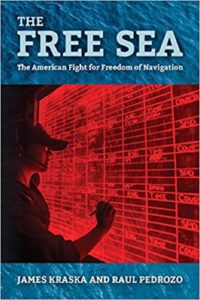
US Naval history book – “The Free Sea” (Naval Institute Press, 2018) – James Kraska interview

James Kraska was a Judge Advocate General for the US Navy and has extensive experience on defense issues and Freedom of Navigation issues. He’s currently a visiting Professor of Law at the Naval War College. He has co-authored a book on the history of US enforcement of Freedom of Navigation and we spoke about the book.
1:56 – Professor. Kraska was a Navy Judge Advocate lawyer and in this capacity he learned and practiced the law regarding Freedom of Navigation. He taught at the Naval War College and completed a degree on the subject. Raul Pedroza, the other author, is also a retired Navy JAG and a professor of law.

3:55 – It has been imperative for the US to protect the sea for economic and security purposes. The book is a mix of history and law on Freedom of Navigation. The book starts with the Quasi-War with France and continues all the way through the current Chinese attempts to assert unlawful control of regional seas.

6:55 – The US defends Freedom of Navigation globally because no one else will do it. Many countries depend on the US to maintain order at sea. The Dutch enforced freedom of the seas in the 1500s and then the British took over enforcing these global rights.

8:57 – The US took over from the British around the 1880s. By 1945, the US had fully assumed the role of protecting freedom of the seas.

11:00 – Freedom of navigation is a continuous struggle to maintain these freedoms. The Gulf of Tonkin and Pueblo incidents are examples of violent conflict involving freedom of navigation.

12:37 – Political will and military capability are needed to maintain freedom of navigation. Territorial seas are part of the global commons. The US has operated on territorial seas and also on high seas to protect navigation freedoms. Surveillance aircraft are also used to maintain freedom of navigation on the seas.

17:31 – Using international airspace to protect the seas has been developing for the last hundred years. The International Civil Aviation organization also supports airspace use to protect Freedom of Navigation.

19:00 – The threat of piracy greatly declined by the 20th century as states have cohered into stronger entities. Piracy existed around Somalia because it was a failed state. Before the Treaty of Paris in 1856, many states used privateers to attack enemy shipping. After the treaty, states agreed to stop using privateers. Since then, threats to freedom of navigation come from nation states.

21:40 – Chinese actions now are the greatest threats to freedom of navigation since Germany’s U-boat wars. During the Cold War, the US and Soviet Union worked in tandem to preserve navigational freedoms.   The Soviet Union needed it more than the US due to the location of their bases. China wants to undo parts of the international agreements on freedom of navigation and keep others out of the waters close to their territory. They want to dominate the seas within the first island chain including the South China Sea and the East China Sea.

27:56 – During WWII, Japan wanted to control the seas around East Asia through war. China is trying to achieve the same goal but through a “Finlandization” of its neighbors. China has used fishing claims to try to assert control in these areas but that doesn’t work within the existing international agreements.

32:57 – The main focus of the book is that freedom of the seas is not a condition that [exists] can exist without promotion and protection. If the US stops exercising rights over global seas, then these rights will erode for all nations.

34:45 – Wilson called for a protection of freedom of navigation by all nations and for all nations. Roosevelt also insisted on maintaining these global rights. A group of united nations met during WWII to maintain rights and later they met after the war to form the United Nations.

37:27 – Both authors have extensive experience in this field especially for events over the last 15 years and beyond. They used CIA archives and presidential libraries to do some research.

39:00 – Washington saw the US as a liberal actor that supported all nations and conducted trade with all as well. But European politics continued to drag the US into conflict and affected trade.

42:50 – He was most moved by the sacrifices made to protect US interests. John Negroponte made an impassioned speech on freedom of the seas to remind people how much US security depended on freedom of the seas.

44:58 – His next writing project might be on the free seas from the British perspective. He’s also working on a project about Japan’s relationship with sea.

45:35 – Many of his articles are on the SSRN.

Links

https://www.ssrn.com/en/

For more “Military History Inside Out” please follow me on Facebook at warscholar, on twitter at Warscholar, on youtube at warscholar1945 and on Instagram @crisalvarezswarscholar

Guests: James Kraska

Host: Cris Alvarez

Tags: military, history, military history, conflict, war, interview, non-fiction book, freedom of the seas, freedom of navigation, China, US, Britain, Germany, Japan, East China Sea, South China Sea, Quasi-War, Pueblo incident, WWII

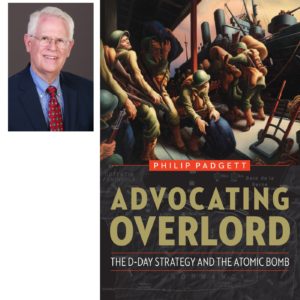
WWII history book – “Advocating Overlord” (Potomac Books, 2018) – Phil Padgett interview

Phil Padgett has worked as a political scientist in the field of security studies for much of his career. He turned his skills to writing a book on the WWII Operation Overlord, the atomic bomb, and the relationship between the US and UK during the war.

2:21 – Phil Padgett is a political scientist and has long been fascinated by a meeting between Churchill and Roosevelt during WWII.

4:30 – Phil found a letter by a Naval officer who said big things were being discussed by Roosevelt on a small boat on a lake in Canada during WWII.

6:15 – The book goes over Overlord more than on the discussions for cooperation between the US and UK on the Manhattan Project.

8:10 – The crux of the book is about the UK and the US reestablishing trust during the war.

10:00 – The US Joint Chiefs of Staff had to deal with many military leaders turning against Overlord in favor of a Mediterranean strategy.

12:45 – The US wanted a quick war and a quick strike in order to then move against Japan.

14:48 – Phil talks about the secrecy and knowledge of all parties about atomic bomb research.

19:53 – Both the US and UK knew the atomic bomb was a very powerful weapon and both were concerned about who would control atomic bombs after the war. Nations also felt that strategic bombing could have strong political effect on warring nations.

22:42 – Churchill liked to feed information to Roosevelt before the US joined the war that British bombing was having an effect on Germany.

23:55 – Canada is involved heavily in Overlord. General thinking about the[n] war was that a major amphibious assault would not work.

29:49 – His quid pro quo idea is very controversial. He used primary records at the US National Archives and at the British National Archives.

31:54 – Phil found one of Churchill’s papers with a scorch mark from a cigar burn and it brought him to the moment when history was happening. He also enjoyed going to the war rooms, Hyde Park and being on the battleship Texas.

34:45 – Phil was surprised by the amount that WWI influenced WWII. Especially with air power and a fear of repeating trench warfare.

36:16 – There didn’t seem to be a contingency plan if D-Day didn’t go well. If it failed, they probably would only have been able to conduct a Mediterranean operation afterwards. In late 1943, there was a US threat of a railroad strike over wages and hours. If it occurred, D-Day would have been delayed six months.

39:33 – Roosevelt was pretty much his own Secretary of State on these issues. The Secretary of State ran day-to-day diplomatic operations.

43:33 – Transcripts of the phone calls between Churchill and Roosevelt would be useful to historians. The Germans had cracked the allied system from 1940 to 1943 and kept transcripts of the calls. The records were kept in Berlin and appear to have been destroyed during the bombing of Berlin.

46:42 – Phil is happy he’s started the conversation about the quid pro quo idea.

48:44 – Phil has a website at www.philpadgett.com for the book. The website also has answers to frequently asked questions plus it has more photos.

Links

www.philpadgett.com

For more “Military History Inside Out” please follow me on Facebook at warscholar, on twitter at Warscholar, on youtube at warscholar1945 and on Instagram @crisalvarezswarscholar

Guests: Phil Padgett

Host: Cris Alvarez

Tags: military, history, military history, conflict, war, interview, non-fiction book, WWII, world war 2, D-Day, Normandy, Churchill, Roosevelt, Stalin, US, UK, Soviet Union, Berlin, scientists, Joint Chiefs of Staff, war plans