WWII history book – “No Forgotten Fronts” (Naval Institute Press, 2018) – Lisa Shapiro interview


Professor Lisa Shapiro holds masters degrees in literature and management and teaches at San Diego Mesa College. She has previously taught creative writing. She’s written a book based on thousands of archived letters sent by San Diego State students who were in WWII to their professor Dr. Post. I interviewed Professor Shapiro about the book titled “No Forgotten Fronts.”
1:54 – Professor Shapiro talks about her first historical project. It dealt with European medieval historical fiction. Her interest in WWII came out of her work with community college students in San Diego.
3:57 – She began studying war literature and got a second degree in that subject. In the school archives she found letters written to a professor during WWII.
5:46 – Professor Shapiro explains the basis and details of the book. It’s a collection of student letters written to their professor, Dr. Post. He turned the letters into a regular newsletter. He did this through the entire war.
10:16 – Several hundred students participated in writing to Dr. Post. This includes men and women and many wrote repeatedly. People also provided funds to support him. The original documents are in the San Diego State college archives.
12:16 – Professor Shapiro discusses how the US military censors worked with Dr. Post. He took care to keep out sensitive information out of his newsletters.
16:35 – Sometimes students wrote things only for Dr. Post and not the newsletter.
17:16 – Dr. Post was also able to connect two brothers, one of whom was a prisoner of war during the war. Dr. Post even visited their mother to provide reassurance about her sons. One student who was at Anzio wrote that he had lost his marbles and Dr. Post knew he needed some mental comfort. Dr. Post notified a nearby chaplain in Europe from San Diego State to visit this soldier and also gave comfort to the student’s father.
22:54 – Professor Shapiro explains how Dr. Post got information on killed or injured students and how he dealt with that information. Dr. Post would also update information he had published.
27:57 – Dr. Post didn’t have any children. Professor Shapiro discusses how Dr. Post met his wife in college. But both were active in the lives of their students. He also did trick roping and performed for his students. His wife was a singer. Dr. Post did have a nephew in the Marines who would write to Dr. Post.
30:36 – There don’t seem to have been any other people who collected letters from specific groups during WWII. Others have created letter collections after wars.
34:43 – The students loved getting the newsletters.
36:07 – Professor Shapiro focused on the letters that captivated her. The emotion of the letters touched her. She was able to track the stories of specific individuals.
40:28 – Professor Shapiro reads a letter from Herman Adelson who nicknamed himself Little Geronimo since he was a paratrooper. He and the others really believed in what they were fighting for. For good, freedom and democracy.
43:22 – A letter arrived for Dr. Post saying that Herman had died during D-Day and included a eulogy for him. San Diego State lost three members of their championship basketball team during the war. But the community found comfort in knowing what their loved ones had been doing.
48:29 – Professor Shapiro did a lot of reading to brush up on her knowledge of WWII and current events at the time the letters were written. She used Anthony Deevers’ history. She also read a lot of San Diego history. San Diego had a lot of women participate in the war. A lot of San Diego State students became pilots.
53:40 – Professor Shapiro had few problems getting the book published. She had to shorten the book since it was very long at first.
55:02 – Grif Williams was one of the students and was famous for being on the Doolittle Raid. He was taken prisoner eventually and he was eventually a cellmate with another San Diego State student who had been captured in Germany.
59:26 – The website for the book is NoForgottenFronts.com.

For more “Military History Inside Out” please follow me on Facebook at warscholar, on twitter at Warscholar, on youtube at warscholar1945 and on Instagram @crisalvarezswarscholar

Guests: Lisa Shapiro
Host: Cris Alvarez
Tags: war, military, WWII, WWII history, san diego, san diego state, pacific war, d-day, north africa, europe, germany, doolittle raid, anzio
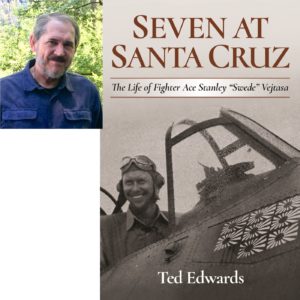
WWII history book – “Seven at Santa Cruz” (Naval Institute Press, 2018) – Ted Edwards interview

Ted Edwards grew up around WWII veterans and ended up studying history in college. He’s a mountaineer and involved with US Gymnastics and kept journals about his experiences. These varied interests resulted in a meeting with some famed WWII naval aviators and he ended up writing a book about one of them. I interviewed him about the new book.

[Editor’s note: Mr. Edwards mentioned an “A-team” but he meant Lundstrom’s First not A Team. He also mentions Joe Stapp but he meant John.]

1:58 – Ted first discusses how he got into writing and history. He was born in 1945 and grew up around WWII veterans. He became fascinated with military history. He learned how to write history at Stonybrook.

4:31 – He took up journaling and did so when he did mountaineering and was involved with US gymnastics.

5:01 – He attended an event for men who had been on the USS Enterprise and he met a man who who flew on the Enterprise and wrote a book about it. Ted was then introduced to Swede and they spoke a while.

7:21 – Swede had done a lot on the Enterprise but none of the official accounts of his exploits matched. They then discussed what actually happened during his career. Swede then let Ted record and then write about Swede’s career. It was an 8 year endeavor.

10:02 – The book talks about the A-team, which were the first group of pilots who fought the Japanese after Pearl Harbor. The book also talks about leadership failures including those of Admiral Kincaid. There is also a discussion of Medal of Honor politics.

12:20 – Swede saw a report about one of his important missions that was supposed to have been written by him but he said he was certain he never wrote the report. Swede kept his own journal during his life.

15:31 – Swede went on missions right after Pearl Harbor and said that even a month later the devastation was apparent.

18:43 – Bill Birch, Swede’s old squadron commander, had taught Swede and fellow pilots a lot about dogfighting which helped him achieve success.

20:50 – He switched to fighters after success as a bomber pilot.

22:04 – The day before the battle of Santa Cruz might be more important than the battle itself. Swede’s group had a terrible patrol that made the battle that much more difficult.

23:36 – Swede was shocked when he heard that Admiral Kincaid was in charge of the carrier task force before Santa Cruz because Kincaid wasn’t an aviator.

25:17 – Kincaid creates a Wildcat strike group to go out 300 hundred plus miles and Swede objected because of the distance but they’re sent out.

27:08 – The patrol found nothing and returned late even though almost none of them was qualified for night landing. Then the Enterprise wasn’t where it was supposed to be and it was dark. They followed an oil slick to find the ship.

33:31 – The US rotated its veteran aviators to train young pilots whereas the Japanese used their best pilots until they died. Swede didn’t like being made an instructor but he did enjoy being an instructor once he started.

37:31 – He was made CO of the Constellation in the 1960s but there was a fatal accident that hurt his career. He took responsibility for it though.

40:31 – Ted interviewed a number of WWII naval aviators for the book.

45:09 – Swede told Ted about John Stapp who was studying the forces on pilots when they ejected from planes.   John used a high speed spinning sled to test this and Swede was offered a ride and declined because John got beat up by the machine. John became famous for this and got seat belts mandated for cars.

51:01 – Ted had to learn the format that Naval Institute Press used for his books before he could finish it.

For more “Military History Inside Out” please follow me on Facebook at warscholar, on twitter at Warscholar, on youtube at warscholar1945 and on Instagram @crisalvarezswarscholar


Guests: Ted Edwards

Host: Cris Alvarez

Tags: military, history, military history, conflict, war, interview, non-fiction book, stonybrook, corsair, wildcat, enterprise, constellation, aviation accidents, torpedo bombers, dive bombers, combat air patrol

Early 20th Century naval history – Learning War – Trent Hone interview

Trent Hone was written frequently on US Naval history. I interviewed him about his upcoming book Learning War: The Evolution of Fighting Doctrine in the US Navy, 1898-1945 to be published by the Naval Institute Press.

1:45 – Mr. Hone discusses some of his earlier naval doctrine writing. He’s written about night combat in the US Navy in early WWII. He also wrote on how naval doctrine changed over WII. He’s collaborated on different navy history projects. He helped with the WWI navy book To Crown the Waves.

4:45 – Mr. Hone discusses his current book. From the 1890s to the 1940s, the Navy became a learning organization.

8:28 – The Spanish American war is where the US Navy realizes it needs a new institutional structure. This leads to the creation of the General Board in the Navy. Also, there’s a conflict between engineering officers versus line officers. Line officers were then required to be engineering officers and the Naval Academy changed its focus to engineering too.

10:59 – After the Spanish-American war, the US becomes a global empire. The new territories are across the oceans. The General Board thinks seriously about what the Navy should look like with these new overseas commitments.

13:40 – The board is made up of navigation, intelligence, the head of the Navy, and the others. Some leaders in the Navy didn’t trust the Board since it put civilian control over the Navy. The board leads the creation of the Chief of Naval Operations.

16:42 – Surface tactics change before WWI. The Atlantic Fleet was established and the Navy learns how to fight as a fleet rather than as squadrons. They also learn how to use torpedoes in combat. New communications are developed for tactical exercises and new ideas created for independent action.

20:30 – The US Navy went into WWI ready for a big fleet action. But Germany instead uses U-boats to win the war. The US Navy then rushed to built ships good for fighting U-boats.

22:45 – In 1916, the Navy starts to realize that there are many different ways wars can be fought. The Navy begins to grapple with how aviation can be used in the fleet. Submarines are also an uncertainty as far as what their role will be in war.

25:42 – The idea that the Navy was focused on battleships for the next war is a pervasive belief. This idea is tied with the Gun Club, which were admirals focused on big gun battles. There was more diversity in thinking about how the next war would be fought.

29:00 – WWII leaders were adept at using all their available technologies. The Navy generally did promote the best rather than those who were connected politically. Performance mattered. The Navy also created good ways to exchange feedback about important issues. There was also a great deal of creativity during tactical exercises.

32:52 – Mr. Hone looked at exercise reports and doctrinal manuals. But they lacked context about how these ideas were created. He looked at various primary and secondary sources in the National Archives and the Navy War College archives.

37:21 – PBYs were used at night during WWII. There was a large pre-WWII effort to get patrol planes and ships to work together at night. The Navy was also working on destroyer night combat before WWI.

42:00 – Mr. Hone was surprised at how far back some Navy innovations went. He would like to do more research on how the large the spheres of influence of some officers were.

44:22 – Mr. Hone focused on one action on November 13, 1942 at Guadalcanal. History has said that Officer Callahan was confused and overwhelmed at Iron Bottom. However, Navy documents suggest that he used his force the way they were expected to be used against a Japanese battleship.

48:06 – The US Navy learned quicker than the Japanese Navy in WWII and this came from the organizational structure.

53:00 – Guadalcanal has many wrecks that provide information on how the Naval campaign was waged.

53:47 – The book will be on USNI.org and Amazon. His personal website is trenthone.com.

55:00 – The Navy planned for a campaign against the Japan in WWII but they didn’t have an idea of how they would end the campaign. The Japanese focus was on one big battle and they pursued that idea throughout. Pearl Harbor, Midway, and Leyte Gulf were Japanese big battle concepts.

Links

https://www.usni.org/store/books/ebook-editions/crown-waves

https://www.usni.org/

https://trenthone.com/

For more “Military History Inside Out” please follow me on Facebook at warscholar, on twitter at Warscholar, on youtube at warscholar1945 and on Instagram @crisalvarezswarscholar

Guests: Trent Hone

Host: Cris Alvarez