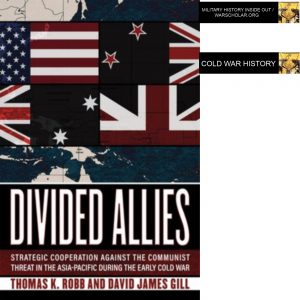
Cold War military history book – “Divided Allies” (Cornell University Press, 2019) – Thomas Robb interview

Dr. Thomas Robb is a historian who studies and teaches British and US military history. We spoke about his latest co-authored book on how the ANZUS and SEATO treaties were developed. Check out the book here.

0:44 – Thomas Robb talks about how he got into writing on Cold War Asia-Pacific military relations.

4:03 – Thomas talks about how he begins the book with WWII and moves into the Cold War chronologically.

6:38 – Thomas talks about Australia’s strong concern about tPacific regional security.

8:25 – Thomas discusses France’s decline and Japan’s importance.

8:48 – Thomas talks about West’s concern with Japan’s resurgence economically.

10:04 – Thomas discusses China’s role in the region.

11:50 – Thomas talks about the Soviet role in the Pacific region.

14:12 – Thomas mentions Soviet pilots in the Korean War.

14:52 – Thomas talks about economic versus national needs of the four nations involved.

16:26 – Thomas mentions complaints about ANZUS.

18:38 – Thomas talks about the approach to nuclear weapons.

21:21 – Thomas discusses the US need for the treaty.

22:03 – Thomas talks about the relative military strengths of the four nations negotiating the treaties.

22:27 – Thomas says NZ and Australia were diplomatically punching above their weight.

22:45 – The Philippines not included in ANZUS.

24:57 – Thomas talks about how each nation could militarily contribute to the alliance.

26:01 – A cordon defense would go nuclear.

27:59 – Thomas talks about western concerns that Japan would become communist.

29:05 – Japanese reparations are discussed.

29:45 – Japanese strategic value was shown.

30:59 – Thomas talks about the payment of German reparations after WWI and compares that to the idea of having Japan pay reparations.

32:55 – Thomas talks about British strategic goals and aliances.

34:00 – The US prodded Britain to drop japan as an ally.

34:57 – Thomas talks about Churchill’s sentimentality.

35:54 – Thomas talks about how domestic politics impacted these treaty negotiations.

37:12 – The public used an excuse to not legitimize some treaty negotiations.

38:50 – The Eisenhower library just released a bunch of previously classified documents.

39:42 – Thomas talks about the archives he used for his research including various Presidential libraries.

42:23 – Thomas talks about going to the Truman library.

43:52 – The UK was angry that Australia and New Zealand went off without them and joined the US.

47:54 – Thomas talks about the interplay of racial ideas influenced policy.

50:44 – Thomas talks about how some of the American negotiators had very intense military ideas.

51:25 – Some of the Americans seemed bonkers to the Australians in their goals.

53:47 – The British met with press barons to impugn the character of a foreign minister over ANZUS negotiations.

1:00:19 – Thomas talks about a new project to study the political economy of the US Civil War.

Links of interest

Check out the book here.

https://www.cornellpress.cornell.edu/book/9781501741845/divided-allies/#bookTabs=3

https://twitter.com/obucoldwarrior

For more “Military History Inside Out” please follow me at www.warscholar.org, on Facebook at warscholar, on twitter at Warscholar, on youtube at warscholar1945 and on Instagram @crisalvarezswarscholar. Or subscribe to the podcast on Apple Podcasts | Stitcher | Spotify

Guests: Thomas Robb

Host: Cris Alvarez

Tags: military, history, military history, conflict, war, interview, non-fiction book, asia-pacific, australia, new zealand, cold war, wwii, world war two, great britain, united states, united kingdom, japan, france, communism, china, NATO, korean war, ANZUS, nuclear weapons, macarthur, truman, philippines, okinawa, malay, SEATO, dean acheson, Russian Empire, Churchill, france, Dulles, US Civil War

Modern warfare book – “The Decline of European Naval Forces” (Naval Institute Press, 2018) – Jeremy Stöhs interview

Jeremy Stöhs is an Austrian-American defense analyst at the Institute for Security Policy at Kiel University and its adjunct Center for Maritime Security & Strategy. I interviewed him about his new book “The Decline of European Naval Forces.”

1:28 – Jeremy talks about where his interest in history started. His parents were his first inspiration. He did mandatory military service in Austria and then joined the police for a short time. Then he left the police and studied history. He joined a think tank about intelligence matters, historic and contemporary security matters.

3:52 – He studies the period of the 80s to the end of the Cold War. Much information is classified so he needs to use other open sources.

6:50 – There is no comprehensive overview of European navies since the end of the Cold War.

9:07 – Some nations at the end of the Cold War prudently saw the end of the Soviet Union coming. But many did not. Most were focused on waging a conventional or nuclear war against a peer adversary. They were focused on controlling sea lines of communication. The US naval strategy was to put pressure on the Soviet flanks and the NATO countries followed the US lead. Sea control and sea denial and controlling SLOCs.

13:22 – Jeremy includes 11 European nations in his study. Denmark and Germany quickly shifted to out of area deployments. Britain switched from anti-submarine warfare to focusing on out of area deployments.

15:23 – Maritime traffic increased year by year after the end of the Cold War. A lot of maritime traffic has moved to Asia. Small conflicts popped up after the Cold War and European navies started deploying to areas they hadn’t been before. The Mediterranean, red Sea and the Horn of Africa. But many focused on territorial defense.

17:52 – Greece and Turkey began building similar naval forces to counter each other.

18:52 – Jeremy’s book is budgetary and platform specific. He looks at the physical make up of the navies. He also looks at men and material. Many have realized they’ve under-invested. But too many focus on the big Navy idea that the US has developed.

23:52 – Many of these navies have experienced a steep decline in their navies. However individual ships are of much higher quality than individual ships from 25 years ago. Current ships have much more battlespace awareness and are more proficient at war and other tasks.

25:37 – Through the 1990s, high intensity conflict skills atrophied, whereas low intensity conflict capabilities grew. European navies are much better at low intensity than they were 30 years ago.

27:24 – He looked at official grand strategy, military strategy, naval strategy and then naval maritime doctrine open source documents. He also used official statements about the navies. There is also a lot of secondary sources for military technology.

30:08 – The maritime research community is small and very helpful among its members. A lot of governments and citizens don’t understand the importance of maritime issues so maritime researchers feel the need to work together.

35:04 – Europeans are no longer as connected to the oceans as they used to be. But people are beginning to realize the importance of the navy again. They have more than a military role. Navies also have a constabulary role. The 2007 debt crisis hurt a lot of these navies.

39:22 – European navies are highly professional. They can really work well together especially among NATO countries.

42:26 – However Jeremy was surprised by how steep the decline was in the navies. Navy capabilities take decades to develop but the politicians haven’t thought in this time frame. Governments didn’t have the money for navies. The Dutch navy for example was slashed. Germany has decided to become more expeditionary but they can’t build the platforms they need for this.

46:52 – Jeremy will continue to focus on European naval forces. His book will become dated as soon as it is published. He wants to find out what the internal conversations were in these countries. He wants to speak with more decision makers. Some sources up to 1996 and 1998 are being declassified.

50:33 – There’s a huge focus on the US and Chinese navies but no one is studying European navies as a whole. Even landlocked countries can help with maritime security. He hopes the book will raise eyebrows in the US. He also wants to highlight his think tank in Kiel.

53:25 – It’s becoming increasingly difficult for young scholars to get books published. Jeremy feels very fortunate that the naval Institute would publish his book.

54:44 – The Institute for Security Policy at Kiel University can be found www.kielseapowerseries.com. They are in twitter as kielseapowerseries. They have a big conference every June.


Links

https://www.kielseapowerseries.com/en/

https://www.ispk.uni-kiel.de/de/mission-statement

Twitter: @SeapowerSeries


For more “Military History Inside Out” please follow me on Facebook at warscholar, on twitter at Warscholar, on youtube at warscholar1945 and on Instagram @crisalvarezswarscholar


Guests: Jeremy Stöhs (Jeremy Stohs)

Host: Cris Alvarez