Battles of January 27 summaries plus museums, artwork, books and songs

Battles of January 27 including descriptions of the battles, geographic locations, associated artwork, and museums where a person can find associated artifacts and artwork.

Songs of the day:

To Start Anew – variation 1 (Yiddish folk song)

To Start Anew – variation 2 (Yiddish folk song)

Tokugawa Fallen (Traditional Japanese Minyo Song)

Fushimi Shadows (Skate Punk Modern Song)

Restoration Dawn – variation 1 (Pop Funk Modern Song)

Restoration Dawn – variation 2 (Pop Funk Modern Song)

1. Battle of Toba-Fushimi

Date: January 27, 1868 (January 27-31, 1868)

War: Boshin War (Japan)

Cause: Tensions had reached a breaking point between the forces of the Imperial Court (allied with the Satsuma and Chōshū domains) and the Tokugawa Shogunate. Following the Shogun Tokugawa Yoshinobu’s “resignation,” dissatisfactions regarding his continued influence led him to march his army from Osaka toward Kyoto to deliver a letter of protest to the Emperor, sparking a direct military confrontation.

Result: Decisive Imperial victory. Despite being outnumbered 3 to 1, the Imperial forces possessed superior modern weaponry (Armstrong guns and Minie rifles). The defeat of the Shogunate forces shattered their morale and ultimately led to the Fall of Edo and the Meiji Restoration, modernizing Japan.

Paintings & Art Painting: Picture of the Great Battle of Toba-Fushimi (Toba Fushimi Daisenso no Zu)

  • Artist: Unknown / Utagawa School (Often attributed to artists like Mousai or Utagawa Kuniteru II who created woodblock prints of the event).
  • Year: c. 1868

Museums & Artifacts Kyoto National Museum (Kyoto, Japan)

  • Description of holdings: The museum holds a significant collection of artifacts from the Meiji Restoration era, including Nishiki-e (woodblock prints) depicting the battle, imperial uniforms, and weaponry used by the “Satcho” alliance.

Location

  • General: Fushimi Ward, Kyoto, Japan.
  • Coordinates: 34°55′47″N 135°44′25″E

Recommended Book The Collapse of the Tokugawa Bakufu, 1862–1868 by Conrad Totman.


2. The Lifting of the Siege of Leningrad (Operation January Thunder)

Date: January 27, 1944 (Official end of the siege) (September 8, 1941-January 27, 1944)

War: World War II (Eastern Front)

Cause: German Army Group North had besieged the city of Leningrad (St. Petersburg) since September 1941, aiming to starve the city into submission. The Soviet Leningrad-Novgorod Strategic Offensive was launched to permanently drive German forces away from the city outskirts.

Result: Soviet victory. On January 27, Joseph Stalin formally announced the end of the siege. It was the deadliest blockade in human history, resulting in over 1 million civilian deaths, but the city was never taken.

Paintings & Art Painting: Leningrad Woman (Leningradka)

  • Artist: Yaroslav Nikolaev
  • Year: 1942 (Created during the siege)

Museums & Artifacts State Memorial Museum of the Defense and Siege of Leningrad (St. Petersburg, Russia)

  • Description of holdings: This museum is entirely dedicated to the event. It houses personal diaries (including that of Tanya Savicheva), bread ration cards, shrapnel, improvised stoves (“burzhuyka”), and extensive art collections created by artists trapped within the city during the blockade.

Location

  • General: St. Petersburg, Russia (The siege perimeter surrounded the city).
  • Coordinates: 59°56′N 30°19′E

Recommended Book Leningrad: The Epic Siege of World War II, 1941-1944 by Anna Reid.


3. Liberation of Auschwitz (Vistula–Oder Offensive)

Date: January 27, 1945

War: World War II

Cause: As part of the massive Soviet Vistula–Oder Offensive, the Red Army pressed west across Poland toward Germany. The 60th Army of the First Ukrainian Front advanced upon the town of Oświęcim to secure the area and key bridges.

Result: Soviet Victory / Liberation. Soldiers of the 322nd Rifle Division entered the camp, encountering brief resistance from retreating German units. They liberated approximately 7,000 surviving prisoners. The date is now commemorated internationally as Holocaust Remembrance Day.

Paintings & Art Painting: Arrival of a Transport (and other sketches)

  • Artist: David Olère (A survivor who worked in the Sonderkommando; his art is primary visual testimony).
  • Year: c. 1946–1950s

Museums & Artifacts Auschwitz-Birkenau State Museum (Oświęcim, Poland)

  • Description of holdings: The site itself is a living museum, preserving the barracks, gas chambers, and crematoria. Collections include piles of victims’ shoes, suitcases with names, canisters of Zyklon B, and art created illegally by prisoners during their captivity.

Location

  • General: Oświęcim, Lesser Poland Voivodeship, Poland.
  • Coordinates: 50°02′09″N 19°10′42″E

Recommended Book Auschwitz: A New History by Laurence Rees.

Books for sale

WarScholar Press

Contact Information

For more “Military History Inside Out” please follow me at www.warscholar.org, on Facebook at warscholar, on twitter at Warscholar, on youtube at warscholar1945 and on Instagram @crisalvarezswarscholar. Or subscribe to the podcast on Apple Podcasts | Google Podcasts | Stitcher | Spotify

Tags: military museum, military artwork, battles, Military History, War History, Battle Art, War Paintings, War Art, Military Art, Museum Visit, Art History, Historical Artifacts, Museum Collection, Battlefield Tours, History Museum, Museum Life, History In Art, Historic Preservation, January 27, On This Day, History, Military History, War History, Historical Events, History Buff, World History,  Boshin War, Samurai History, Meiji Restoration, Siege Of Leningrad, WWII, Eastern Front, Red Army, Auschwitz, Holocaust Remembrance Day, We Remember, Never Again, Kyoto National Museum, Dark Tourism, Memorial

As an Amazon Associate I earn from qualifying purchases.
Military History Inside Out banner

Battles of January 26 summaries plus museums, artwork, books and songs

Battles of January 26 including descriptions of the battles, geographic locations, associated artwork, and museums where a person can find associated artifacts and artwork.

Songs of the day:

Ula Grave (Traditional Russian Bylina)

Vilnius Victorious (Lithuanian traditional 16th century ballad)

1. Battle of Ula (Battle of Chashniki)

Date: January 26, 1564

War: Livonian War (1558–1583)

Cause: The Tsardom of Russia, seeking to expand its access to the Baltic Sea, launched a massive invasion into the Grand Duchy of Lithuania. Two Russian armies intended to link up near Orsha to march on the capital, Vilnius.

Result: A decisive Lithuanian victory. Despite being outnumbered (approx. 4,000 Lithuanians against 20,000–30,000 Russians), the Lithuanian forces led by Mikołaj “the Red” Radziwiłł surprised the Russian column. The Russian commander, Pyotr Shuysky, was killed, and the Russian advance was halted, saving Vilnius from siege.

Paintings & Art

  • Art: Battle of Ula (Commemorative Medal)
    • Artist: Lina Kalinauskaitė
    • Year: 2016 (Modern commemorative art in the style of Renaissance medals)
    • Note: While contemporary 16th-century woodcuts exist in chronicles, this modern relief medal is a significant artistic work dedicated specifically to this battle.

Museums & Artifacts

  • National Museum of Lithuania (Vilnius, Lithuania): Holds armor, weaponry, and numismatic collections from the Grand Duchy era, including items related to the campaigns of the Radziwiłł family.
  • Kremlin Armory Museum (Moscow, Russia): Contains weaponry and regalia from the era of Ivan the Terrible, providing context for the Russian forces involved.

Location

  • General: Ula River, north of Chashniki, Vitebsk Region, modern-day Belarus.
  • Coordinates: 54°53′51″N 29°09′18″E

Recommended Book

  • The Livonian War 1558–1582 by Alexander Filjushkin.

2. Battle of Talikota

Date: January 26, 1565

War: Conflicts between the Deccan Sultanates and the Vijayanagara Empire

Cause: Four Deccan Sultanates (Bijapur, Bidar, Ahmadnagar, and Golconda) formed a grand alliance to crush the power of the Vijayanagara Empire, whose dominance and interference in Sultanate affairs had become intolerable to them.

Result: Decisive Sultanate victory. The Vijayanagara leader Rama Raya was captured and beheaded. The capital city of Vijayanagara (Hampi) was sacked and destroyed, leading to the collapse of the empire.

Paintings & Art

  • Painting: Battle of Talikota (Miniature painting from the Ta’rif-i Husain Shahi)
    • Artist: Unknown Court Artists of Ahmadnagar
    • Year: c. 1565–1569
  • Painting: Panorama of the Battle of Talikota
    • Artist: Unknown (Deccan School)
    • Year: Late 16th Century

Museums & Artifacts

  • Bharata Itihasa Samshodhaka Mandala (Pune, India): Houses the original Ta’rif-i Husain Shahi manuscript containing miniatures of the battle.
  • Salar Jung Museum (Hyderabad, India): Contains an extensive collection of Deccan arms, armor, and manuscripts from the Sultanate period.
  • Archaeological Museum (Kamalapura/Hampi, India): Located near the ruins, it houses sculptures and weapons recovered from the destroyed capital.

Location

  • General: Near the villages of Rakkasagi and Tangadigi, south of the Krishna River, Karnataka, India.
  • Coordinates: 16.4799° N, 76.2735° E.

Recommended Book

3. Battle of Montjuïc

Date: January 26, 1641

War: The Reapers’ War (Catalan Revolt)

Cause: The principality of Catalonia revolted against the Spanish Crown due to the stationing of troops and heavy taxation. A large Spanish army was sent to crush the rebellion and advanced to the walls of Barcelona.

Result: A Catalan victory. A hasty force of Catalan militia, aided by French cavalry, successfully defended the strategic hill of Montjuïc against the seasoned Spanish tercios. The Spanish commander, the Marquis of Los Vélez, was forced to retreat, consolidating the rebellion.

Paintings & Art

  • Painting: Batalla de Montjuïc, el 1641
    • Artist: Pandolfo Reschi
    • Year: c. 1641–1670 (17th Century)

Museums & Artifacts

  • Montjuïc Castle (Barcelona, Spain): The fortress itself is the primary artifact, housing a military museum with weapons, uniforms, and maps detailing the battle and the defense of the city.
  • Galleria Corsini (Florence, Italy): Holds the original Pandolfo Reschi painting depicting the battle scene.

Location

  • General: Montjuïc Hill, overlooking Barcelona, Spain.
  • Coordinates: 41°21′49″N 2°09′54″E

Recommended Book


4. Fall of Khartoum

Date: January 26, 1885 (Part of the Siege of Khartoum March 13, 1884-January 26, 1885)

War: The Mahdist War

Cause: An Islamist revolt led by the Mahdi (Muhammad Ahmad) besieged the Egyptian-held city of Khartoum, which was defended by the British General Charles Gordon. The Mahdist forces launched a final assault before a British relief column could arrive.

Result: Mahdist victory. The city’s defenses were breached, the garrison was massacred, and General Gordon was killed. The British relief force arrived two days too late, leading to the withdrawal of British forces from Sudan for over a decade.

Paintings & Art

  • Painting: General Gordon’s Last Stand
    • Artist: George William Joy
    • Year: 1893

Museums & Artifacts

  • Leeds Art Gallery (Leeds, United Kingdom): Houses the famous painting by George William Joy.
  • The Gordon Highlanders Museum (Aberdeen, Scotland): Contains personal artifacts, letters, and uniforms associated with General Gordon and the relief expedition.
  • Khalifa House Museum (Omdurman, Sudan): Located across the Nile from Khartoum, this museum (the former house of the Mahdi’s successor) houses weapons, banners, and relics from the Mahdist forces.

Location

  • General: The Governor-General’s Palace, Khartoum, Sudan.
  • Coordinates: 15°36′11″N 32°31′39″E

Recommended Book


5. Battle of Seattle

Date: January 26, 1856

War: Puget Sound War

Cause: Native American tribes (including elements of the Yakama and Nisqually), frustrated by treaty violations and land encroachment, launched an attack on the fledgling settlement of Seattle.

Result: US/Settler victory. The settlers, aided by Marines from the USS Decatur anchored in Elliott Bay, repelled the attack using cannon fire. The battle marked a turning point in securing the settlement, though tensions remained high.

Paintings & Art

  • Painting: Battle of Seattle
    • Artist: Emily Inez Denny
    • Year: c. 1890s (Painted by a survivor of the pioneer era)

Museums & Artifacts

  • MOHAI (Museum of History & Industry) (Seattle, USA): Holds the original Emily Inez Denny painting, as well as a cannonball fired during the battle and other pioneer-era artifacts.
  • Log House Museum (Seattle, USA): Located near Alki Beach, offering local history on the Duwamish tribe and early settler relations.

Location

  • General: Downtown Seattle (Pioneer Square area), Washington, USA.
  • Coordinates: 47°36′02″N 122°19′56″W

Recommended Book


6. Operation Ring (Meeting of the Fronts at Stalingrad)

Date: January 26, 1943 (Part of the Battle of Stalingrad July 17, 1942-February 2, 1943)

War: World War II (Eastern Front)

Cause: Part of “Operation Ring,” the final Soviet offensive to destroy the encircled German forces in Stalingrad. The goal was to slice the German pocket in half.

Result: Soviet victory. The Soviet 21st Army linked up with the 62nd Army at Mamayev Kurgan. This meeting physically split the German 6th Army into two isolated pockets (North and South), making coordinated German resistance impossible and leading to their surrender days later.

Paintings & Art

  • Painting: The Defeat of Fascist Forces at Stalingrad (The Stalingrad Panorama)
    • Artists: A collective of artists from the Grekov Studio of War Art
    • Year: Completed 1982 (Depicts the January fighting)

Museums & Artifacts

  • The Battle of Stalingrad Museum-Panorama (Volgograd, Russia): Houses the massive 360-degree panoramic painting of the battle and thousands of artifacts, including weapons, uniforms, and personal letters from both sides.
  • Mamayev Kurgan Memorial Complex (Volgograd, Russia): The actual site of the fierce fighting and the meeting of the fronts, now a massive memorial park dominated by “The Motherland Calls” statue.

Location

  • General: Mamayev Kurgan hill, Volgograd (formerly Stalingrad), Russia.
  • Coordinates: 48°44′33″N 44°32′13″E

Recommended Book

Books for sale

WarScholar Press

Contact Information

For more “Military History Inside Out” please follow me at www.warscholar.org, on Facebook at warscholar, on twitter at Warscholar, on youtube at warscholar1945 and on Instagram @crisalvarezswarscholar. Or subscribe to the podcast on Apple Podcasts | Google Podcasts | Stitcher | Spotify

Tags: military museum, military artwork, battles, Military History, War History, Battle Art, War Paintings, War Art, Military Art, Museum Visit, Art History, Historical Artifacts, Museum Collection, Battlefield Tours, History Museum, Museum Life, History In Art, Historic Preservation, January 26, On This Day, History, Military History, War History, Historical Events, History Buff, World History, Battle Of Ula, Livonian War, Reapers War, Battle Of Montjuic, Catalan History, General Gordon, Khartoum 1885, Mahdist War, Battle Of Seattle, Puget Sound War, Stalingrad, Operation Ring, WWII History, Eastern Front, MOHAI, Stalingrad Panorama, Leeds Art Gallery, Talikota, Vijayanagara, Deccan Sultanate, Indian History

As an Amazon Associate I earn from qualifying purchases.
Military History Inside Out banner

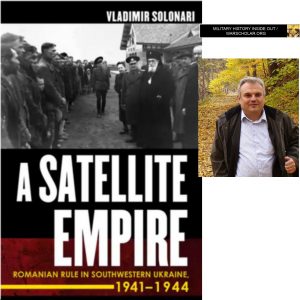
WWII military history book – “A Satellite Empire” (Cornell University Press, 2019) – Vladimir Solonari interview

Dr. Vladimir Solonari is a history professor at the University of Central Florida. He has written extensively on ethnic cleansing in Romania during WWII and we discussed his latest book on Romanian occupation of Transnistria in Ukraine during WWII. Check out the book here.

0:45 – Vladimir talks about why he is writing about Romanian occupation of Ukraine during WWII.

2:43 – Vladimir talks about the geography of the Ukrainian region the book focuses on.

5:58 – Vladimir talks about German post-WWII plans for this Ukrainian region had Germany won the war. Romania was trying to get Transylvania back.

8:18 – Vladimir talks about how the progress of Operation Barbarossa affected Romanian strategic plans for this region.

12:19 – Vladimir talks about how Romanian troops were deployed around the Eastern Front and used.

14:42 – Vladimir talks about Romanian elite troops known as “mountain shooters”.

15:30 – Vladimir talks about Romanian policing of the Transnistria region. He discusses Soviet created terrorist groups used to harass the Romanians. He also discusses local partisan groups.

22:35- Vladimir talks about how Romania conducted ethnic cleansing of Jews, Roma, Ukrainians, Bulgarians, and Hungarians and moved them to Transnistria. He also discusses how typhus spread through the camps.

27:05 – Vladimir talks about whether the Romanians used specialized troops to massacre ethnic prisoners.

29:55 – Vladimir talks about how some Romanian officers opposed ethnic cleansing. Ethnic German villages were willing to conduct ethnic cleansing in this region.

33:30 – Vladimir talks about how Romania wanted to show its power on the world stage and to Europe.

36:30 – Vladimir talks about German perceptions of Eastern Europe as an empty space that needed order.

38:07 – Vladimir talks about the archives he used for his research.

39:31 – Vladimir relates a story about an aspiring composer in Odessa who was living a double life and pining over a lost love.

46:05 – Vladimir talks about how the Romanian government withdrew their approval for him to use certain photographs in his book.

47:46 – Vladimir talks about visiting a museum and the catacombs of Odessa.

57:14 – Vladimir talks about the complexity of the whole situation.

59:58 – Vladimir tried to determine how much the German and Romanian occupation attitudes depended on racist ideas.

1:07:30 – Vladimir talks about the legalities that the Romanians applied to conducting their ethnic cleansing.

Links of interest

Check out the book here.

https://www.cornellpress.cornell.edu/book/9781501743184/a-satellite-empire/

https://history.cah.ucf.edu/faculty-staff/?id=318

For more “Military History Inside Out” please follow me at www.warscholar.org, on Facebook at warscholar, on twitter at Warscholar, on youtube at warscholar1945 and on Instagram @crisalvarezswarscholar

Guests: Vladimir Solonari

Host: Cris Alvarez

Tags: military, history, military history, conflict, war, interview, non-fiction book, Romania, ukraine, world war ii, wwii, ethnic cleansing, Odessa, Russia, USSR, Germany, fascism, communism, transylvania, transnistria, Moldova, operation barbarossa, crimea, sevastopol, stalingrad, eastern front, Hitler, mountain shooters, spy networks, terrorists, intelligence, partisan, stukas, jewish, hungary, bulgaria, roma, typhus, Antonescu, police, gendarme, colonialism, US Holocaust Museum, Sviatoslav Richter, NKVD, cannibalism, Stalin, cornell