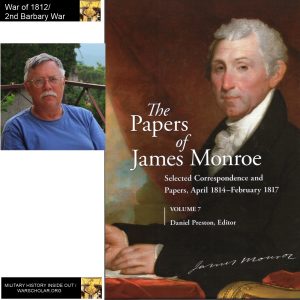
War of 1812 military history book – “The Papers of James Monroe, Volume 7” – (ABC-CLIO, 2020) – Dan Preston interview

Check out this book here   https://amzn.to/3dIM4ok

Dr. Daniel Preston has spent much of his career compiling and editing the papers of early American Revolution hero and then President James Monroe. We spoke about the latest completed volume of his papers, volume 7, which covers the middle and end of the War of 1812 and then naval expeditions to the North African coast.

1:23 – Dan talks about how he got into studying James Monroe.

2:30 – Dan talks about the War of 1812.

5:16 – Dan talks about US incursions into foreign territory.

6:48 – Dan talks about Monroe’s feelings on the readiness of the US Army in this time.

10:11 – Dan talks about Monroe’s feelings about the War of 1812.

13:20 – Dan talks about what Monroe did as Secretary of War in the fall of 1814.

20:16 – Dan talks about worries that the British would win.

24:58 – Dan talks about the US military and Native Americans.

28:57 – Dan talks about the Native American military threat to the US.

34:37 – Dan talks about the Second Barbary War with Algeria and the South American revolutions.

38:31 – Dan discusses details of the Second Barbary War.

42:14 – Dan talks about the possibility of a US Britain alliance against common enemies.

46:29 – Dan talks about the financial troubles of both the US and Britain and the burning of Washington, DC.

49:56 – Dan goes into detail about the burning of Washington.

51:04 – Dan talks about Monroe’s ideas on defending Washington.

59:43 – Dan talks about the large volume of letters he had to research.

1:02:57 – Dan talks about where the Monroe letters and documents are found.

1:04:35 – Dan talks about President Madison’s cabinet.

1:06:32 – Dan talks about commentaries on the documents

1:09:29 – Dan talks about documents they couldn’t find.

1:10:55 – Dan talks about Monroe’s uncertain birthday.

1:12:43 – Dan’s work and the papers can be found on amazon and on the University of Mary Washington website and by searching “Monroe Papers” or at Academics.umw.edu/jamesmonroepapers.


Links of interest

https://amzn.to/3dIM4ok

https://products.abc-clio.com/abc-cliocorporate/product.aspx?pc=B5565C

https://academics.umw.edu/jamesmonroepapers/

For more “Military History Inside Out” please follow me at www.warscholar.org, on Facebook at warscholar, on twitter at Warscholar, on youtube at warscholar1945 and on Instagram @crisalvarezswarscholar. Or subscribe to the podcast on Apple Podcasts | Stitcher | Spotify

Guests: Dan Preston

Host: Cris Alvarez

Tags: military, history, military history, conflict, war, interview, non-fiction book, James Monroe, Jefferson, James Madison, Presidency, Florida, Texas, Virginia, militia, Continental Congress, filibuster, France, Napoleonic Wars, engineers, coastal defenses, British Army, Royal Navy, Chesapeake, Baltimore, Washington, US history, American history, Andrew Jackson, Mobile, New Orleans, Long Island, New England, New York, Henry Dearborn, Canada, Maine, Tennessee Volunteers, Europe, Great Britain, Monroe doctrine, Republicanism, French Revolution, Native Americans, Creeks, Shawnee, Miami, Winnebago, Wyandot, Huron, Algiers War, Spain, Barbary, Libya, Tripoli, Morocco, US Navy, merchant fleet, Mediterranean, American Diplomatic Service, Great Lakes, Michigan, Washington DC, Philadelphia, New York, Patuxent, Alexandria, Stephen Decatur, Oliver Hazard Perry, Library of Congress, New York Public Library, National Archives, Barbary War

Check out this book here   https://amzn.to/3dIM4ok

As an Amazon Associate I earn from qualifying purchases.
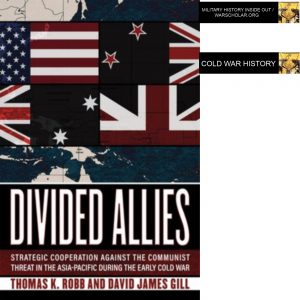
Cold War military history book – “Divided Allies” (Cornell University Press, 2019) – Thomas Robb interview

Dr. Thomas Robb is a historian who studies and teaches British and US military history. We spoke about his latest co-authored book on how the ANZUS and SEATO treaties were developed. Check out the book here.

0:44 – Thomas Robb talks about how he got into writing on Cold War Asia-Pacific military relations.

4:03 – Thomas talks about how he begins the book with WWII and moves into the Cold War chronologically.

6:38 – Thomas talks about Australia’s strong concern about tPacific regional security.

8:25 – Thomas discusses France’s decline and Japan’s importance.

8:48 – Thomas talks about West’s concern with Japan’s resurgence economically.

10:04 – Thomas discusses China’s role in the region.

11:50 – Thomas talks about the Soviet role in the Pacific region.

14:12 – Thomas mentions Soviet pilots in the Korean War.

14:52 – Thomas talks about economic versus national needs of the four nations involved.

16:26 – Thomas mentions complaints about ANZUS.

18:38 – Thomas talks about the approach to nuclear weapons.

21:21 – Thomas discusses the US need for the treaty.

22:03 – Thomas talks about the relative military strengths of the four nations negotiating the treaties.

22:27 – Thomas says NZ and Australia were diplomatically punching above their weight.

22:45 – The Philippines not included in ANZUS.

24:57 – Thomas talks about how each nation could militarily contribute to the alliance.

26:01 – A cordon defense would go nuclear.

27:59 – Thomas talks about western concerns that Japan would become communist.

29:05 – Japanese reparations are discussed.

29:45 – Japanese strategic value was shown.

30:59 – Thomas talks about the payment of German reparations after WWI and compares that to the idea of having Japan pay reparations.

32:55 – Thomas talks about British strategic goals and aliances.

34:00 – The US prodded Britain to drop japan as an ally.

34:57 – Thomas talks about Churchill’s sentimentality.

35:54 – Thomas talks about how domestic politics impacted these treaty negotiations.

37:12 – The public used an excuse to not legitimize some treaty negotiations.

38:50 – The Eisenhower library just released a bunch of previously classified documents.

39:42 – Thomas talks about the archives he used for his research including various Presidential libraries.

42:23 – Thomas talks about going to the Truman library.

43:52 – The UK was angry that Australia and New Zealand went off without them and joined the US.

47:54 – Thomas talks about the interplay of racial ideas influenced policy.

50:44 – Thomas talks about how some of the American negotiators had very intense military ideas.

51:25 – Some of the Americans seemed bonkers to the Australians in their goals.

53:47 – The British met with press barons to impugn the character of a foreign minister over ANZUS negotiations.

1:00:19 – Thomas talks about a new project to study the political economy of the US Civil War.

Links of interest

Check out the book here.

https://www.cornellpress.cornell.edu/book/9781501741845/divided-allies/#bookTabs=3

https://twitter.com/obucoldwarrior

For more “Military History Inside Out” please follow me at www.warscholar.org, on Facebook at warscholar, on twitter at Warscholar, on youtube at warscholar1945 and on Instagram @crisalvarezswarscholar. Or subscribe to the podcast on Apple Podcasts | Stitcher | Spotify

Guests: Thomas Robb

Host: Cris Alvarez

Tags: military, history, military history, conflict, war, interview, non-fiction book, asia-pacific, australia, new zealand, cold war, wwii, world war two, great britain, united states, united kingdom, japan, france, communism, china, NATO, korean war, ANZUS, nuclear weapons, macarthur, truman, philippines, okinawa, malay, SEATO, dean acheson, Russian Empire, Churchill, france, Dulles, US Civil War