Battles of January 29 summaries plus museums, artwork, books

Battles of January 29 including descriptions of the battles, geographic locations, associated artwork, and museums where a person can find associated artifacts and artwork.

1. Battle of Brienne

Date: January 29, 1814

War: War of the Sixth Coalition (Napoleonic Wars)

Cause: Following the disastrous campaign in Russia and the defeat at Leipzig, Napoleon was fighting a defensive war on French soil. The Battle of Brienne was triggered by Napoleon’s attempt to surprise and crush the Prussian and Russian forces under Marshal Blücher before they could unite with the main Allied army.

Result: French Victory (Tactical). Napoleon successfully forced Blücher to retreat from the town of Brienne-le-Château, though he failed to destroy the Allied army. Both sides suffered heavy casualties, and Napoleon himself narrowly escaped capture by Cossacks during the night.

Paintings & Art

Painting: Battle of Brienne, 29th January 1814 Artist: Jean-Antoine-Siméon Fort Year: 1840

Museums & Artifacts

Musée Napoléon (Brienne-le-Château, France): Located in the very town of the battle, it houses personal artifacts of Napoleon, who attended military school there, and exhibits regarding the 1814 campaign. Palace of Versailles (Versailles, France): Houses the original Jean-Antoine-Siméon Fort painting in the Gallery of Battles.

Location

General: Brienne-le-Château, Aube, France Coordinates: 48°23′29″N 4°31′15″E

Recommended Book The Fall of Napoleon: The Allied Invasion of France, 1813-1814 by Michael V. Leggiere.

Imagined Painting
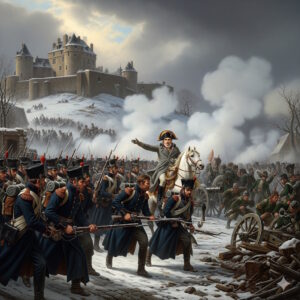
Part of the Battle Shown: This image depicts the French assault on the town and château of Brienne during the late afternoon. It captures the moment the French infantry, under Napoleon’s direct supervision, breached the initial defenses to drive Blücher’s forces out of the urban center.

Elements and Rationale:

  • The People & Uniforms: I included French infantry in their signature blue greatcoats and shakos to reflect the winter campaign gear of 1814. Napoleon is centrally placed on a white horse, a classic trope of Napoleonic art (like that of David or Gros) to signify leadership and the “miracle” of his presence during the defensive campaign. The Allied forces (Prussians/Russians) are shown in green and grey to distinguish them in the chaos.
  • The Weapons: Fixed bayonets are prominent to emphasize the close-quarters, high-stakes nature of street fighting where musket fire was often followed by a cold-steel charge.
  • The Buildings: The stone château is the focal point of the background because it was the strategic prize of the day and Napoleon’s former school, adding a layer of personal irony to the scene.
  • Background/Atmosphere: The heavy grey sky and snow-covered ground are essential for historical accuracy, as the 1814 campaign was fought in brutal winter conditions, which significantly hampered movement and morale.
  1. Battle of Bear River (Bear River Massacre)

    Date: January 29, 1863

War: American Civil War / Western Frontier Conflicts

Cause: Growing tensions between Mormon settlers, emigrants on the Oregon Trail, and the Northwestern Shoshone over resources and land. Colonel Patrick Edward Connor led a force of California Volunteers to “punish” the Shoshone for alleged attacks on travelers.

Result: Union/US Military Victory. It was a one-sided slaughter where roughly 250 to 400 Shoshone (including many women and children) were killed. It effectively broke the power of the Northwestern Shoshone in the region.

Paintings & Art

Painting: The Battle of Bear River (Mural) Artist: Edmond J. Fitzgerald Year: 1941

Museums & Artifacts

American West Heritage Center (Wellsville, Utah, USA): Contains exhibits on the Shoshone people and the regional history surrounding the conflict. Bear River Massacre Site (Preston, Idaho, USA): A National Historic Landmark with markers and commemorative plaques; the Northwestern Band of the Shoshone Nation is currently developing a cultural center at the site.

Location

General: Near Preston, Idaho, USA Coordinates: 42°08′46″N 111°54′44″W

Recommended Book The Shoshoni Frontier and the Bear River Massacre by Brigham D. Madsen.

Imagined Painting
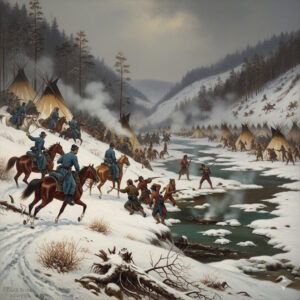
Description of the Painting (Style of 1860s-1880s): A wide, panoramic landscape painting showing the frozen Bear River in the foreground. U.S. Cavalry soldiers in dark blue uniforms are seen crossing the icy water and ascending the bluffs. In the middle ground, the Shoshone willow-brush lodges (wickiups) are visible nestled in the ravine, with plumes of white smoke rising into a crisp morning sky.

Elements and Rationale:

  • Uniforms & Equipment: The soldiers would wear the standard-issue Civil War-era Union blue uniforms with “Hardee hats” or forage caps. They would be carrying Springfield rifled muskets and sabers.
  • The People: The Shoshone would be depicted in traditional winter buffalo robes and buckskins, highlighting the suddenness of the dawn attack on a non-combatant village.
  • Background: The “Steam Steaming” (hot springs) near the site would be represented by mist rising from the river, providing a ghostly, atmospheric quality common in 19th-century frontier art.
  • Buildings: Instead of permanent structures, the focus would be on the temporary winter encampment, showing the vulnerability of the Shoshone position against a professional military force.
    1. Battle of Rennell Island

Date: January 29–30, 1943

War: World War II (Guadalcanal Campaign)

Cause: As the Japanese were preparing to evacuate Guadalcanal, they launched a series of air attacks to disrupt US Navy efforts to resupply the island. Task Force 18, escorting a convoy, was intercepted by Japanese land-based torpedo bombers.

Result: Japanese Victory. The heavy cruiser USS Chicago was torpedoed and subsequently sunk the following day. The US force was compelled to withdraw, though the transport ships they were protecting reached their destination safely.

Paintings & Art

Painting: Naval Battle off Rennell Island Artist: Yasushi Santa (三田康) Year: 1943

Museums & Artifacts

National Museum of the U.S. Navy (Washington D.C., USA): Holds models of the USS Chicago and documentation/photographs from the Battle of Rennell Island. Yamato Museum (Kure, Japan): Features artifacts and exhibits related to the Imperial Japanese Navy’s “Betty” bombers used in the engagement.

Location

General: South of Rennell Island, Solomon Islands Coordinates: 11°25′S 160°20′E

Recommended Book The Naval Siege of Guadalcanal: Night Battles in the Solomon Islands by James D. Hornfischer.

Imagined Painting
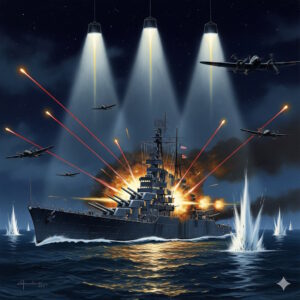
Description of the Painting (Style of 1940s-1960s): A “Combat Art” style painting, reminiscent of the works found in the Navy’s historical archives. The scene is set at dusk/night, dominated by the silhouette of the USS Chicago. Great fountains of water erupt from torpedo hits, illuminated by the orange and yellow glow of fires on deck and the brilliant white of Japanese “floating” flares hanging in the sky.

Elements and Rationale:

  • The Vessels: The USS Chicago (CA-29) would be shown with its distinct heavy cruiser profile. I would include the anti-aircraft tracers (red and white streaks) arching into the dark sky to show the intensity of the defense.
  • The Aircraft: Mitsubishi G4M “Betty” bombers would be shown as dark, low-flying shadows skimming the water’s surface, reflecting the Japanese tactic of low-level torpedo runs to avoid radar and AA fire.
  • Atmosphere: The contrast between the deep indigo of the Pacific night and the violent flares/explosions captures the confusion and terror of night naval warfare before the widespread perfection of radar-directed fire.
  • Background: Rennell Island would be a dark, low landmass on the horizon, providing a sense of geographical scale and the proximity of land during the Solomons campaign.
    1. Battle of Khafji

Date: January 29 – February 1, 1991

War: Gulf War (Operation Desert Storm)

Cause: Iraqi leader Saddam Hussein ordered a multi-pronged invasion of Saudi Arabia to draw Coalition ground forces into a costly battle and disrupt their preparations for the liberation of Kuwait.

Result: Coalition Victory. After initially occupying the town of Khafji, Iraqi forces were driven out by Saudi Arabian and Qatari ground forces supported by US Marine Corps reconnaissance and heavy Coalition air strikes.

Paintings & Art

Painting: War Painting (Invasion Series) Artist: Afifa Aleiby Year: 1991

Museums & Artifacts

National Museum of Saudi Arabia (Riyadh, Saudi Arabia): Features exhibits on the Gulf War and the defense of the Kingdom. National Museum of the Marine Corps (Triangle, Virginia, USA): Displays artifacts and vehicles, including LAV-25s, used by the Marines who directed fire during the battle.

Location

General: Khafji, Saudi Arabia (on the Kuwaiti border) Coordinates: 28°25′N 48°30′E

Recommended Book The Battle of Al-Khafji: The First Ground Battle of the Gulf War by V.J. Croizat.

Crusade: The Untold Story of the Persian Gulf War by Rick Atkinson

Imagined Painting
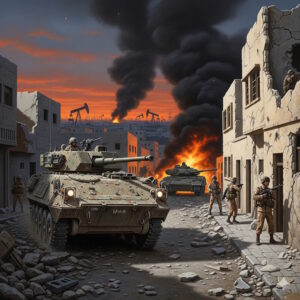
Description of the Painting (Style of 1990s Contemporary Realism): A gritty, realistic acrylic painting depicting a chaotic street battle in the abandoned Saudi Arabian town of Khafji at twilight. In the foreground, a U.S. Marine Corps LAV-25 (Light Armored Vehicle) is maneuvering around a debris-filled corner, its bushy 25mm chain gun trained on a distant target. In the middle ground, Saudi National Guard soldiers are dismounting from V-150 Commando vehicles to clear a building. The background is dominated by a dark, apocalyptic sky, stained black and oily orange from the burning oil wells set alight by Iraqi forces, casting an eerie, unnatural gloom over the scene. Iraqi T-55 tanks are visible as burning hulks in the distance.

Elements and Rationale:

  • The Vehicles (LAV-25 & V-150): The Battle of Khafji was the first major ground engagement of the war and heavily involved Coalition light armor. The LAV-25 is iconic to the US Marines’ involvement in this specific battle, chosen for its speed and reconnaissance capabilities.
  • The Sky (Oil Fires): The sabotage of Kuwaiti oil wells by retreating Iraqi forces created a distinct environmental backdrop for this battle. The “noon-day darkness” caused by the smoke is a defining visual element of the Gulf War.
  • The People (Saudi & Qatari Forces): Unlike many other Gulf War battles which were predominantly US-led, the retaking of Khafji was a joint effort where Saudi and Qatari troops bore the brunt of the street fighting. Including them is essential for historical accuracy.
  • The Setting (Urban): Most people associate Desert Storm with open tank battles in the sand. Khafji was unique because it was urban combat in a coastal city, making the “buildings and debris” element crucial to distinguishing it from the rest of the campaign.

Books for sale

WarScholar Press

Contact Information

For more “Military History Inside Out” please follow me at www.warscholar.org, on Facebook at warscholar, on twitter at Warscholar, on youtube at warscholar1945 and on Instagram @crisalvarezswarscholar. Or subscribe to the podcast on Apple Podcasts | Google Podcasts | Stitcher | Spotify

Tags: military museum, military artwork, battles, Military History, War History, Battle Art, War Paintings, War Art, Military Art, Museum Visit, Art History, Historical Artifacts, Museum Collection, Battlefield Tours, History Museum, Museum Life, History In Art, Historic Preservation, January 29, On This Day, History, Military History, War History, Historical Events, History Buff, World History, Napoleonic Wars, Napoleon, American Civil War, Shoshone History, WWII, Pacific War, Naval History, Battle Of Brienne, Bear River Massacre, Battle Of Khafji, Desert Storm, Gulf War, Combat Art, Cultural Heritage, Art Curation

As an Amazon Associate I earn from qualifying purchases.
Military History Inside Out banner

Battles of January 23 summaries plus museums, artwork, books

Battles of January 23 including descriptions of the battles, geographic locations, associated artwork, and museums where a person can find associated artifacts and artwork.

1. The Battle of Spion Kop

Date: January 23–24, 1900

War: Second Boer War

Cause: British General Sir Redvers Buller launched an offensive to relieve the besieged town of Ladysmith. British forces attempted to capture the strategic hill of Spion Kop (“Spy Hill”) to command the higher ground surrounding the Boer lines along the Tugela River.

Result: Boer Victory. After a brutal and bloody engagement on the cramped summit, British forces withdrew in confusion despite having nearly secured the position. It was a humiliating defeat for the British, resulting in heavy casualties and delaying the relief of Ladysmith.

Paintings & Art

  • Painting: The Battle of Spion Kop (Also known as Spion Kop)
    • Artist: Frans Oerder (Also depicted by war artist Melton Prior in sketches)
    • Year: c. 1900 (Sketches/Early works)
  • Painting: British Soldiers Tending Wounded Boers
    • Artist: H.M. Paget
    • Year: 1900

Museums & Artifacts

  • KwaZulu-Natal Museum (Pietermaritzburg, South Africa): Houses significant artifacts from the Anglo-Boer War, including weaponry and personal items from the Tugela campaign.
  • National Army Museum (London, UK): Holds uniforms, medals, and letters from soldiers who fought at Spion Kop, as well as sketches by war correspondents.
  • War Museum of the Boer Republics (Bloemfontein, South Africa): extensive collection of Boer armaments and art related to the battle.

Location

  • General: KwaZulu-Natal, South Africa (near the town of Ladysmith).
  • Coordinates:

    28∘39′00″S,29∘30′59″E

Recommended Book


2. The Defense of Rorke’s Drift

Date: January 22–23, 1879 (Conclusion of the battle)

War: Anglo-Zulu War

Cause: Following the disastrous British defeat at Isandlwana on January 22, a large Zulu reserve force of approximately 3,000–4,000 warriors defied orders and crossed into Natal to attack the small British mission station and hospital at Rorke’s Drift, defended by barely 150 British and colonial troops.

Result: British Victory. The defenders successfully repelled repeated Zulu assaults throughout the night of January 22 and the early morning of January 23. The Zulus withdrew at dawn, leaving behind hundreds of dead. Eleven Victoria Crosses were awarded to the defenders, the most for a single engagement in British military history.

Paintings & Art

  • Painting: The Defence of Rorke’s Drift, 1879
    • Artist: Alphonse de Neuville
    • Year: 1880
  • Painting: The Defence of Rorke’s Drift
    • Artist: Lady Elizabeth Butler
    • Year: 1880

Museums & Artifacts

  • The Royal Welsh Regimental Museum (Brecon, Wales): The primary museum for the 24th Regiment of Foot. It houses one of the finest collections of Zulu War artifacts, including Zulu shields recovered from the battlefield and uniforms of the defenders.
  • Art Gallery of New South Wales (Sydney, Australia): Houses the famous Alphonse de Neuville painting of the battle.
  • KwaZulu-Natal Museum (Pietermaritzburg, South Africa): Contains a dedicated gallery to the Anglo-Zulu war with battlefield relics.

Location

  • General: Rorke’s Drift, KwaZulu-Natal, South Africa.
  • Coordinates:

    28∘21′29″S,30∘32′12″E

Recommended Book


3. Capture of the Dutch Fleet at Den Helder

Date: January 23, 1795

War: War of the First Coalition (French Revolutionary Wars)

Cause: The extremely cold winter of 1794–1795 froze the Zuiderzee, trapping the Dutch Republican fleet in the ice near the island of Texel. French General Jean-Charles Pichegru ordered General Jan Willem de Winter to lead a regiment of French hussars (cavalry) across the frozen ice to capture the ships.

Result: French Victory. In one of the rarest events in military history, French cavalry surrounded and captured a naval fleet frozen in the ice. The Dutch surrender was negotiated without a major massacre, marking the end of the Dutch Republic and the establishment of the Batavian Republic.

Paintings & Art

  • Painting: La prise de la flotte hollandaise par la cavalerie française (The Capture of the Dutch Fleet by French Cavalry)
    • Artist: Charles-Louis Mozin
    • Year: 1836
  • Painting/Engraving: Capture of the Dutch Fleet at Den Helder
    • Artist: Alexandre Ferdinandus
    • Year: c. 19th Century (History illustration)

Museums & Artifacts

  • Château de Versailles (Versailles, France): Holds the Charles-Louis Mozin painting depicting this event in the Gallery of Battles (Galerie des Batailles).
  • Rijksmuseum (Amsterdam, Netherlands): Features extensive collections covering the French period and the Batavian Republic, including prints and political cartoons related to the fleet’s capture.
  • Dutch Navy Museum (Den Helder, Netherlands): Located near the site of the event, offering history on the Dutch fleet during the Revolutionary era.

Location

  • General: Den Helder / Texel, The Netherlands (North Sea).
  • Coordinates:

    52∘57′00″N,4∘45′00″E

Recommended Book


4. The Fall of Tripoli

Date: January 23, 1943

War: World War II (North African Campaign)

Cause: The British Eighth Army, commanded by General Bernard Montgomery, had been relentlessly pursuing the German Afrika Korps and Italian forces west across Libya following the victory at El Alamein. Tripoli was the major remaining Axis supply port in Libya.

Result: Allied Victory. British troops entered Tripoli on the morning of January 23, 1943. The capture of the city effectively ended Italian rule in Libya and secured a vital port for the Allies to support the final push into Tunisia.

Paintings & Art

  • Painting: On the Road to Tripoli
    • Artist: Edward Ardizzone
    • Year: 1943
  • Painting/Sketch: Tripoli: The Harbour (Various wartime sketches)
    • Artist: Edward Bawden (War Artist)
    • Year: 1943

Museums & Artifacts

  • Imperial War Museum (London, UK): Holds a vast collection of artwork by official war artists like Ardizzone and Bawden who documented the North African campaign, alongside vehicles and uniforms from the Eighth Army.
  • The Tank Museum (Bovington, UK): Features tanks used in the desert campaign (Shermans, Crusaders) and specific exhibits on the pursuit to Tripoli.

Location

  • General: Tripoli, Libya.
  • Coordinates:

    32∘53′14″N,13∘11′29″E

Recommended Book

Books for sale

WarScholar Press

Contact Information

For more “Military History Inside Out” please follow me at www.warscholar.org, on Facebook at warscholar, on twitter at Warscholar, on youtube at warscholar1945 and on Instagram @crisalvarezswarscholar. Or subscribe to the podcast on Apple Podcasts | Google Podcasts | Stitcher | Spotify

Tags: military museum, military artwork, battles, Military History, War History, Battle Art, War Paintings, War Art, Military Art, Museum Visit, Art History, Historical Artifacts, Museum Collection, Battlefield Tours, History Museum, Museum Life, History In Art, Historic Preservation, January 23, On This Day, History, Military History, War History, Historical Events, History Buff, World History, Spion Kop, Boer War, Rorkes Drift, Zulu War, Den Helder, French Cavalry, Napoleonic Wars, WWII, North Africa Campaign, Tripoli 1943, DeNeuville, Lady Butler, Imperial War Museum, Rijksmuseum, Versailles

As an Amazon Associate I earn from qualifying purchases.

Military History Inside Out banner

Battles of January 19 summaries plus museums, artwork, books, and a song

Battles of January 19 including descriptions of the battles, geographic locations, associated artwork, and museums where a person can find associated artifacts and artwork.

Song of the day:

Quentin Burns variation 1

Quentin Burns variation 2

1. Battle of Mill Springs

Date: January 19, 1862

War: American Civil War

Cause: This battle was precipitated by the Confederate need to defend the Cumberland Gap and the Union Army’s drive to push the Confederate defense line out of Eastern Kentucky. Confederate General Felix Zollicoffer, against orders, moved his troops across the Cumberland River to the north bank, placing them in a precarious position with the river at their back. Union General George H. Thomas moved to attack this exposed force.

Result: The battle was a decisive Union victory. It broke the Confederate defensive line in Eastern Kentucky and led to the death of General Zollicoffer (the first Confederate general to die in the Western Theater). The victory boosted Northern morale and opened the path for the Union into Tennessee.

Paintings & Art

  • Painting: Battle of Mill Spring, K.Y. Jan. 19th 1862
    • Artist: Currier & Ives (Lithograph)
    • Year: c. 1862

Museums & Artifacts

  • Mill Springs Battlefield National Monument (Nancy, Kentucky, USA): The Visitor Center and Museum houses a comprehensive collection of artifacts recovered from the battlefield, including weapons, uniforms, and personal items of soldiers. It also features interpretive exhibits on the battle’s strategy.
  • Smithsonian American Art Museum (Washington, D.C., USA): Holds various Civil War lithographs, including works by Currier & Ives similar to the Mill Springs prints.

Location

  • General: Nancy, Kentucky (historically Logan’s Crossroads).
  • Coordinates: 37.0544° N, 84.7397° W

Recommended Book


2. Siege of Ciudad Rodrigo

Date: Stormed on January 19, 1812 (January 7-20, 1812)

War: The Peninsular War (Napoleonic Wars)

Cause: Following victories in Portugal, the Duke of Wellington needed to secure the key border fortresses to open the invasion route into French-held Spain. Ciudad Rodrigo controlled the northern corridor. Wellington launched a rapid siege to capture the city before French Marshal Marmont could bring a relief army.

Result: The British captured the fortress after a bloody storming of the breaches on the evening of January 19. The victory secured the frontier and allowed Wellington to advance toward Badajoz and eventually Madrid. However, the discipline of the British troops collapsed after the victory, leading to a brutal sack of the city.

Paintings & Art

  • Painting: The Storming of Ciudad Rodrigo (Aquatint/Engraving)
    • Artist: Thomas Sutherland (after William Heath)
    • Year: 1815
  • Artifact: The Wellington Service Ice Pails (Depicting the storming)
    • Artist: Designed by Digby Scott and Benjamin Smith II
    • Year: c. 1814–1817

Museums & Artifacts

  • National Army Museum (London, UK): Holds extensive collections relating to the Peninsular War, including maps, letters from Wellington, and prints depicting the siege.
  • Apsley House (The Wellington Museum) (London, UK): The former home of the Duke of Wellington houses the famous Portuguese Service (silver) and the Ice Pails which depict the battle scenes, along with captured French imperial eagles.
  • British Museum (London, UK): Holds the original prints and etchings of the storming by Sutherland and Heath.

Location

  • General: Ciudad Rodrigo, Salamanca, Spain.
  • Coordinates: 40.5982° N, 6.5305° W

Recommended Book


3. Battle of St. Quentin

Date: January 19, 1871

War: Franco-Prussian War

Cause: As the Prussians besieged Paris, the French Army of the North, commanded by General Faidherbe, attempted to disrupt the Prussian supply lines and relieve the capital. The Prussian First Army, under General Goeben, moved to intercept the French forces near the town of Saint-Quentin to prevent this relief effort.

Result: The Prussians won a clear victory, forcing the French Army of the North to retreat in disorder. This defeat effectively ended any hope of relieving Paris from the north, and the city surrendered shortly thereafter, leading to the end of the war and the unification of Germany.

Paintings & Art

  • Painting: Battle of St. Quentin, 19 January 1871 (Lithograph)
    • Artist: Richard Knötel
    • Year: c. Late 19th Century (from Uniformenkunde)
  • Painting: Charge of the German Cavalry at St. Quentin
    • Artist: Amling Franz
    • Year: c. 1875

Museums & Artifacts

  • Musée de l’Armée (Invalides) (Paris, France): Contains one of the world’s largest collections of military history, including uniforms, weaponry, and paintings from the Franco-Prussian War (War of 1870).
  • Deutsches Historisches Museum (Berlin, Germany): Holds artifacts and documents relating to the wars of German unification, including the Battle of St. Quentin.
  • Town of Saint-Quentin (Aisne, France): The town itself features the Monument de 1870 commemorating the defense of the city.

Location

  • General: Saint-Quentin, Aisne, Hauts-de-France, France.
  • Coordinates: 49.8454° N, 3.2864° E

Recommended Book


4. Battle of Braddock Down

Date: January 19, 1643

War: First English Civil War

Cause: Royalist forces in Cornwall, led by Sir Bevil Grenville and Sir Ralph Hopton, were attempting to secure the county for King Charles I. They were intercepted by a Parliamentarian army under Colonel Ruthin, who had invaded Cornwall and was camped at Braddock Down, waiting for reinforcements.

Result: The Royalists launched a surprise attack. After an exchange of musket fire, a Royalist charge broke the Parliamentarian line. The Parliamentarians fled, and the Royalists secured Cornwall, capturing substantial arms and prisoners.

Paintings & Art

  • Painting: Sir Bevil Grenville (Portrait associated with the era/commander)
    • Artist: Unknown (School of Van Dyck)
    • Year: c. 1640s
  • Illustration: The Battle of Braddock Down
    • Artist: Harry Fisher (Historical Illustrator)
    • Year: 20th Century (Modern historical reconstruction)

Museums & Artifacts

  • Royal Cornwall Museum (Truro, UK): Contains exhibits on the Civil War in Cornwall, including artifacts related to Sir Bevil Grenville and the Royalist campaigns.
  • National Civil War Centre (Newark, UK): The dedicated museum for this conflict, housing armor, pamphlets, and weaponry used during battles like Braddock Down.

Location

  • General: Boconnoc / Braddock, Cornwall, United Kingdom.
  • Coordinates: 50.4160° N, 4.5660° W

Recommended Book

Books for sale

WarScholar Press

Contact Information

For more “Military History Inside Out” please follow me at www.warscholar.org, on Facebook at warscholar, on twitter at Warscholar, on youtube at warscholar1945 and on Instagram @crisalvarezswarscholar. Or subscribe to the podcast on Apple Podcasts | Google Podcasts | Stitcher | Spotify

Tags: military museum, military artwork, battles, Military History, War History, Battle Art, War Paintings, War Art, Military Art, Museum Visit, Art History, Historical Artifacts, Museum Collection, Battlefield Tours, History Museum, Museum Life, History In Art, Historic Preservation, January 19, On This Day, History, Military History, War History, Historical Events, History Buff, World History, Civil War, Mill Springs, Union Victory, Napoleonic Wars, Peninsular War, Ciudad Rodrigo, Wellington, Franco Prussian War, St Quentin, English Civil War, Royalists, Cornwall History

As an Amazon Associate I earn from qualifying purchases.

Military History Inside Out banner