Battles of January 17 summaries plus museums, artwork, and books

Battles of January 17 including descriptions of the battles, geographic locations, associated artwork, and museums where a person can find associated artifacts and artwork.

Song of the day: It’s About That Line – Funk Pop Song

1. Battle of Cowpens

Date: January 17, 1781

War: American Revolutionary War

Cause: Part of the British “Southern Strategy” to regain control of the colonies. British Lieutenant Colonel Banastre Tarleton was sent to crush a detachment of the Continental Army led by Brigadier General Daniel Morgan, which threatened British supply lines and operations in South Carolina.

Result: A decisive American victory and a turning point in the Southern campaign. Morgan’s tactical masterpiece destroyed Tarleton’s force, boosting Patriot morale and setting the stage for the eventual British surrender at Yorktown.

Paintings & Art

  • Painting: The Battle of Cowpens
    • Artist: William Ranney
    • Year: 1845
  • Painting: Battle of Cowpens
    • Artist: Frederick Kemmelmeyer
    • Year: 1809

Museums & Artifacts

  • Cowpens National Battlefield (Gaffney, South Carolina, USA): The visitor center houses a museum with authentic weapons, uniforms, and exhibits detailing the battle.
  • Yale University Art Gallery (New Haven, Connecticut, USA): Holds Frederick Kemmelmeyer’s painting of the battle.
  • Museum of the American Revolution (Philadelphia, Pennsylvania, USA): Features rotating exhibits and artifacts related to the Southern Campaign and the Revolutionary War.

Location

  • General: Near the town of Chesnee, South Carolina, USA.
  • Coordinates: 35°08′12″N 81°49′05″W

Recommended Book


2. Battle of Falkirk Muir

Date: January 17, 1746

War: Jacobite Rising of 1745

Cause: The Jacobite army, led by Prince Charles Edward Stuart (Bonnie Prince Charlie), was besieging Stirling Castle. A British government force under General Henry Hawley marched to relieve the castle and destroy the Jacobite army.

Result: A Jacobite victory. The Jacobites successfully repelled the government dragoons and infantry in failing light and heavy rain, though they failed to fully capitalize on the retreat of Hawley’s forces, making it a hollow strategic win.

Paintings & Art

  • Map/Engraving: A Plan of the Battle on Falkirk Muir
    • Artist: Thomas Jefferys
    • Year: 1746 (Contemporary engraving)
  • Painting: The Battle of Falkirk Muir (Modern interpretation widely used in history books)
    • Artist: Chris Collingwood
    • Year: Modern (c. 1990s–2000s)

Museums & Artifacts

  • Callendar House (Falkirk, Scotland): Located near the battlefield, this mansion has a permanent exhibition telling the story of the battle and the history of the area.
  • National Museum of Scotland (Edinburgh, Scotland): Holds significant Jacobite artifacts, including weapons and personal effects of Prince Charles Edward Stuart.
  • Falkirk Muir Battlefield (Falkirk, Scotland): A monument stands on the site, and the terrain remains largely readable for visitors.

Location

  • General: Southwest of Falkirk, Scotland, UK.
  • Coordinates: 55°59′17″N 3°49′10″W

Recommended Book


3. Battle of Abu Klea

Date: January 17, 1885

War: Mahdist War (Sudan Campaign)

Cause: The British “Desert Column” was marching across the Bayuda Desert to relieve General Charles Gordon, who was besieged in Khartoum. They were intercepted by a large Mahdist force near the Abu Klea wells.

Result: A British victory, though a costly and near-disastrous one. The British square was briefly broken by the Mahdist charge—an extremely rare event—before the attack was repulsed. The delay contributed to the column arriving in Khartoum too late to save Gordon.

Paintings & Art

  • Painting: The Battle of Abu Klea, 17th January 1885
    • Artist: William Barnes Wollen
    • Year: 1896
  • Painting: The Battle of Abu Klea (Illustration/Print)
    • Artist: Frederic Villiers (War Correspondent)
    • Year: 1885

Museums & Artifacts

  • National Army Museum (London, UK): Holds the painting by William Barnes Wollen and numerous artifacts from the Sudan campaigns, including uniforms and weaponry.
  • Royal Green Jackets (Rifles) Museum (Winchester, UK): Contains artifacts related to the regiments that fought in the campaign.

Location

  • General: Near the wells of Abu Klea (Abu Tulayh), Sudan.
  • Coordinates: 16°59′00″N 33°18′00″E

Recommended Book


4. Battle of Ko Chang

Date: January 17, 1941

War: Franco-Thai War

Cause: A French naval task force, including the light cruiser Lamotte-Picquet, launched a surprise dawn attack against the Royal Thai Navy fleet anchored at Ko Chang to break the stalemate of the border war and stop Thai incursions into French Indochina.

Result: A French tactical victory. The French fleet sank two Thai torpedo boats and heavily damaged a coastal defense ship with no losses of their own. However, the strategic impact is debated as the Thai military claimed to have repelled the invasion.

Paintings & Art

  • Illustration: Franco-Thai War: Battle Fought Between Thailand And Vichy France (Modern historical illustration)
    • Artist: Giuseppe Rava
    • Year: Contemporary (2000s)
  • Note: Due to the obscurity of the battle in Western art history, few classic oil paintings exist; the primary visual records are memorial dioramas and modern naval illustrations.

Museums & Artifacts

  • Ko Chang Naval Battle Memorial (Trat, Thailand): Features a museum shaped like a warship, statues, and annual ceremonies honoring the Thai sailors.
  • Thai National Memorial (Pathum Thani, Thailand): Houses a large diorama depicting the naval engagement.
  • HTMS Maeklong (Samut Prakan, Thailand): A preserved museum ship similar to those that fought, offering context on the era’s Thai naval technology.

Location

  • General: Gulf of Thailand, off the coast of the island of Ko Chang, Thailand.
  • Coordinates: 12°00′04″N 102°27′04″E

Recommended Book

  • The Indochina War: Thailand Fights France by Sorasanya Phaengspha.

Books for sale

WarScholar Press

Contact Information

For more “Military History Inside Out” please follow me at www.warscholar.org, on Facebook at warscholar, on twitter at Warscholar, on youtube at warscholar1945 and on Instagram @crisalvarezswarscholar. Or subscribe to the podcast on Apple Podcasts | Google Podcasts | Stitcher | Spotify

Tags: military museum, military artwork, battles, Military History, War History, Battle Art, War Paintings, War Art, Military Art, Museum Visit, Art History, Historical Artifacts, Museum Collection, Battlefield Tours, History Museum, Museum Life, History In Art, Historic Preservation, January 17, On This Day, History, Military History, War History, Historical Events, History Buff, World History, Battle Of Cowpens, American Revolution, Revolutionary War, Abu Klea, Mahdist War, British Empire, Jacobites, Falkirk Muir, Bonnie Prince Charlie, Battle Of Ko Chang, Franco Thai War, Naval History

As an Amazon Associate I earn from qualifying purchases.
Military History Inside Out banner

Battles of December 13 plus museums and artwork information

Battles of December 13 including descriptions of the battles, geographic locations, associated artwork, and museums where a person can find associated artifacts and artwork.

1. The Battle of Nanking (Fall of Nanking)

  • Date: November 11 – December 13, 1937
  • War: Second Sino-Japanese War
  • General Location: Nanjing (Nanking), Jiangsu Province, China
  • Geographic Coordinates: 32°02′38″N 118°46′43″E
  • Cause: The Imperial Japanese Army advanced upon Nanking (Nanjing), the capital of the Republic of China, intending to force a Chinese surrender after the bloody Battle of Shanghai.
  • Result: Japanese victory. The city fell on December 13, leading immediately to the Nanking Massacre (Rape of Nanking), where hundreds of thousands of civilians and disarmed soldiers were murdered by Japanese troops.
  • Recommended Book: The Rape of Nanking: The Forgotten Holocaust of World War II by Iris Chang
Paintings & Artwork
  • Painting: Deliverance
    • Artist: Christian Poirot
    • Year: 2015 (A massive oil painting donated to the Memorial Hall to mark the 70th anniversary).
  • Painting: Flower Market (Nanjing 1936) #2
    • Artist: John Young
    • Year: 2010 (Part of the “Safety Zone” series reflecting on the tragedy).
Museums with Artifacts
  • Memorial Hall of the Victims in Nanjing Massacre by Japanese Invaders (Nanjing, China)
    • Collections: Built on a site where thousands were buried, this museum houses bones of victims, historical documents, photographs, and artifacts detailing the battle and subsequent massacre.
  • Nanjing Museum (Nanjing, China)
    • Collections: While a general history museum, it holds significant artifacts from the Republican era and the 1937 defense of the city.

2. The Battle of the River Plate

  • Date: December 13, 1939
  • War: World War II
  • General Location: South Atlantic Ocean, off the estuary of the River Plate (near Uruguay and Argentina)
  • Geographic Coordinates: 34°34′00″S 48°17′00″W
  • Cause: Allied hunting groups were searching the South Atlantic for the German “pocket battleship” Admiral Graf Spee, which had been raiding merchant shipping.
  • Result: A tactical stalemate but a strategic British victory. The Graf Spee was damaged and forced to dock in Montevideo, Uruguay. Believing he faced a superior force, the German captain scuttled his ship days later.
  • Recommended Book: The Battle of the River Plate by Dudley Pope
Paintings & Artwork
  • Painting: HMS Achilles in the Battle of the River Plate
    • Artist: Frank Norton
    • Year: 1940
  • Painting: The Battle of the River Plate
    • Artist: Norman Wilkinson
    • Year: c. 1940
Museums with Artifacts
  • National Museum of the Royal New Zealand Navy (Auckland, New Zealand)
    • Collections: Houses the primary 6-inch gun director and other artifacts from HMNZS Achilles, one of the cruisers that fought the Graf Spee.
  • Falkland Islands Museum (Stanley, Falkland Islands)
    • Collections: Holds items related to HMS Exeter, which retreated to the Falklands after being heavily damaged in the battle.
  • Museo Naval de Montevideo (Montevideo, Uruguay)
    • Collections: Displays the massive anchor and rangefinder salvaged from the wreck of the Admiral Graf Spee.

3. The Battle of St. Pierre (Battle of the Nive)

  • Date: December 13, 1813
  • War: Peninsular War (Napoleonic Wars)
  • General Location: Saint-Pierre-d’Irube, near Bayonne, France
  • Geographic Coordinates: 43°29′00″N 1°28′00″W
  • Cause: Following Wellington’s crossing of the Nive River, the French Marshal Soult launched a counter-offensive to crush the isolated British wing commanded by General Rowland Hill.
  • Result: Anglo-Portuguese victory. General Hill’s troops, though outnumbered, held off Soult’s attacks until reinforcements arrived, ending the French threat in the immediate area.
  • Recommended Book: The Peninsular War: A New History by Charles Esdaile
Paintings & Artwork
  • Painting/Print: The Battle of St. Pierre (Watercolour/Print)
    • Artist: William Heath
    • Year: c. 1815–1820 (Heath produced a famous series of martial achievements of the British Army).
  • Painting: The Battle of the Nive
    • Artist: Thomas Jones Barker
    • Year: c. 1870s
Museums with Artifacts
  • Wellington Museum (Apsley House) (London, United Kingdom)
    • Collections: Contains the Duke of Wellington’s personal effects, batons, and art collection, including pieces related to his Peninsular campaigns.
  • Musée de l’Armée (Les Invalides) (Paris, France)
    • Collections: Holds extensive Napoleonic era uniforms, weapons, and personal items belonging to Marshal Soult and other French commanders of the campaign.

Books for sale

WarScholar Press

Contact Information

For more “Military History Inside Out” please follow me at www.warscholar.org, on Facebook at warscholar, on twitter at Warscholar, on youtube at warscholar1945 and on Instagram @crisalvarezswarscholar. Or subscribe to the podcast on Apple Podcasts | Google Podcasts | Stitcher | Spotify

Tags: military museum, military artwork, battles, Civil War, American History, Virginia History, WWII, Naval History, Napoleonic Wars, Military Art

As an Amazon Associate I earn from qualifying purchases.
Military History Inside Out banner

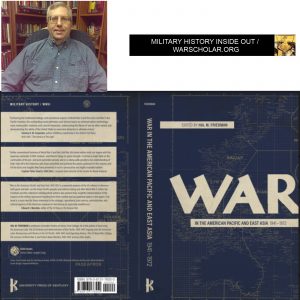
WWII and Cold War history book – “War in the American Pacific and East Asia, 1941-1972” (University of Kentucky Press, 2019) – Hal Friedman interview

Dr. Hal M. Friedman is Associate Chair of History and Professor of Modern History at Henry Ford College. He has published multiple books on U.S. national security policy in the immediate postwar Pacific. He recently edited a book on the same subject and we spoke about the subject matter and the process of publishing essay collections.

0:46 Hal talks about how he got into writing on this subject and how his father had fought in WWII.

3:25 – Hal wanted to do a collection that marked the 60th anniversary of Operation Crossroads. He talks about how this collection came about.

6:16 – Hal talks about the essays in the book and the Pacific thread that binds them together.

9:25 – Hal talks about his trilogy on American national security in the Pacific basin and how those connect to this book.   The U.S. dropped Japan as the main enemy and replaced it with the Soviet Union.

11:00 – Hal brings up the term American Lake for the Pacific.

15:00 – Hal talks about the goals of the US Navy before and after WWII.

21:00 – Hal talks about how the nuclear situation was addressed right after WWII.

24:20 – Hal talks about how European colonialism affected American security plans in the Pacific.

27:04 – Hal talks about how the US tried to eject all non-native foreigners, including European Catholic missionaries, from the Micronesia Islands.

30:22 – Hal discusses the economics of the American security program in the Pacific.

44:00 – Hal talks about how he put the book together.

46:19 – Hal discusses how R1 type institutions don’t respect other institutions as much as they should.

47:52 – Hal talks about the difficulties of putting together a book of history essays.

50:00 – Hal talks about the Association of the US Army authors’ day and how helpful University of Kentucky Press has been.

52:39 – Hal talks about his next project – U.S. war plans for the Pacific from 1945-1947.

53:39 – Hal can be found at the University of Kentucky Press website.

56:36 – Hal mentions that the history field is doing badly.

Links of interest

https://www.kentuckypress.com/live/title_detail.php?titleid=5527#.XY_4w397mM8

https://www.tamupress.com/search-results/?keyword=Arguing-over-the-American-Lake

For more “Military History Inside Out” please follow me on Facebook at warscholar, on twitter at Warscholar, on youtube at warscholar1945 and on Instagram @crisalvarezswarscholar

Guests: Hal Friedman

Host: Cris Alvarez

Tags: military, history, military history, conflict, war, interview, non-fiction book, crossroads, naval history, pacific war, kentucky, henry ford, micronesia, navy, marines, marshall, chiang kai-shek, okinawa, Soviet Union, Japan, communism, nuclear war, spruance, colonialism, Interior, AUSA, OPLANS