google-site-verification=LH5b8KjkZx977mE6aIcHeL0dUUXTFgHv_F3FyX8BtNs google-site-verification=LH5b8KjkZx977mE6aIcHeL0dUUXTFgHv_F3FyX8BtNs

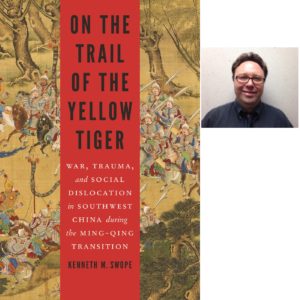
Chinese 17th C military history book – “On The Trail of the Yellow Tiger” (University of Nebraska Press, 2018) – Dr. Ken Swope interview

Dr. Ken Swope is a history professor at the University of Southern Mississippi. He studies and writes on the imperial and military history of East Asia. In this podcast, I interview him about his upcoming book On the Trail of the Yellow Tiger: War, Trauma, and Social Dislocation in Southwest China During the Ming-Qing Transition.

1:27 – Dr. Ken Swope discusses how he started writing history. He studied Chinese history from the 16th and 17th century and has mainly written on that period.

2:47 – He discusses the origination of the current book which grew out of his research on previous books on Chinese history. He’s used obscure materials for research that not many people know about.

4:32 – The subject of this book is a person nicknamed the Yellow Tiger, a legendary figure associated with peasant rebellions against the Ming Dynasty. Follow on rebellions were very bloody. His own adopted sons become the defenders of the Ming Dynasty against the Manchus.

7:32 – Ken Swope then discusses what made the Ming Dynasty weak and susceptible to rebellion. Much was written in his previous books. Court intrigue contributed to the weakness. At the same time the Manchus were on the rise in the early 1600s. They also suffered climate change that caused epidemics and famine. Many rebels had been part of the postal service and when they were laid off they became bandits.

11:47 – Many of the peasant rebels were literate. China had very high literacy rates in this historical period. Silver from the Americas helped feed Chinese trade.

13:50 – Communications at the time was weak and the rebels could hide in places the government couldn’t reach. The Mings also had been involved in many wars and were taxing people too much. But they still had a huge army in comparison to the rebels. They also used eunuchs to collect taxes for the Emperor.

17:13 – Ken Swope says that the main theme of the book is the effects of war on society. The trauma and changes it creates. Uprisings in the southwest area of China are common and they experience lots of conflict and disruption.

19:12 – He had many resources to go to for research. There were many collected records for the period. Many people wrote things down at the time. Memoirs, diaries, battlefield reports, imperial proclamations, foreign accounts, “wild” histories, and family chronicles.

Lots of the materials were compiled during the Ching period. Other items were compiled in the 19th and 20th centuries.

22:47 – He came across some interesting artifacts. He found an interesting [tomb] grave in an obscure area. He found a public park with steles that had pictures of old heroes and their execution sites. He found the spot where the last Ming Emperor was executed. There was also a big naval battle in 1647 and many artifacts, maybe 30,000, have been found in the river where it happened. Ken Swope did a paper on this find.

27:32 – The old documents are written in classical Chinese. Taiwan and Hong Kong still use traditional characters. It’s a difficult form of Chinese to read. Some of the manuscripts are handwritten which makes them more difficult to read.

30: 10 – Ken Swope most enjoyed looking at documents that only a handful of people have ever read in 400 years. The battlefield sites were also very interesting to see including a famous pass to Chongching. The weapons and historic homes were interesting to see. But there’s not a lot of battlefield preservation in China.

32:18 – He was most surprised by the frank discussions that people had at the time about life in China. People were worried about the poor and being away from home. There were also many rural folk tales about ghosts and evil spirits.   During times of chaos people say the spirit world is out of hand too.

37:00 – Both armies created and read omens during fighting. For example, before Chungdu fell, they claimed all the turtles left the city. But the government also tried to discourage belief in omens.

38:45 – The Jesuit accounts often tried to put a positive spin on the events they were witnessing. Taoism was prominent in this time too. But the people accepted all thoughts and religions together.

40:53 – The biggest challenge he had in researching was figuring out motivations and keeping all the people straight. There were dozens of major players involved in the events he wrote about.

42:42 – He was impressed by how many people thought in terms of a national or regional context and were fighting for something bigger than themselves. Characters will fight to the death for an ideal. This includes female warriors.

44:29 – he wants this book to connect China to the global problems happening in the 17th century. He also wants to increase knowledge about figures who are heroes and famous in China today. China also has more sources for 17th century warfare than anywhere else in the world.

46:30 – Ken Swope didn’t have big problems getting the book published. His success with previous books helped get this one published. Getting your name out there will help get your work published.

48:35 – The next book is a biography of General Zuo. He was a 19th century general who fought the rebellions during this period. He crushed many massive Muslim rebellions and modern people are curious how he accomplished this.

51:23 – His works can be found on Amazon. He’s on Nebraska Press, Oklahoma Press and Routledge. British bookstores carry is books too and so does the British Museum. There’s a lot of interesting Chinese military history to study.


Links

http://www.nebraskapress.unl.edu/nebraska/9780803249950/

For more “Military History Inside Out” please follow me on Facebook at warscholar, on twitter at Warscholar, on youtube at warscholar1945 and on Instagram @crisalvarezswarscholar

Guests: Ken Swope

Host: Cris Alvarez

Tags: military history, chinese history, chinese war, chinese military, peasant rebellion, rebellion, 17th century, ching, ming, manchu, ghosts, spirits, spirit world
 

How a young woman developed a WWI spy ring to help the British fight the Ottoman Empire with Gregg Wallance

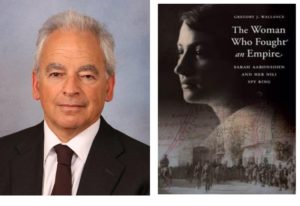
Greg Wallance The Woman Who Fought an Empire

How a young woman developed a WWI spy ring to help the British fight the Ottoman Empire with Gregg Wallance

Check out this book here   https://amzn.to/2XYhzGq

Gregory Wallance is author of the upcoming book The Woman Who Fought an Empire: Sarah Aaronsohn and Her Nili Spy Ring. In this podcast I interview Mr. Wallance about the details of the book and how he went about researching it. Mr. Wallance has written books on historic legal issues and how the State Department responded to the Holocaust. He has been an Assistant United States Attorney and is currently a lawyer focused on white collar crime. The Woman Who Fought an Empire (Potomac Books, 2018)

Interview Timeline

1:56 – Mr. Wallance begins by discussing his previous work on a book about the criminal justice system in the 1970s. He wrote about the Dred Scott case as well as the State Department’s response to the Holocaust.

2:38 – Mr. Wallance talks about his interest in writing about espionage and WWI and his studies on undercover techniques. His work led him to Sarah’s story.

3:05 – Mr. Wallance discusses the focus of the book. Sarah’s parents were from Romania and were part of the first modern wave of settlers to Israel. Her life resembled that of a pioneer child. She learned to ride horses, shoot and work in the fields. She was highly intelligent and well-educated woman.

4:15 – Sarah’s parents were part of a wave of hundreds of Romanians who went to Palestine without the needed farming skills. Sarah married a Constantinople businessman and moved there but the war broke out and she became homesick. She took a train back to her settlement to see her family. Her thousand-mile train trip went through the area of the Armenian genocide as it was occurring. Sarah witnessed this and feared this same thing could happen to her Jewish people in Palestine. She saw horrible atrocities against Armenians as she traveled. She decided that Great Britain must be the Ottoman Empire to avoid this. Her brother joined her in her new plan.

8:18 – Mr. Wallace says the book is a celebration of Sarah’s courage. Her first shock was what she witnessed. The second was the death of a close friend who was leading the spy ring. Sarah took over the ring after his death. She did so under very dangerous conditions behind enemy lines. The British collected her intelligence one a month by ship. Most of the ring was made up of unruly male Jews, many who loved her. But she was committed to her spying. She saw it as a sacred duty. Her brother was in Cairo working with British intelligence and he begged her to go to Cairo but she refused. The British officers she dealt with admired her commitment to the cause and her courage.

12:08 – The British used some Arab agents but didn’t have many spies in the area. They found Sarah’s ring to have been the only worthwhile one. It might have been the best British spy system of the war. Some of her agents were Jewish men in the Ottoman Army. One of her best coups was finding out about new planes the Ottomans were sending to the Sinai. The information informed the British they would lose air superiority in the Sinai and they were able to respond to this threat and regained air superiority and won the third battle of Gaza thought they lost the first two. They were then able to conquer Jerusalem.

15:24 – Sarah would travel through the countryside and clandestinely meet with the troops who gave her the information they had collected. She didn’t look like a spy. However, she was eventually found it. Only Sarah and her brother knew that the leader of the spy ring had died in the desert. He was charismatic and inspiring and they didn’t want the others to lose morale by finding out he was died. Sarah cold-bloodedly told her spies he had gone to Britain to train. One member of the ring didn’t believe her and went off to Cairo to learn the truth. The Ottomans caught him and tortured him until he gave them information on Sarah and others. Sarah ended up being captured in October 1917. She was tortured for four days in her village. Sarah refused to give information and even taunted her captors. She wanted to be remembered as a warrior who had fought for her people. The Turks let her go home to change her dress before being taken for further torture. Sarah had a hidden pistol in the house and used it to shoot herself. She is remembered as the Jewish Joan of Arc. Her home is now a museum and regularly visited by school children.

21:06 – The local population did not support Sarah. Many of the local Jewish people were terrified of retaliation against them all if she were caught. Many told her to stop spying but she refused. But she thought that she needed to save them. Her actions eventually led to the creation of Israel but at the time she was considered a rebel. The area was pretty primitive and horses were the main means to get around. It was an agricultural area. The Ottomans had taken their equipment for the war.

24:00– The locals were subjected to Ottoman brutality but for the most part the local Jewish people tried to keep their heads down and avoid trouble. They had been doing that for two millennia. But Sarah had a different idea.

25:26 – The local Jewish community was made up of Romanian Jews but also Russian and Eastern European wars. The community was prosperous and somewhat cultured before the war. It was known as little Paris.

26:46 – Many of the locals who had known her since she was a child and who led the community were angry with her but they didn’t turn her in. Sarah was observant in her religion but was not very religious according to the record. Her family did care about Jewish traditions.

28:51 – Mr. Wallance went to Israel to research the book. He went to the museum and Sarah’s family home. Her sister collected the letters she exchanged with others. Mr. Wallance needed translators for these letters which were written in an older version of Hebrew. Most of the book is based on the letters.

30:23 – Mr. Wallance consulted with historians and checked secondary sources. Her brother had been famous for his ability in agricultural science and his discoveries. A fund was set up to help him build an agricultural research facility in Palestine. The building became the headquarters for the spy ring. They collected their information for the British there and meet the British sailors on the beach. The British would provide supplies in return.

33:32 – The most interesting artifact he found was the family home. The home even had an escape tunnel in case of a raid. It also had a cubbyhole where Sarah hid her gun. Sarah couldn’t use the escape tunnel because the Ottomans had too many guards around the house. The guards were trying to keep any spies from escaping the town. The Ottomans also threatened to destroy the town if the others didn’t turn the spies in. When Sarah had been led from the torture house to her own home to change her dress, many locals cursed Sarah and threw stones at her. One witness said it was women throwing the stones and cursing at her. Some even told the Ottomans where to search. Sarah was able to write down their names since the Turks spoke their names and Sarah overheard and knew Turkish. There is a tale that later the spies found these women and killed them. However, the Jewish spies were reviled even after the war. Over time, Sarah became regarded as a hero and a leader. People began to conduct pilgrimages to her home on the day of her death.

43:04 – A policeman in 1967 thought he could find the gravesite of Sarah’s friend Feinberg who had died in the desert. After the Six Day War, Israel captured the Sinai and then the policeman was able to work with local Bedouins to find Feinberg’s bones under a date palm tree. The lore is that the date tree grew from dates Feinberg had with him and that maybe they were dates Sarah had given him. Feinberg was then given a military funeral. Then a formal ceremony was held at Sarah’s grave.

47:56 – The most enjoyable part of the research was reading the translated letters and feeling that she came alive. He was most surprised by the transition Sarah underwent in a short period. She went from housewife to leader of a spy ring. A highly effective leader of a spy ring. One mystery was how she learned of Feinberg’s death and her relationship with him. Some think it was a romance, but it also seems it might simply have been a very strong friendship. Feinberg had been engaged to Sarah’s sister. The ties of loyalty and devotion between all three of them was strong.

52:43 – Sarah showed dread at having to tell Feinberg’s family the truth about his death. She was fearful and felt grief over having to lie and to reveal what she had done.

54:05 – Mr. Wallance hopes to make Sarah accessible to Americans. He hopes the book rebuts the Hollywood myth of female spies as femme fatales. He says the stereotype is unfair.

55:23 – Mr. Wallance had been working on a book about three spies – Sarah and two others. That was too difficult so he cut it down to just Sarah. The book can be found on Amazon and will be formally released on March 1. He has recordings of readings from Sarah’s letters at http://www.gregorywallance.com/.

Links to items mentioned

https://amzn.to/2XYhzGq

www.GregoryWallance.com

For more “Military History Inside Out” please follow me on Facebook at warscholar, on twitter at Warscholar, on youtube at warscholar1945 and on Instagram @crisalvarezswarscholar

Guests: Gregory Wallance

Host: Cris Alvarez

Tags: world war one, palestine, spies, british, ottoman, jewish, female spy, israel, sarah aaronsohn, turks, armenians, romania, sinai

Check out this book here   https://amzn.to/2XYhzGq

As an Amazon Associate I earn from qualifying purchases.

Military History Inside Out banner