Battles of December 4 plus museums and artwork information

Battles of December 4 including descriptions of the battles, geographic locations, associated artwork, and museums where a person can find associated artifacts and artwork.

The Battle of Lund (Charles XI’s War: The Scanian War Between Sweden and Denmark, 1675-1679 (Century of the Soldier 1618-1721))

Date: December 4, 1676
War: The Scania War (1675–1679)
Cause: The Swedish King Charles XI launched a desperate winter counter-offensive to break the Danish siege of Malmö and reclaim the province of Scania, which had been invaded by Denmark.
Result: A decisive Swedish victory, though it was one of the bloodiest battles in Scandinavian history with extremely high casualties on both sides.
Location: The main monument (Slaget vid Lund) stands on the site of the fiercest fighting, just north of the city of Lund.
Coordinates: 55°26′22.6″N 13°06′50.8″E (Decimal: 55.439611, 13.114111)
Paintings:
Slaget vid Lund (The Battle of Lund) by Johann Philip Lemke (1696).
King Charles XI at the Battle of Lund by David Klöcker Ehrenstrahl (c. 1690s).
The Battle of Lund (Contemporary Engravings) by Romeyn de Hooghe (c. 1677).
Museums with Associated Artifacts & Art:
Swedish History Museum (Historiska museet) (Stockholm, Sweden): Holds artifacts from the Scania War and related military history.
Malmö Art Museum / Malmöhus Castle (Malmö, Sweden): Located near the conflict zone, this museum features exhibits on the Scania War and regional history.
The Royal Armory (Livrustkammaren) (Stockholm, Sweden): Contains weapons, armor, and uniforms from the era of Charles XI.
Kulturen (Lund, Sweden): An open-air museum that frequently highlights local history related to the battle.
The Battle of the Shangani Patrol (The Shangani Patrol) (Matabele: The War of 1893 and the 1896 Rebellions)
Date: December 4, 1893
War: The First Matabele War
Cause: A small British South Africa Company patrol, led by Major Allan Wilson, crossed the Shangani River in pursuit of the Ndebele King Lobengula. They were cut off from their main column by the rising river and surrounded by over 3,000 Ndebele warriors.
Result: Total annihilation of the patrol. The 34 soldiers fought to the last man, an event that became a significant legend in British colonial history known as “Wilson’s Last Stand.”

Location: The Pupu Battlefield Memorial (where the patrol made its last stand), located near the Shangani River in the Lupane district, roughly 40km east of the main Bulawayo-Victoria Falls road.

Coordinates: 18°46′05″S 28°07′33″E (Decimal: -18.768056, 28.125833)

Note: Major Wilson and his men were later reburied at World’s View in the Matobo Hills, but the coordinates above mark the actual battlefield.

Paintings:
There Were No Survivors (also known as The Last Stand of Major Allan Wilson) by Allan Stewart (1896).
The Shangani Patrol by Richard Caton Woodville (c. 1900).
Museums with Associated Artifacts & Art:
Natural History Museum of Zimbabwe (Bulawayo, Zimbabwe): Features exhibits on the Ndebele kingdom and the colonial wars, including relics from the patrol.
National Army Museum (London, United Kingdom): Holds archives, medals, and artwork related to the British South Africa Company and the Matabele Wars.
Zimbabwe Military Museum (Gweru, Zimbabwe): dedicated to the military history of the nation, including the colonial conflicts.

The Battle of Longewala (Indo-Pakistani War of 1971: Volume 1 – Indian Military Intervention in East Pakistan (Asia@War))

Date: December 4–7, 1971 (Battle began the night of Dec 4)
War: Indo-Pakistani War of 1971
Cause: A surprise Pakistani armored invasion force (over 40 tanks and 2,000 troops) attempted to capture the Indian border post of Longewala to cut off Jaisalmer.
Result: A decisive Indian victory. A small company of Indian soldiers (approx. 120 men) held the post throughout the night of December 4th until the Indian Air Force arrived at dawn to destroy the Pakistani tank column.

Location: The Longewala War Memorial, which sits directly on the site of the 1971 engagement in the Thar Desert, Rajasthan.

Coordinates: 27°31′12″N 70°09′36″E (Decimal: 27.520000, 70.160000)

Paintings & Visuals:
The Battle of Longewala (Dioramas and Murals) by Unknown Military Artists / Indian Army Corps of Engineers (Contemporary/Modern).
Hunter over Longewala (Aviation Art depictions) often featured in Air Force galleries, depicting the Hawker Hunter jets destroying tanks.
Museums with Associated Artifacts & Art:
Longewala War Memorial (Longewala, Rajasthan, India): Located at the actual battle site, this open-air museum features the captured Pakistani T-59 tanks, the original Indian recoilless rifles used in the defense, and murals depicting the events of the night of December 4.
Jaisalmer War Museum (Jaisalmer, India): Features a dedicated “Longewala Hall” with detailed paintings, maps, and artifacts from the battle.
Indian Air Force Museum (Palam, New Delhi, India): Houses the Hawker Hunter aircraft type used to stop the armored advance.

The Battle of Waynesboro, Georgia (Southern Storm: Sherman’s March to the Sea)

Date: December 4, 1864
War: American Civil War (Sherman’s March to the Sea)
Cause: Union Cavalry commander Judson Kilpatrick moved to burn bridges and clear the route for General Sherman’s main army, clashing with Confederate cavalry led by Joseph Wheeler.
Result: Union victory. The Confederate forces were pushed back, allowing Sherman’s army to continue its march toward Savannah and the sea.

Location: The battle took place around the town of Waynesboro, Georgia. A historical marker denoting the cavalry action is located near the intersection of South Liberty Street and GA Hwy 24.

Coordinates: 33°05′23″N 82°00′57″W (Decimal: 33.089722, -82.015833)

Paintings:
Sherman’s March to the Sea (Engravings/Sketches) by Alexander Hay Ritchie (1868). (While specific oil paintings of the Waynesboro skirmish are rare, this famous engraving covers the campaign).
Contemporary War Sketches published in Harper’s Weekly (December 1864).
Museums with Associated Artifacts & Art:
Atlanta History Center (Atlanta, USA): Contains one of the largest collections of Civil War artifacts, including the “Cyclorama” painting (though depicting the Battle of Atlanta, it covers the context of the campaign).
Burke County Museum (Waynesboro, Georgia, USA): A local museum holding specific artifacts and information regarding the cavalry action in Waynesboro.
The National Civil War Museum (Harrisburg, Pennsylvania, USA): Houses a vast collection of artifacts, uniforms, and sketches from Sherman’s campaigns.

Books for sale

WarScholar Press

Contact Information

For more “Military History Inside Out” please follow me at www.warscholar.org, on Facebook at warscholar, on twitter at Warscholar, on youtube at warscholar1945 and on Instagram @crisalvarezswarscholar. Or subscribe to the podcast on Apple Podcasts | Google Podcasts | Stitcher | Spotify

Tags: military museum, military artwork, Sweden history, Denmark history, India history, Pakistan history, French history, Prussian history, Australian history, US Civil War, South Africa History, battles

As an Amazon Associate I earn from qualifying purchases.
Military History Inside Out banner

Battles of December 1 plus museums and artwork information

Battles of December 1 including descriptions of the battles, associated artwork, and museums where a person can find associated artifacts and artwork.

1. Battle of Limanowa (Battle of Limanowa-Łapanów) (https://amzn.to/4rqFDgk)

  • Date: December 1 – December 13, 1914 (Started on December 1)
  • War: World War I (Eastern Front)
  • Cause: The battle was a counter-offensive launched by the Austro-Hungarian Army to halt the “Russian Steamroller” (the advancing Russian 3rd Army) which was threatening to capture Krakow, a vital strategic and industrial hub.
  • Result: A strategic victory for the Central Powers (Austria-Hungary). The Russian advance was stopped, and the lines stabilized, temporarily saving Krakow from occupation and boosting Austro-Hungarian morale.
Associated Paintings
  • Painting/Work: Austro-Hungarian troops advance in Limanowa December 1914
    • Artist: Arthur Heyer
    • Year: c. 1915–1919 (Published in Der Krieg 1914-19 in Wort und Bild, 1919)
  • Painting/Work: Charge of the Nádasdy Hussars at Limanowa (Depicting the heroic death of Colonel Ottmar Muhr)
    • Artist: Unknown / Various Hungarian military artists (Often reproduced in regimental histories)
    • Year: c. 1915–1920
  • Painting/Work: Scene during the Battle of Limanowa-Lapanow (Print)
    • Artist: Robert Hunt Library / Mary Evans Picture Library
    • Year: c. 1914–1915
Museums and Collections
  • Regional Museum of the Limanowa Region (Muzeum Regionalne Ziemi Limanowskiej)Limanowa, Poland
    • Located in the heart of the battlefield area, this museum houses a dedicated collection regarding World War I in the region, including weapons, uniforms, photographs, and personal items from soldiers who fought in the battle.
  • Museum of Military History (Heeresgeschichtliches Museum)Vienna, Austria
    • As the leading museum for the Austrian Armed Forces, it contains extensive exhibits on the Eastern Front of WWI, including uniforms of the Austro-Hungarian Hussars and equipment used during the Galician campaigns.
  • Museum of the Polish Army (Muzeum Wojska Polskiego)Warsaw, Poland
    • Holds a vast collection of weaponry and memorabilia related to the Polish Legions (who fought alongside the Austro-Hungarians at Limanowa under Piłsudski) and general WWI history on Polish soil.
2. Battle of Stony Creek Station (https://amzn.to/4p9JLjr)
  • Date: December 1, 1864
  • War: American Civil War (Richmond–Petersburg Campaign)
  • Cause: A Union cavalry raid led by Brig. Gen. David McM. Gregg aimed to disrupt the Confederate supply lines by destroying the Stony Creek Station on the Weldon Railroad, a critical artery for General Robert E. Lee’s army in Petersburg.
  • Result: Union victory. The Union forces successfully captured the station, burned 3,000 sacks of corn, destroyed supplies and equipment, and captured approximately 190 Confederate soldiers before withdrawing.
Associated Paintings
  • Painting/Work: The Fight at Stony Creek Station (Sketch/Illustration)
    • Artist: James E. Taylor (Special Artist for Frank Leslie’s Illustrated Newspaper)
    • Year: 1864
  • Painting/Work: Confederate Prisoners Captured at Stony Creek (Sketch)
    • Artist: Alfred Waud or James E. Taylor
    • Year: 1864
Museums and Collections
  • Petersburg National BattlefieldPetersburg, Virginia, USA
    • While the specific site of Stony Creek is south of the main park, this museum serves as the primary repository for artifacts and interpretation of the Richmond–Petersburg Campaign, including the supply line raids.
  • Pamplin Historical Park & The National Museum of the Civil War SoldierDinwiddie County, Virginia, USA
    • Located near the Boydton Plank Road (another key supply line), this world-class museum focuses on the life of the common soldier and holds extensive artifacts related to the cavalry operations and the siege of Petersburg.
  • The American Civil War MuseumRichmond, Virginia, USA
    • Contains comprehensive collections of cavalry equipment, weaponry, and personal items from both Union and Confederate forces active in the Virginia theater in 1864.
3. Battle of Magnesia
  • Date: December, 190 BC (Exact day unknown; sources place it in the winter of 190–189 BC, commonly cited as December)
  • War: Roman–Seleucid War (https://amzn.to/48pplf8)
  • Cause: The conflict arose from the expansionist policies of the Seleucid King Antiochus III the Great into Greece and Asia Minor, which challenged Roman hegemony in the Mediterranean. The Romans, led by Consul Lucius Cornelius Scipio (later Asiaticus) and his brother Scipio Africanus, crossed into Asia Minor to confront the Seleucid army.
  • Result: Decisive Roman victory. The destruction of the Seleucid army forced Antiochus to sign the Treaty of Apamea, stripping him of significant territory in Asia Minor and cementing Rome’s dominance in the Eastern Mediterranean.
Associated Paintings
  • Painting/Work: The Battle of Magnesia (Engraving/Illustration)
    • Artist: Hubert-François Gravelot (and others in historical treatises)
    • Year: c. 1750–1770
  • Painting/Work: Lucius Cornelius Scipio Asiaticus (Depicted in triumphs associated with the battle)
    • Artist: Various (Roman frescoes / Renaissance tapestries)
    • Year: Various (e.g., 16th–17th Century tapestries often depicted the Scipio brothers’ campaigns)
  • Painting/Work: Defeat of Antiochus at Magnesia (Historical Illustration)
    • Artist: Unknown (Featured in 19th-century history texts like Cassell’s History)
    • Year: c. 1880–1890
Museums and Collections
  • Pergamon MuseumBerlin, Germany
    • Houses the Pergamon Altar (currently under restoration), built by King Eumenes II of Pergamon. Eumenes was a key ally of Rome at Magnesia, and the altar’s friezes (depicting the Gigantomachy) are believed by many scholars to be an allegorical celebration of his victories over the Galatians and Seleucids during this period.
  • Louvre MuseumParis, France
    • Contains fragments and architectural elements from the Temple of Artemis at Magnesia (Magnesia ad Maeandrum). While the temple predates the battle, the city site is the battle’s namesake. The museum also houses the Winged Victory of Samothrace, often associated with naval victories of this era (Battle of Myonessus) that preceded the land battle of Magnesia.
  • Condé Museum (Musée Condé)Chantilly, France
    • Holds the famous 15th-century miniature painting of the Battle of Magnesia by Jean Fouquet (or his circle), illustrating the conflict in a medieval style.
  • Aydın Archeology MuseumAydın, Turkey
    • Located near the actual archaeological site of Magnesia ad Maeandrum, this museum houses statues, coins, and physical artifacts excavated from the ancient city and the surrounding region where the campaign took place.

      Books for sale

      WarScholar Press

      Contact Information

      For more “Military History Inside Out” please follow me at www.warscholar.org, on Facebook at warscholar, on twitter at Warscholar, on youtube at warscholar1945 and on Instagram @crisalvarezswarscholar. Or subscribe to the podcast on Apple Podcasts | Google Podcasts | Stitcher | Spotify

      Tags: military museum, military artwork, US Civil War, WWI, Ancient Warfare

      As an Amazon Associate I earn from qualifying purchases.
      Military History Inside Out banner

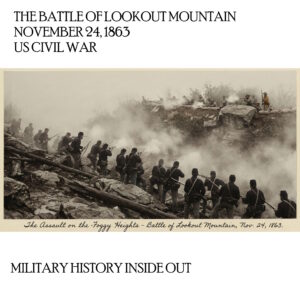
US Civil War – Battle of Lookout Mountain November 24, 1863 – An introduction and timeline of major events

Battle of Lookout Mountain – a fictional image of the battle

This podcast episode is a work of historical fiction written to teach listeners, in an entertaining way, about the background and major events that happened during the battle.

US Civil War – Battle of Lookout Mountain November 24, 1863

Books for sale

Battle above the Clouds: Lifting the Siege of Chattanooga and the Battle of Lookout Mountain, October 16 – November 24, 1863

WarScholar Press

Contact Information

For more “Military History Inside Out” please follow me at www.warscholar.org, on Facebook at warscholar, on twitter at Warscholar, on youtube at warscholar1945 and on Instagram @crisalvarezswarscholar. Or subscribe to the podcast on Apple Podcasts | Google Podcasts | Stitcher | Spotify

Tags: US Civil War, Battle, Lookout Mountain, historical fiction, documentary fiction

As an Amazon Associate I earn from qualifying purchases.

Military History Inside Out banner