Podcast: Play in new window | Download
Subscribe: RSS
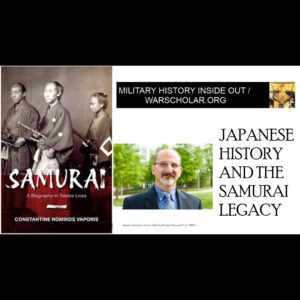
Samurai. A Biography in Twelve Lives – Interview with Dr. Constantine Nomikos Vaporis
(Oxford University Press, Published: September 25, 2026)
Interview
What is your name? Constantine Nomikos Vaporis
What is the title of your book? Samurai. A Biography in Twelve Lives.
Who is the book publisher? Oxford University Press
When will the book be released? September 25, 2026
Please provide some background on the date and area that we’re talking about.
Japan during the early modern or Tokugawa period, 1603-1868, with some coverage of the immediate post-Restoration era, roughly 1868-1900
What is the book focused on? As the title suggests, it tells the story of the Tokugawa period and the samurai through a focus on the lives of twelve individuals.
How did you get involved in this subject and what prompted you to actually write this book? I’ve been writing about the samurai for some time, including The Samurai Encyclopedia (2022) (https://www.tuttlepublishing.com/japan/the-samurai-encyclopedia) and the earlier Tour of Duty: Samurai, Military Service in Edo, and the Culture of Early Modern Japan (2008). In Tour of Duty, I began to write about the personal experiences of samurai serving their daimyo lords on their required biannual period of alternate attendance in the shogun’s capital of Edo. In The Samurai Encylopedia I began to write short biographies of a number of samurai. From doing this work, it occurred to me that telling the history of the Tokugawa period and of the samurai as a social group through selective biographies would be an effective narrative strategy. As I did with The Samurai Encyclopedia, I wanted to write a book that would be accessible to a general, educated audience (it is an “academic market” book).
How did you do your research for the book and where did you get your information from? Interviews, archival research, site visits, archaeological sites?
Most of the research was archival in nature and involved work in a number of Japanese cities, Tokyo, of course, but also Kyoto, Ako, Kochi, Sendai, Hachinohe, Kakunodate, Hagi, and Aizu Wakamatsu. It involved working in the documentary collections of former domain governments but also relied heavily on the personal writings, mostly diaries, that samurai often kept.
Did you come across any noteworthy artifacts or documents, perhaps something you didn’t expect to find?
A record kept by a samurai scholar in Tosa domain (Kochi) was particularly noteworthy because it contained not just his household’s financial records, which is not that unusual, but also copies of the correspondence that he kept between himself and his merchant-financier (moneylender). This provided a fascinating glimpse into the “debt hell” that many samurai experienced.
When doing your research did you visit any of the places that you discuss in the book?
Yes, all the places mentioned above.
Did you use any new technologies, AI perhaps, or something else that helped with your research? No, not at all.
What was the most surprising thing you discovered during your research?
As I said, I’ve been writing about samurai for some time so there was not much that surprised me. Yet, the most surprising part of the book was doing the research on of Yamamoto (Niijima) Yae, the final biography in the book. She was the daughter of a gunnery instructor in Aizu domain and learned to shoot herself. She was also skilled with the pole weapon (naginata). Even though samurai were men (only men could serve a lord) Yae and a small group of women from Aizu actually fought like samurai in the Meiji Restoration (the Boshin War). She went on to live a long and fascinating life, being twice decorated by the Meiji emperor for her work with the Red Cross! Her life made me think of the women who fought in disguise in the American Civil War.
Was there anything you found particularly difficult to research or get an answer for?
It was difficult to get a good picture of family life from the diaries and other written sources kept by samurai, who were by definition male. Even the names of their wives were often unstated in their personal diaries, where a wife would most often be referred to by that title rather than her given name. Family life was rarely a subject that male samurai would write about in their personal diaries, requiring the use of other types of sources to try to flesh out that aspect of their lives.
Was there anything you couldn’t include in your book for any reason – page length or otherwise?
Sure. I had to be very selective in the lives that I included given that the book needed to remain under 300 pages (I barely made it!) and that my goal was to cover the entire Tokugawa period, all 265 years of it. I also wanted my lives to include samurai from different regions of Japan.
In your research and writing, what had the most emotional impact on you in this research either positively or negatively?
The Tokugawa period isn’t so far removed from the present that one can’t personally relate to the historical figures as real people. I found that writing the biography of one particular person whom I disliked was particularly challenging. I don’t want to say who that was, and I hope that the reader cannot figure it out; but I was surprised by how difficult it was to write about an unsavory character.
Is there anything else that you’d like the book to do for readers apart from filling in historical gaps and enjoying a good read?
I’d like readers to understand that although they originated as a military elite, most samurai during the Tokugawa period never experienced combat. The very success of Tokugawa rule undermined the samurai’s original military function. Peace created a crisis of identity for the warrior class. Samurai had to reconcile their inherited identity as warriors with the mundane realities of bureaucratic service; other samurai served as scholars, teachers, tea masters, and even artists, while the majority remained un- or under-employed. I’d like readers to understand that they were not a homogeneous social class–the differences among samurai were often as significant as the similarities. The class included powerful daimyo, relatively prosperous retainers, impoverished lower-ranking warriors, and masterless samurai. Their opportunities, responsibilities, and lifestyles varied enormously according to their rank, wealth, gender, family background, and historical circumstances. Lastly, I’d like readers to understand that the popular conception of bushidō as an ancient and unchanging ethical code is historically misleading. Samurai values evolved over time, and ideals such as loyalty, honor, and self-sacrifice were interpreted differently in different contexts.
What’s your next project? I am working on a very different project now. My tentative title is: The Black Ships: A Cultural History of the Opening of Japan, 1852-54. No doubt the title will change because the focus of this work is on the American side. It tells the story of the opening of Japan through the eyes of five men, intellectuals, artists, scientists, linguists, who accompanied Perry on the mission. So I am continuing my work in biography but doing so to tell a very different type of story—a micro-history rather than the broad sweep that my latest samurai book takes.
Do you have a social media or other site that people can go to to follow you or find out what you are working on next?
My personal website is the best place: https://www.constantinenomikosvaporis.com/
But I also have an Instagram account under: cnvaporis
Is there anything I didn’t ask that I should have or do you have any final thoughts or words?
This was a labor of love that took far too long to publish because of the deadlines imposed by other writing projects and seven years in university administration. It is written in what I hope is a very accessible manner so that the general reader should be able to enjoy it. Thank you, Cris, for the opportunity to reach out to your audience!
Contact Information
For more “Military History Inside Out” please follow me at www.warscholar.org, on Facebook at warscholar, on twitter at Warscholar, on youtube at warscholar1945 and on Instagram @crisalvarezswarscholar. Or subscribe to the podcast on Apple Podcasts | Spotify
As an Amazon Associate I earn from qualifying purchases.

Tiny URL for this post: