google-site-verification=LH5b8KjkZx977mE6aIcHeL0dUUXTFgHv_F3FyX8BtNs google-site-verification=LH5b8KjkZx977mE6aIcHeL0dUUXTFgHv_F3FyX8BtNs

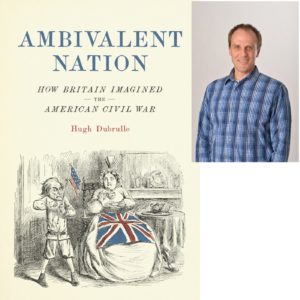
US Civil War history book – “Ambivalent Nation” (Louisiana State University Press, 2018) – Hugh Dubrulle interview

Dr. Hugh Dubrulle is a Professor in the Department of History at Saint Anselm College in New Hampshire. He has studied British history and US Civil War history extensively and has written a new book about British attitudes towards the US Civil War. I interviewed Dr. Dubrulle about the book and his findings.

2:00 – Dr. Dubrulle’s family grew up in France during WWII. The stories they told of that time inspired him to study history. When he grew up in the US, his family took trips including one to Vicksburg when he was a small child that inspired him. He then began studying British history and eventually became interested in studying British history alongside the American Civil War.

5:00 – He wrote a dissertation on this subject some time ago and that began to turn into the book.

7:17 – Past scholars have divided the British into two factions – pro-North and pro-South. Dr. Dubrulle wanted to write about the complexities of British attitudes towards Americans and the war. During the war, America was still heavily dependent on Britain economically and in other ways. The war was very disruptive to British trade.

10:47 – John Bright, pro-North, was one of the few British leaders who were whole-heartedly behind one side. But most leaders were of two minds during the war.

13:38 – Some British thought that middle-class Yankees would just pay Irish and Germans to do their fighting for them. They thought that the American middle class reflected their own middle class.

16:25 – Many British people thought New York was the financial and cultural capital of the US.

18:52 – The British were very concerned with Canadian security during the Civil War. They worried that if the North lost, they would turn north and attack Canada.

20:44 – Several British military missions traveled to the US during the war to observe. These were overwhelming Army officers and few Navy officers.

22:52 – The UK contemplated getting involved in the war on the side of the South at various times.

25:23 – After the war, the British were worried about what the US would do next. The US had raised an army larger than any that could be sent to protect Canada. But some British also worried the US would become a military dictatorship. They wondered if it would pay its debts and so on.

27:04 – Many British people were critical of Lincoln. But many lower class British people liked that a working man could become President. The British press liked Jefferson Davis. They saw a Northern middle class attacking a government of gentlemen in the South.

29:37 – British people were ambivalent about Sherman’s campaigns. They admired the military maneuvers but they were also appalled by the material destruction of the campaign. Sherman was liked more than Grant was.

31:32 – Dr. Dubrulle read many books and newspapers that were contemporary to that period. He also read personal correspondence. He found materials all over Britain for documents. The British Library has a huge collection of historic newspapers.

33:40 – The London Times was the most important newspaper at the time right before the war. But then paper became cheap and then a number of newspapers for the middle and working class rose up during the war. The Illustrated London News was the pioneer newspaper in the UK for illustrated news. Their artist worked in the North at first and then in the South afterwards. Emory University has a lot of his work.

38:48 – Dr. Dubrulle found a number of Southern newspapers and a diary of a British person who visited New York during the war.

40:49 – Dr. Dubrulle was surprised at how divergent British opinions were in public and in private.

42:31 – Frank Lolley was a very pro-South British person in public but in private he was very troubled about the Confederacy.

48:37 – The British had a problem with Northern nationalism. They didn’t believe there was a basis for American unity. They thought it was all based on the size of the country.

51:45 – He’s hoping that the discussion of British attitudes towards the US Civil War will focus more on the bigger picture than on who thought what.

Links

http://iln.digitalscholarship.emory.edu/

For more “Military History Inside Out” please follow me on Facebook at warscholar, on twitter at Warscholar, on youtube at warscholar1945 and on Instagram @crisalvarezswarscholar

Guests: Dr. Hugh Dubrulle

Host: Cris Alvarez

Tags: military, history, military history, conflict, war, interview, non-fiction book, US, Civil War, Grant, Lincoln, Sherman, Davis, North, South, London, New York, antebellum
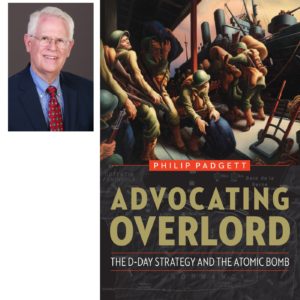
WWII history book – “Advocating Overlord” (Potomac Books, 2018) – Phil Padgett interview

Phil Padgett has worked as a political scientist in the field of security studies for much of his career. He turned his skills to writing a book on the WWII Operation Overlord, the atomic bomb, and the relationship between the US and UK during the war.

2:21 – Phil Padgett is a political scientist and has long been fascinated by a meeting between Churchill and Roosevelt during WWII.

4:30 – Phil found a letter by a Naval officer who said big things were being discussed by Roosevelt on a small boat on a lake in Canada during WWII.

6:15 – The book goes over Overlord more than on the discussions for cooperation between the US and UK on the Manhattan Project.

8:10 – The crux of the book is about the UK and the US reestablishing trust during the war.

10:00 – The US Joint Chiefs of Staff had to deal with many military leaders turning against Overlord in favor of a Mediterranean strategy.

12:45 – The US wanted a quick war and a quick strike in order to then move against Japan.

14:48 – Phil talks about the secrecy and knowledge of all parties about atomic bomb research.

19:53 – Both the US and UK knew the atomic bomb was a very powerful weapon and both were concerned about who would control atomic bombs after the war. Nations also felt that strategic bombing could have strong political effect on warring nations.

22:42 – Churchill liked to feed information to Roosevelt before the US joined the war that British bombing was having an effect on Germany.

23:55 – Canada is involved heavily in Overlord. General thinking about the[n] war was that a major amphibious assault would not work.

29:49 – His quid pro quo idea is very controversial. He used primary records at the US National Archives and at the British National Archives.

31:54 – Phil found one of Churchill’s papers with a scorch mark from a cigar burn and it brought him to the moment when history was happening. He also enjoyed going to the war rooms, Hyde Park and being on the battleship Texas.

34:45 – Phil was surprised by the amount that WWI influenced WWII. Especially with air power and a fear of repeating trench warfare.

36:16 – There didn’t seem to be a contingency plan if D-Day didn’t go well. If it failed, they probably would only have been able to conduct a Mediterranean operation afterwards. In late 1943, there was a US threat of a railroad strike over wages and hours. If it occurred, D-Day would have been delayed six months.

39:33 – Roosevelt was pretty much his own Secretary of State on these issues. The Secretary of State ran day-to-day diplomatic operations.

43:33 – Transcripts of the phone calls between Churchill and Roosevelt would be useful to historians. The Germans had cracked the allied system from 1940 to 1943 and kept transcripts of the calls. The records were kept in Berlin and appear to have been destroyed during the bombing of Berlin.

46:42 – Phil is happy he’s started the conversation about the quid pro quo idea.

48:44 – Phil has a website at www.philpadgett.com for the book. The website also has answers to frequently asked questions plus it has more photos.

Links

www.philpadgett.com

For more “Military History Inside Out” please follow me on Facebook at warscholar, on twitter at Warscholar, on youtube at warscholar1945 and on Instagram @crisalvarezswarscholar

Guests: Phil Padgett

Host: Cris Alvarez

Tags: military, history, military history, conflict, war, interview, non-fiction book, WWII, world war 2, D-Day, Normandy, Churchill, Roosevelt, Stalin, US, UK, Soviet Union, Berlin, scientists, Joint Chiefs of Staff, war plans

WWII history book – “No Forgotten Fronts” (Naval Institute Press, 2018) – Lisa Shapiro interview


Professor Lisa Shapiro holds masters degrees in literature and management and teaches at San Diego Mesa College. She has previously taught creative writing. She’s written a book based on thousands of archived letters sent by San Diego State students who were in WWII to their professor Dr. Post. I interviewed Professor Shapiro about the book titled “No Forgotten Fronts.”
1:54 – Professor Shapiro talks about her first historical project. It dealt with European medieval historical fiction. Her interest in WWII came out of her work with community college students in San Diego.
3:57 – She began studying war literature and got a second degree in that subject. In the school archives she found letters written to a professor during WWII.
5:46 – Professor Shapiro explains the basis and details of the book. It’s a collection of student letters written to their professor, Dr. Post. He turned the letters into a regular newsletter. He did this through the entire war.
10:16 – Several hundred students participated in writing to Dr. Post. This includes men and women and many wrote repeatedly. People also provided funds to support him. The original documents are in the San Diego State college archives.
12:16 – Professor Shapiro discusses how the US military censors worked with Dr. Post. He took care to keep out sensitive information out of his newsletters.
16:35 – Sometimes students wrote things only for Dr. Post and not the newsletter.
17:16 – Dr. Post was also able to connect two brothers, one of whom was a prisoner of war during the war. Dr. Post even visited their mother to provide reassurance about her sons. One student who was at Anzio wrote that he had lost his marbles and Dr. Post knew he needed some mental comfort. Dr. Post notified a nearby chaplain in Europe from San Diego State to visit this soldier and also gave comfort to the student’s father.
22:54 – Professor Shapiro explains how Dr. Post got information on killed or injured students and how he dealt with that information. Dr. Post would also update information he had published.
27:57 – Dr. Post didn’t have any children. Professor Shapiro discusses how Dr. Post met his wife in college. But both were active in the lives of their students. He also did trick roping and performed for his students. His wife was a singer. Dr. Post did have a nephew in the Marines who would write to Dr. Post.
30:36 – There don’t seem to have been any other people who collected letters from specific groups during WWII. Others have created letter collections after wars.
34:43 – The students loved getting the newsletters.
36:07 – Professor Shapiro focused on the letters that captivated her. The emotion of the letters touched her. She was able to track the stories of specific individuals.
40:28 – Professor Shapiro reads a letter from Herman Adelson who nicknamed himself Little Geronimo since he was a paratrooper. He and the others really believed in what they were fighting for. For good, freedom and democracy.
43:22 – A letter arrived for Dr. Post saying that Herman had died during D-Day and included a eulogy for him. San Diego State lost three members of their championship basketball team during the war. But the community found comfort in knowing what their loved ones had been doing.
48:29 – Professor Shapiro did a lot of reading to brush up on her knowledge of WWII and current events at the time the letters were written. She used Anthony Deevers’ history. She also read a lot of San Diego history. San Diego had a lot of women participate in the war. A lot of San Diego State students became pilots.
53:40 – Professor Shapiro had few problems getting the book published. She had to shorten the book since it was very long at first.
55:02 – Grif Williams was one of the students and was famous for being on the Doolittle Raid. He was taken prisoner eventually and he was eventually a cellmate with another San Diego State student who had been captured in Germany.
59:26 – The website for the book is NoForgottenFronts.com.

For more “Military History Inside Out” please follow me on Facebook at warscholar, on twitter at Warscholar, on youtube at warscholar1945 and on Instagram @crisalvarezswarscholar

Guests: Lisa Shapiro
Host: Cris Alvarez
Tags: war, military, WWII, WWII history, san diego, san diego state, pacific war, d-day, north africa, europe, germany, doolittle raid, anzio