google-site-verification=LH5b8KjkZx977mE6aIcHeL0dUUXTFgHv_F3FyX8BtNs google-site-verification=LH5b8KjkZx977mE6aIcHeL0dUUXTFgHv_F3FyX8BtNs

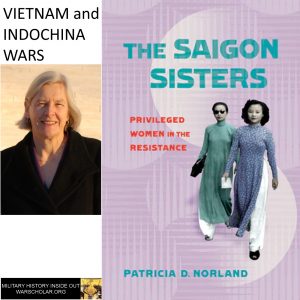
Patricia Norland interview – Vietnam War and Indochina War military history book – “Saigon Sisters” (Cornell University Press, 2020)

Check out this book here   https://amzn.to/392NdWN

Patricia worked for many years in the US Foreign Service. Before this time, she was with a non-profit organization and met nine women who fought against the French and the Americans in the Vietnam War. Patricia kept in touch with these women and after retiring from the foreign service she wrote a book about these women’s wartime experiences. We spoke about the book, Saigon Sisters, these women, and the Indochina and Vietnam Wars.

(THE AUDIO PLAYER IS AT THE BOTTOM OF THE POST.)

Editor’s note: Patricia Norland sent an email clarifying a statement she made during the Interview: “Separately, I should clarify my statement about “managing” the Fulbright program while serving in HCMC; my job was to manage exchange programs, but Fulbright, wisely, establishes a Commission in each country (with ED) that — while coordinating with others– runs the program.”

0:42 – Patricia talks about why she wrote this book and how she met the women she wrote about.

5:09 – We talk about how these nine women gave up privileged lives to fight the French and Americans in the Indochina Wars.

7:04 – Patricia talks about how she breaks the book into two parts- the lives they had before war to 1950 and then 1954, the war years to post 1975.

13:07 – Patricia reads an excerpt from the book discussing the patriotic zeal of the women the book is about.

15:13 – Patricia talks about the conservative nationalism that motivated the Vietnamese Communist revolution.

16:59 – Patricia shares some of the revolutionary poems that these fighters wrote.

19:51 – Patricia talks about how these teenagers were recruited into the revolution.

23:39 – Patricia reads a passage regarding the Japanese occupation of Vietnam and their misuse of rice by troops.

25:59 – Patricia talks about where these women ended up once they joined up with the revolution.

30:42 – Patricia reads a passage from the first woman in the group who joined the Vietnamese Maquis.

33:14 – Patricia talks about the research she did for the book and the interviews she did.

38:19 – Patricia talks about the personal items from the war that these women showed her.

41:41 – Patricia talks about how these women could have had much easier lives if they had turned away from the war. She also addresses how there is disappointment about what happened after 1975.

44:06 – Patricia talks more about the disillusionment of their struggle.

46:21 – Patricia talks about the American presence in Vietnam.

49:53 – Patricia talks about how these women continued fighting against the Americans once they replaced the French.

51:20 – Patricia talks about gender inequality within the revolutionary ranks.

52:28 – Patricia talks about some moving moments in their story.

1:04:05 – Information on the book can be found on the Cornell University Press website.


Links of interest

https://amzn.to/392NdWN

https://www.cornellpress.cornell.edu/book/9781501749735/the-saigon-sisters/

https://www.cornellpress.cornell.edu/vietnamese-women-privilege-and-persistence/


For more “Military History Inside Out” please follow me at www.warscholar.org, on Facebook at warscholar, on twitter at Warscholar, on youtube at warscholar1945 and on Instagram @crisalvarezswarscholar. Or subscribe to the podcast on Apple Podcasts | Google Podcasts | Stitcher | Spotify


Guests: Patricia Norland

Host: Cris Alvarez

Tags: military, history, military history, conflict, war, interview, non-fiction book, Cornell University Press, Vietnam War, church world service, Saigon, French colonial, black pajamas, French, Saigon, double lives, resistance, maquis, National day of the student, US Navy, International Workers day, Communism, French Lycee, Japan, WWII, Viet Cong, French Army, United States, US Embassy, double agent, Afghanistan, NIU, Ken Burns

Check out this book here   https://amzn.to/392NdWN

As an Amazon Associate I earn from qualifying purchases.
How US artillery dominated the Iraq military in the First Gulf War – Interview with L. Scott Lingamfelter

How US artillery dominated the Iraq military in the First Gulf War – Interview with L. Scott Lingamfelter

Check out this book here   https://amzn.to/3e5qbza

Interview Timeline

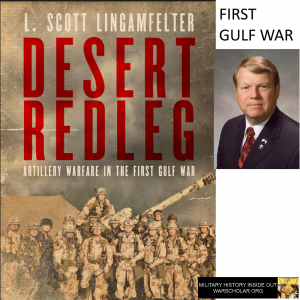
L. Scott Lingamfelter was a senior Artillery Officer and Middle East expert when he participated in the First Gulf War as XO of 1st ARTY. He wrote a book detailing his time in that war, including tactical and operational issues, and his thoughts about the geopolitical and strategic aspects of the war. We spoke about the book and the war. Desert Redleg (University Press of Kentucky, 2020)

0:41 – Scott talks about why he wanted to write about his experiences in the First Gulf War.

1:34 – Scott talks about the start of his career in 1973 as an artillery officer and as a Middle East specialist.

3:12 – Scott talks about the use of artillery between the Vietnam War and the First Gulf War.

6:58 – Scott talks about the logistics of moving artillery into the Gulf War theater.

9:43 – Scott talks about the artillery that the division used.

12:15 – Scott talks about the obstacles they faced once they were in the Middle East.

15:23 – Scott talks about the placement of the artillery units and their protection.

18:19 – Scott talks about the size of the division and armament.

19:56 – Scott talks about counter fire.

21:32 – Scott talks about the other threats to the safety and health of the Division. He discusses unexploded and failed ordnance.

24:26 – Scott talks about the threat of chemical attack.

28:03 – Scott talks about dealing with dust and heat.

29:48 – Scott talks about instilling hygiene practices among the troops.

32:47 – Scott talks about resupply issues and the Tapline Road.

35:51 – Scott talks about the casualties on the Tapline Road.

37:29 – Scott talks about what the damage they had wrought in Iraq was like.

40:02 – Scott discusses the amount of firepower used in the First Gulf War.

44:22 – Scott discusses the combat effects of the artillery on enemy morale.

46:21 – Scott talks about the Vietnam veterans that developed the Air-Land battle concept used in the Gulf War.

47:35 – Scott talks about how he presents information in the book.

52:12 – Scott talks about coordination between foreign partners and with other services.

55:09 – Scott was surprised by the dud rate when he went back to his notes. He was also surprised at how good his diary notes were.

59:06 – Scott talks about how he expected the US to return to Iraq to fight Saddam again.

1:01:31 – Scott talks about how he almost became General Schwarzkopf’s aide-de-camp.

1:03:08 – Scott talks about how the book is written from a tactical point of view.

1:06:42 – Scott talks about getting the book written and published. He had to write some difficult things as he saw them.

1:10:11 – Scott be found at copybookwarrior.com. Readers can use the code FS30 on the University Press of Kentucky until the end of July to get 30% of the book.

Links of interest

https://amzn.to/3e5qbza

https://www.kentuckypress.com/9780813179209/desert-redleg/

https://www.copybookwarrior.com

Contact Information

For more “Military History Inside Out” please follow me at www.warscholar.org, on Facebook at warscholar, on twitter at Warscholar, on youtube at warscholar1945 and on Instagram @crisalvarezswarscholar. Or subscribe to the podcast on Apple Podcasts | Google Podcasts | Stitcher | Spotify

Guests: L. Scott Lingamfelter

Host: Cris Alvarez

Tags: Books, audio interviews, author, academic, podcast, University Press of Kentucky, Modern War, United States,

Check out this book here   https://amzn.to/3e5qbza

As an Amazon Associate I earn from qualifying purchases.

Military History Inside Out banner

20th century military history book – “Saving Israel” (Stackpole Books, 2020) – Boaz Dvir interview

Check out this book here   https://amzn.to/2ZnM73r

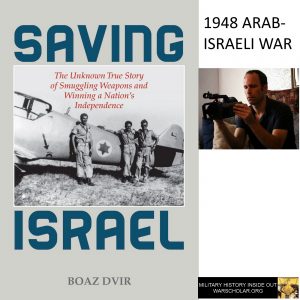
Boaz Dvir is a journalist, writer, and filmmaker. He spent ten years researching the creation of the Israeli Air Force in 1948. He produced a documentary on the subject titled “A Wing and a Prayer” which was shown on PBS. He then wrote a book on the subject. We spoke about the Israeli Air Force of 1948, the secret methods needed to create it, the writing of the book, and what it took to research it.

(THE AUDIO PLAYER IS AT THE BOTTOM OF THE POST.)

0:51 – Boaz talks about why he wrote this book.

3:41 – Boaz talks about how the Israelis were armed with Nazi weapons in 1948.

4:25 – Boaz summarizes what led up to the Arab-Israeli War of 1948.

7:35 – Boaz talks about what he focuses on in the book.

12:32 – Boaz talks about how the Arab were threatening to annihilate the Israelis.

14:41 – Boaz talks about the US Army flight engineer who started the operation to arm Israel.

19:59 – Boaz talks about how the Jewish-American underground set up an airline to fly people into Israel.

23:05 – Boaz talks about how Adolf became an international arms smuggler.

26:54 – Boaz talks about military resistance to the smuggling of weapons.

31:41 – Boaz talks about what the Israeli Air Force consisted of before the 1948 war and what had been created by the end of the war.

32:58 – Boaz talks in detail about the planes they brought into Israel.

35:35 – Boaz talks about the initial operations on both sides during the 1948 war.

39:22 – Boaz talks about the air war during the 1948 war and the initial Arab advantage.

41:54 – Boaz talks about how Israel used Nazi weapons in the 1948 war.

45:14 – Boaz talks about the research he did for the book.

49:10 – Boaz talks about coming across one of the old C-47s used in the 1948 war.

51:19 – Boaz talks about how amazing it was to talk to the US WWII veterans.

54:26 – Boaz talks about the emotional responses to this subject matter.

54:53 – Boaz talked about his surprise at US antagonism towards Israel in 1948.

59:10 – Boaz talks about how the USSR indirectly armed Israel.

1:04:01 – Boaz talks about influence of Jewish Russians on Israel.

1:05:22 – Boaz talks about the British pilots who flew against Israel and the shoot-down of a British reconnaissance plane.

1:08:21 – Boaz talks about the two types of Egyptian pilots that the Israeli pilots faced in 1948.

1:09:52 – Boaz talks about the victims of the war.

1:17:14 – Boaz talks about how the people in his book were innovative.

1:22:30 – Boaz can be found on facebook at Boaz Dvir and on twitter @BoazDvir.


Links of interest

https://amzn.to/2ZnM73r

https://rowman.com/ISBN/9780811737265/Saving-Israel-The-Unknown-Story-of-Smuggling-Weapons-and-Winning-a-Nation%E2%80%99s-Independence

https://twitter.com/boazdvir?ref_src=twsrc%5Egoogle%7Ctwcamp%5Eserp%7Ctwgr%5Eauthor

For more “Military History Inside Out” please follow me at www.warscholar.org, on Facebook at warscholar, on twitter at Warscholar, on youtube at warscholar1945 and on Instagram @crisalvarezswarscholar. Or subscribe to the podcast on Apple Podcasts | Google Podcasts | Stitcher | Spotify


Guests: Boaz Dvir

Host: Cris Alvarez

Tags: military, history, military history, conflict, war, interview, non-fiction book, tags: Israel, Holocaust, Arab-Israeli war, Nazi, Palestine, Jewish, United Nations, US Army Air Force, aviation, neutrality act, WWII, world war two, Britain, Trans-Jordan, ATC, concentration camp, RAF, Royal Navy, arms smuggling, arms embargo, Egypt, Iraq, Hawaii, US Navy, FBI, Czechoslovakia, California, New Jersey, 1948 war, dogfighting, pilots, Negev, B-17, El Al, Tel Aviv, Messerschmitts, Nazi, Spitfires, Syria, flight logs, Israeli Air Force museum, greatest generation, Soviet Union, Stalin, Ben Gurion, Cairo, P-51, Panama, Wing and a Prayer, PBS


Check out this book here   https://amzn.to/2ZnM73r

As an Amazon Associate I earn from qualifying purchases.